
Quick Overview
Book: Tiny Habits
Author: BJ Fogg
Category: Productivity / Habits / Personal Development
Last Updated: July 2026
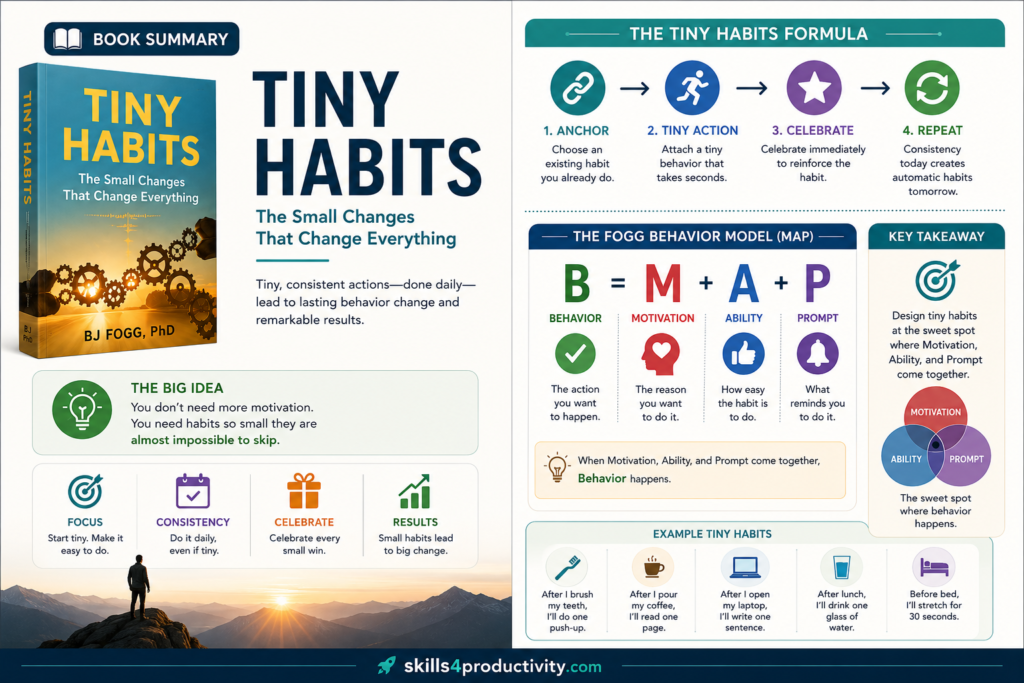
Tiny Habits by BJ Fogg is a practical guide to building lasting habits through small, consistent actions rather than relying on motivation. Instead of making drastic changes, Fogg shows how tiny behaviors repeated daily can lead to remarkable long-term results.
In this summary, you’ll learn the book’s core ideas, the Tiny Habits Formula, the Fogg Behavior Model, and practical examples you can apply today.
📌 Visual Summary
Short on time? This infographic highlights the book’s biggest ideas in under a minute.
Key Lessons from Tiny Habits
Building lasting habits isn’t about having more willpower—it’s about making change feel easy. Here are the biggest lessons from Tiny Habits and how you can apply them in everyday life.
1. Start Smaller Than You Think
Most people fail because they try to change too much at once. BJ Fogg argues that lasting habits begin with actions so small they feel almost effortless. A tiny habit removes the mental resistance that often prevents us from getting started. Once the behavior becomes part of your daily routine, it naturally grows over time.
📌 Example: Instead of aiming to read a chapter every day, start by reading just one page.
This idea closely aligns with the principles in our Atomic Habits Summary, where James Clear explains how small, consistent improvements can lead to remarkable long-term results.
2. Don’t Depend on Motivation
Motivation changes from day to day. Some mornings you’ll feel inspired, while other days you’ll have no energy at all. That’s why Fogg recommends designing habits that are easy enough to complete even when motivation is low. Consistency is built through simplicity, not willpower.
📌 Example: If exercising for 30 minutes feels difficult, begin with one push-up or a one-minute walk.
If you’re looking to improve focus and build productive routines, you’ll also enjoy our Deep Work Summary.
3. Attach New Habits to Existing Routines
One of the easiest ways to remember a new habit is to connect it with something you already do every day. Fogg calls these existing routines anchors. By attaching a tiny habit to an established routine, you create a natural reminder without relying on alarms or motivation.
📌 Example: After brushing your teeth, do one push-up. After making your morning coffee, read one page of a book.
4. Celebrate Every Small Win
Celebrating even the smallest success reinforces positive behavior. According to Fogg, positive emotions help your brain recognize that a habit is rewarding, making you more likely to repeat it. Your celebration doesn’t need to be dramatic—it can be as simple as smiling, saying “Nice job,” or giving yourself a mental high-five.
📌 Example: After completing your tiny habit, pause for a moment and acknowledge that you followed through.
Small wins help build momentum, a principle shared by many of the books featured in our Best Books on Discipline collection.
5. Make Good Habits Easy
The easier a habit is to perform, the more likely you’ll stick with it. Remove obstacles, prepare your environment, and reduce the effort required to take action. Small changes to your surroundings can make a surprisingly big difference.
📌 Example: Keep a book on your bedside table, place a water bottle on your desk, or lay out your workout clothes the night before.
6. Focus on Consistency, Not Perfection
Missing a day isn’t the end of the world. What matters is returning to your habit without feeling discouraged. Tiny Habits encourages progress over perfection. A habit repeated consistently—even if it’s very small—is more valuable than occasional bursts of intense effort.
📌 Example: Reading one page every day is often more effective than trying to read an entire book on the weekend.
7. Small Changes Lead to Big Results
The central message of Tiny Habits is that meaningful change doesn’t happen overnight. Small actions repeated consistently create momentum, build confidence, and eventually become automatic. Over time, those tiny improvements add up to significant personal growth.
📌 Example: A habit that starts with one push-up today could eventually become a regular workout routine.
💡 Did You Know?
BJ Fogg developed the Tiny Habits Method after decades of research into human behavior at Stanford University. His work has influenced many modern habit-building techniques.
The Tiny Habits Method
The book introduces a simple formula for building habits:
After I [existing habit],
I will [tiny behavior],
Then I will celebrate.
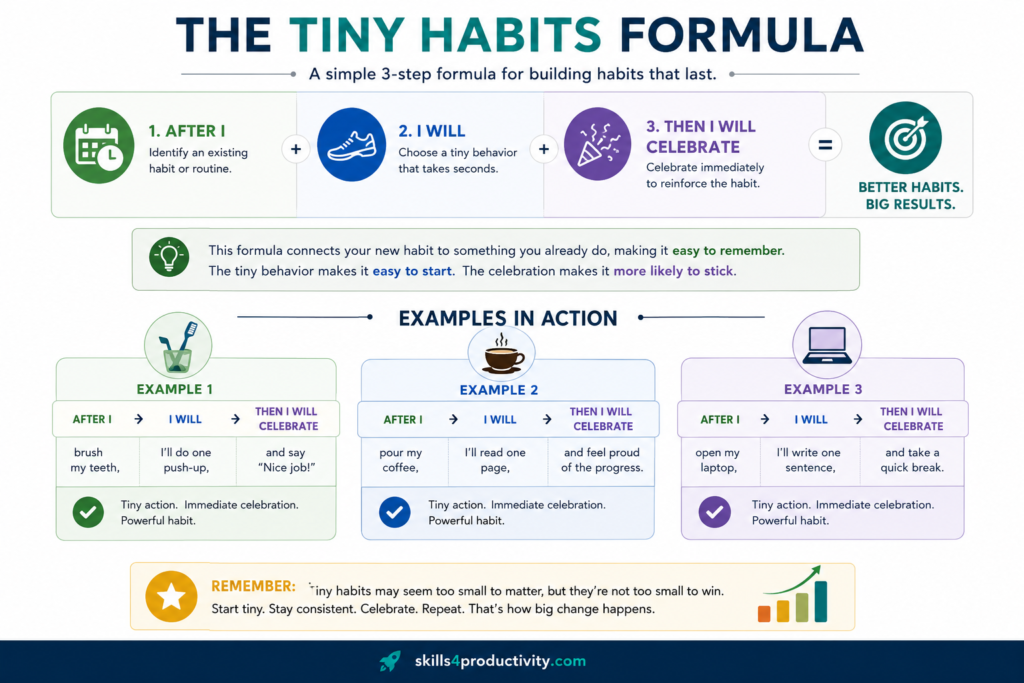
This three-step formula makes new habits easier to remember because it connects them to routines you already perform every day. The immediate celebration reinforces the behavior, making you more likely to repeat it.
Memorable Quotes from Tiny Habits
“Start tiny.”
A reminder that consistency begins with actions that are easy to repeat.
“Emotions create habits.”
Positive emotions reinforce behavior more effectively than willpower alone.
“Tiny changes can lead to remarkable results.”
Small improvements repeated consistently create lasting transformation.
⚡ Tiny Habits in 30 Seconds
✓ Start tiny.
✓ Make habits easy.
✓ Attach them to routines.
✓ Celebrate small wins.
✓ Repeat daily.
Who Should Read This Book?
This book is ideal for:
- Anyone struggling to build consistent habits
- Students developing better study routines
- Busy professionals who want sustainable productivity
- People starting a fitness or health journey
- Anyone who enjoys practical self-improvement books
It may not be the best fit if:
- You’re looking for an in-depth psychology textbook
- You already have well-established daily habits
- You prefer theoretical discussions over practical advice
📚 Get Tiny Habits
Tiny Habits proves that lasting change doesn’t require extraordinary motivation. By making habits small enough to succeed every day, BJ Fogg offers a practical system that almost anyone can follow. If you’ve struggled with consistency, this is one of the most actionable habit-building books available.
📖 Read the Book
Perfect if you enjoy highlighting key ideas and revisiting important concepts at your own pace.
🎧 Listen to the Audiobook
Prefer learning while commuting, exercising, or walking? The audiobook is narrated in an engaging style and is included with an Audible membership.
👉 Listen to Tiny Habits on Audible
Frequently Asked Questions
What is Tiny Habits about?
Tiny Habits teaches that lasting behavior change starts with small, easy-to-repeat actions. BJ Fogg shows how tiny habits can become part of your daily routine without relying on motivation.
What is the Tiny Habits Method?
The Tiny Habits Method is simple:
After I [existing habit], I will [tiny behavior], then I will celebrate.
It makes new habits easier to remember and repeat.
Is Tiny Habits worth reading?
Yes. It’s a practical book for anyone who wants to build better habits without depending on willpower or motivation.
Is Tiny Habits better than Atomic Habits?
Both are excellent. Tiny Habits focuses on starting small, while Atomic Habits emphasizes systems and identity-based habits. They complement each other well.
Who should read Tiny Habits?
It’s ideal for beginners, students, professionals, and anyone looking to build consistent daily habits.
What is an example of a Tiny Habit?
Examples include reading one page after making coffee, doing one push-up after brushing your teeth, or writing one sentence after opening your laptop.
Related Book Summaries
If you found this Tiny Habits summary useful, you may also like:
• Atomic Habits – James Clear
• The Power of Habit – Charles Duhigg
• The Compound Effect – Darren Hardy
• Mini Habits – Stephen Guise
• Deep Work – Cal Newport
Disclosure: This article may contain affiliate links. If you purchase through these links, Skills4Productivity may earn a commission at no additional cost to you.