
Deep Work Overview
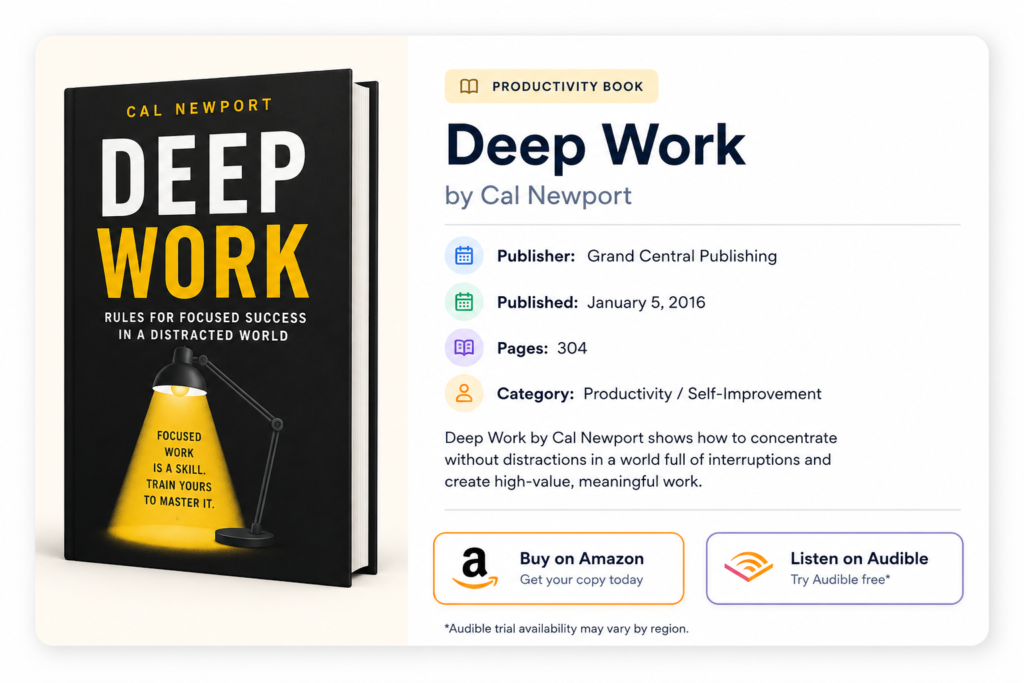
Book: Deep Work
Author: Cal Newport
Category: Productivity / Focus / Career Growth
Best For: Professionals, students, entrepreneurs, and anyone struggling with distractions.
What You’ll Learn:
✓ How to focus without distractions
✓ The four rules of deep work
✓ How to reduce shallow work
✓ Strategies for producing high-value results
📖 Buy Deep Work on Amazon
🎧 Listen on Audible (Free with Audible Trial*)
*Audible trial availability and offers may vary by country.
Summary
Deep Work is one of the most influential productivity books of the modern era. Written by computer science professor Cal Newport, the book argues that the ability to focus intensely on demanding tasks is becoming increasingly rare in today’s distracted world. At the same time, this skill is becoming more valuable than ever.
Newport introduces the concept of “deep work”—periods of uninterrupted concentration that allow people to produce high-quality results, master complex skills, and create meaningful work.
In this Deep Work summary, you’ll learn the book’s core ideas, key lessons, practical strategies, memorable quotes, and how to apply deep work principles to your own life.
What Is Deep Work?
Cal Newport defines deep work as:
Professional activities performed in a state of distraction-free concentration that push your cognitive capabilities to their limit.
Deep work is the type of focused effort required to solve difficult problems, learn challenging skills, write, create, analyze, design, and think deeply.
Examples of deep work include:
- Writing a report without interruptions
- Learning a new programming language
- Studying for an important exam
- Designing a product strategy
- Researching and solving complex problems
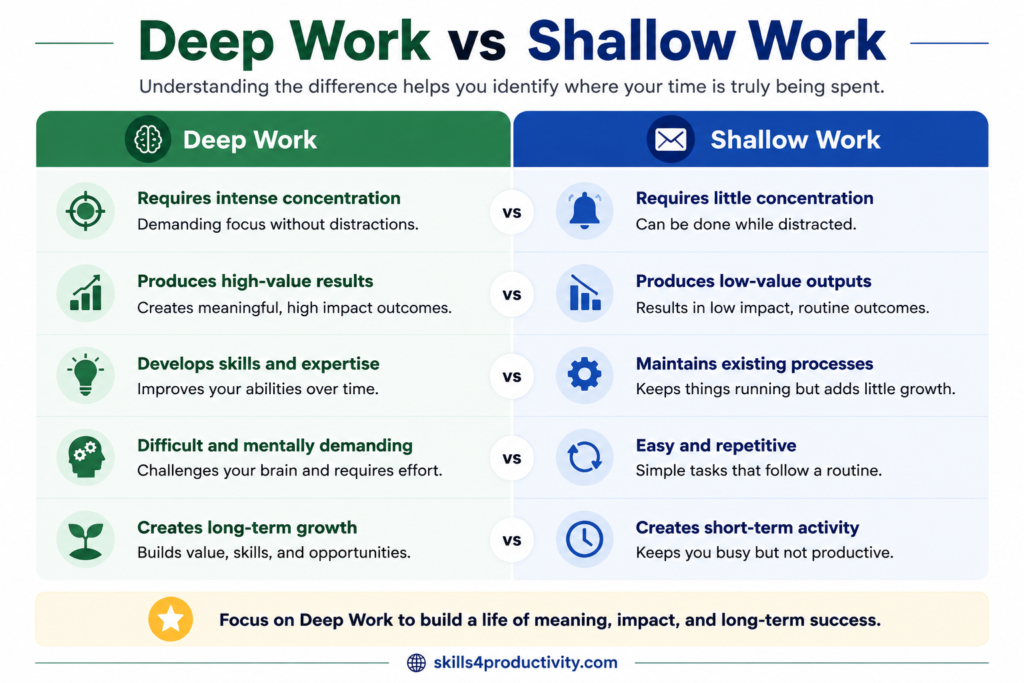
The opposite of deep work is what Newport calls shallow work.
Shallow work consists of tasks that require little concentration and can often be performed while distracted.
Examples include:
- Checking email repeatedly
- Scrolling social media
- Attending unnecessary meetings
- Administrative busywork
- Constantly switching between tasks
According to Newport, many people spend most of their day engaged in shallow work while believing they are being productive.
Why Deep Work Matters
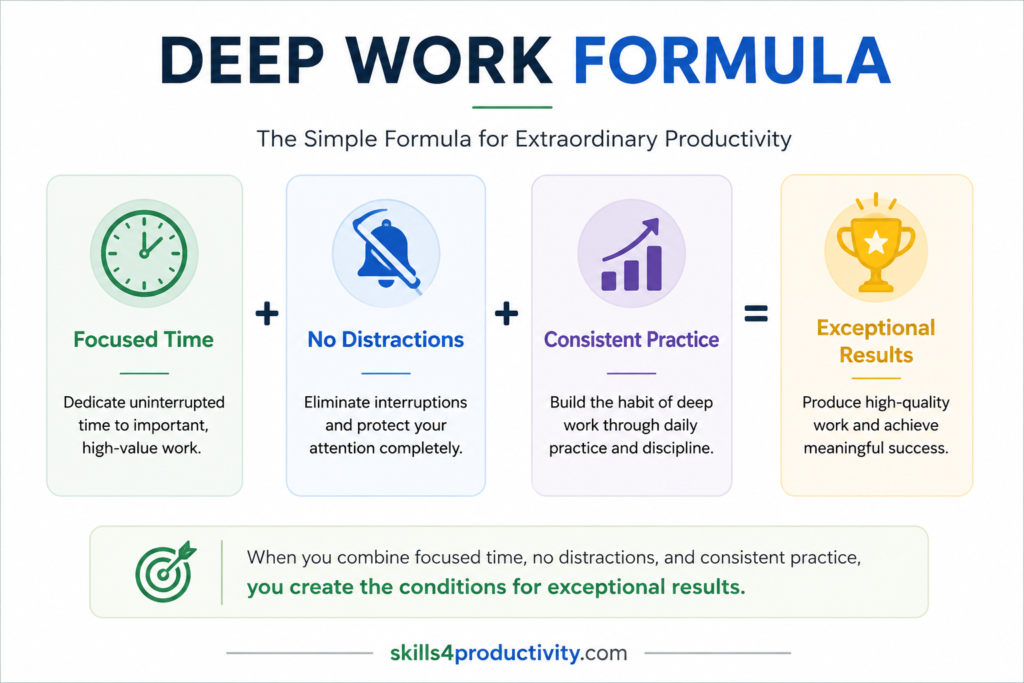
The modern workplace is full of distractions.
Notifications, email, messaging apps, meetings, and social media compete constantly for our attention. As a result, many professionals rarely spend significant time focusing on one important task.
Newport argues that this creates a major opportunity.
>People who develop the ability to work deeply gain an advantage because they can:
- Learn difficult skills faster
- Produce higher-quality work
- Solve more complex problems
- Create greater value
- Advance their careers more quickly
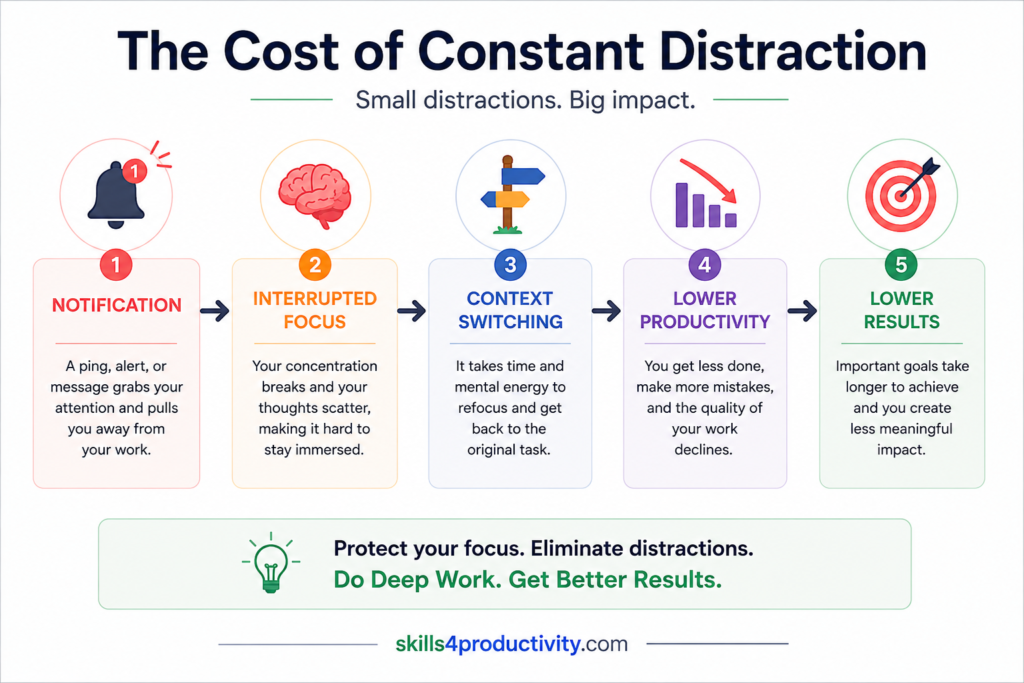
In a knowledge economy, focus has become a competitive advantage.
Part One: The Idea of Deep Work
Deep Work Is Valuable
One of Newport’s central arguments is that the economy increasingly rewards people who can perform cognitively demanding work.
Technology continues to automate routine tasks, making specialized knowledge and expertise more valuable.
Deep work helps individuals build these valuable skills more quickly.
When you focus intensely without distractions, your brain forms stronger connections, learns faster, and produces better results.
The ability to concentrate has become a form of professional capital.
Deep Work Is Rare
Despite its value, deep work is becoming increasingly uncommon.
Many organizations unintentionally encourage distraction through:
- Constant email communication
- Open office environments
- Endless meetings
- Instant messaging tools
- Expectations of immediate responses
Workers often appear productive because they are busy all day. However, busyness is not the same as productivity.
Newport argues that many people measure activity rather than results.
Deep Work Is Meaningful
Deep work is not only valuable—it is also satisfying.
People experience a sense of fulfillment when they become fully immersed in challenging activities.
Psychologists often refer to this state as “flow.”
When individuals focus deeply on meaningful work, they experience:
- Greater engagement
- Increased satisfaction
- Higher-quality output
- Stronger sense of accomplishment
Newport suggests that a meaningful professional life is often built around periods of focused craftsmanship.
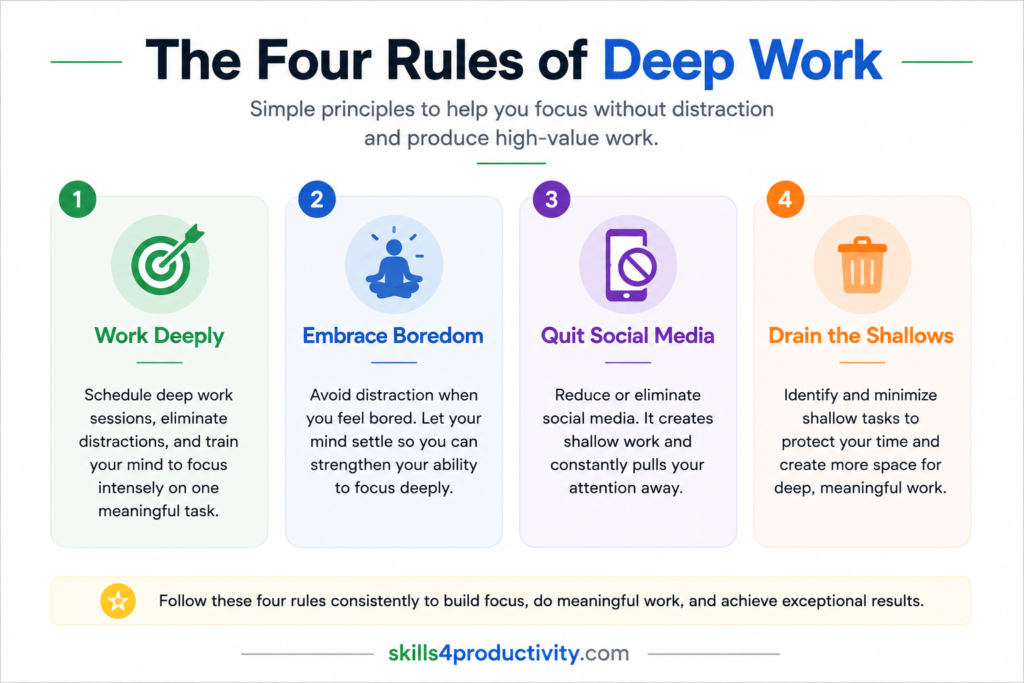
Part Two: The Four Rules of Deep Work
Rule #1: Work Deeply
Deep work rarely happens by accident.
Newport recommends creating systems and rituals that make focus easier.
Examples include:
- Scheduling deep work sessions in advance
- Working in distraction-free environments
- Defining clear objectives before each session
- Establishing specific work routines
The goal is to reduce the mental energy required to begin focused work.
The easier it is to start, the more consistently deep work becomes part of your routine.
Rule #2: Embrace Boredom
Many people train themselves to seek constant stimulation.
Whenever a moment of boredom appears, they reach for a phone, open social media, or check email.
Newport argues that this habit weakens concentration.
Focus is like a muscle.
If you constantly interrupt yourself with entertainment and distractions, your ability to concentrate deteriorates.
To strengthen focus, Newport recommends:
- Spending time without digital stimulation
- Avoiding unnecessary phone use
- Practicing sustained attention
- Resisting the urge to switch tasks
Learning to tolerate boredom improves your ability to work deeply.
Rule #3: Quit Social Media
Newport does not suggest that every social platform is inherently harmful.
>Instead, he recommends applying a cost-benefit analysis.
Ask yourself:
- Does this tool significantly support my goals?
- Does it provide enough value to justify the distraction?
Many people use social media out of habit rather than necessity.
Removing low-value digital distractions creates more time and attention for meaningful work.
Rule #4: Drain the Shallows
Shallow work will always exist.
Emails need responses. Meetings need attendance. Administrative tasks must be completed.
The goal is not to eliminate shallow work entirely.
The goal is to minimize it.
Newport recommends:
- Time-blocking your calendar
- Limiting unnecessary meetings
- Tracking how your time is spent
- Protecting deep work hours
By reducing shallow work, you create more space for activities that generate meaningful results.
Key Lessons from Deep Work
1. Focus Is a Competitive Advantage
Most people struggle to concentrate for extended periods.
Those who develop this skill gain a significant advantage in learning, productivity, and career growth.
2. Busyness Is Not Productivity
Being occupied all day does not guarantee meaningful progress.
Results matter more than activity.
3. Deep Work Must Be Scheduled
If focus is left to chance, distractions will usually win.
Dedicated time blocks make deep work more likely to happen consistently.
4. Attention Is a Limited Resource
Every interruption carries a cost.
Protecting attention is essential for producing high-quality work.
5. Small Improvements Compound Over Time
Even one or two hours of deep work each day can create significant long-term results.
Consistent focus compounds just like investments.
Best Quotes from the Book
“Clarity about what matters provides clarity about what does not.”
“A deep life is a good life.”
“The ability to perform deep work is becoming increasingly rare at exactly the same time it is becoming increasingly valuable.”
“Who you are, what you think, feel, and do, what you love—is the sum of what you focus on.”
“To produce at your peak level you need to work for extended periods with full concentration on a single task.”
How to Apply Deep Work in Your Life
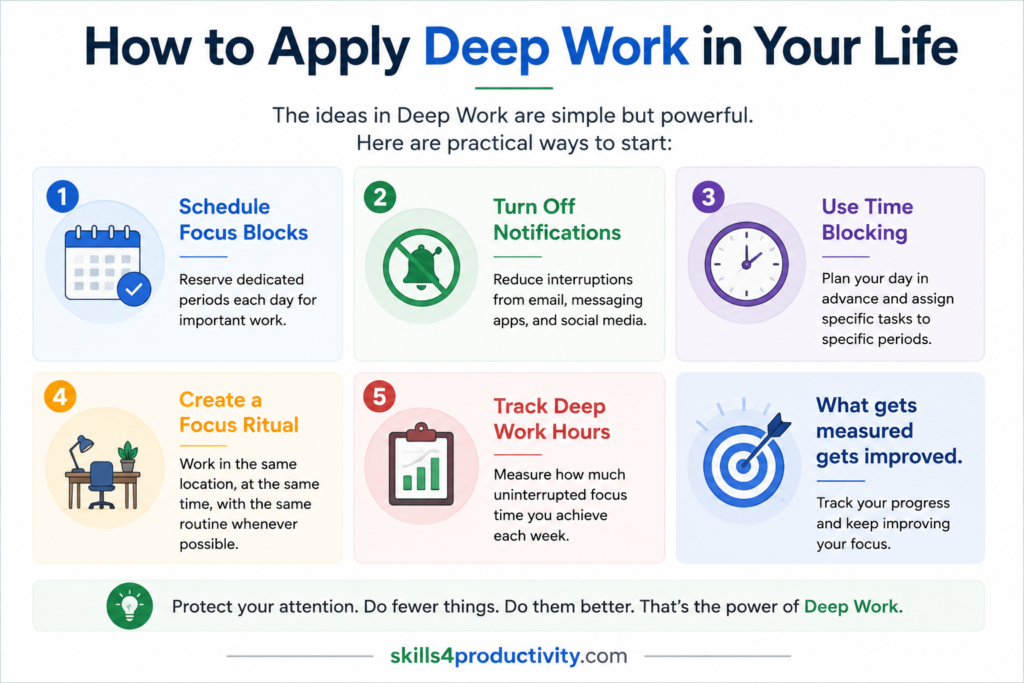
The ideas in Deep Work are simple but powerful.
Here are practical ways to start:
Schedule Focus Blocks
Reserve dedicated periods each day for important work.
Turn Off Notifications
Reduce interruptions from email, messaging apps, and social media.
Use Time Blocking
Plan your day in advance and assign specific tasks to specific periods.
Create a Focus Ritual
Work in the same location, at the same time, with the same routine whenever possible.
Track Deep Work Hours
Measure how much uninterrupted focus time you achieve each week.
What gets measured gets improved.
Who Should Read This Book
This book is particularly valuable for:
- Knowledge workers
- Students
- Entrepreneurs
- Writers
- Programmers
- Researchers
- Managers
- Freelancers
Anyone who wants to improve focus, reduce distractions, and produce better work can benefit from the ideas in this book.
Key Takeaways
✓ Deep work is one of the most valuable skills for success in the modern economy.
✓ Focused, distraction-free work produces better results than constant multitasking.
✓ Scheduling dedicated deep work sessions makes meaningful progress more likely.
✓ Reducing shallow work creates more time for learning, creativity, and high-value output.
✓ Small improvements in focus, repeated consistently, lead to long-term growth and mastery.
Books Similar to Deep Work
If you enjoyed Deep Work, consider reading:
- Atomic Habits by James Clear
- Essentialism by Greg McKeown
- The One Thing by Gary Keller
- Digital Minimalism by Cal Newport (Coming Soon)
- Can’t Hurt Me by David Goggins
These books explore related topics such as focus, habits, discipline, and high performance.
Final Thoughts
Deep Work delivers a simple but increasingly important message: the ability to focus deeply is becoming one of the most valuable skills in the modern world.
While technology and distractions continue to compete for our attention, individuals who learn to work deeply can produce better results, learn faster, and build more meaningful careers.
The book is both a warning about the cost of distraction and a practical guide for reclaiming focus.
Its core lesson remains highly relevant today: meaningful work requires meaningful attention.
Frequently Asked Questions
What is Deep Work about?
Deep Work by Cal Newport is a productivity book that teaches readers how to focus without distractions and produce high-value work in an increasingly distracted world.
What is the main idea of Deep Work?
The central idea is that the ability to perform deep, focused work is becoming increasingly rare and increasingly valuable. People who develop this skill can learn faster, create better work, and achieve greater success.
What are the four rules of Deep Work?
The four rules are:
- Work Deeply
- Embrace Boredom
- Quit Social Media
- Drain the Shallows
Together, these rules help improve focus and reduce distractions.
What is the difference between deep work and shallow work?
Deep work requires intense concentration and produces high-value results. Shallow work consists of routine tasks such as emails, meetings, and administrative work that require little focus and create less value.
Is Deep Work worth reading?
Yes. Deep Work is widely considered one of the best productivity books because it provides practical strategies for improving focus, learning complex skills, and producing meaningful work.
Can students benefit from Deep Work?
Absolutely. Students can use deep work principles to study more effectively, retain information better, and reduce distractions while learning.
How can I start practicing Deep Work?
Start by scheduling dedicated focus sessions, eliminating distractions, turning off notifications, and working on one important task at a time.
Who should read Deep Work?
This book is ideal for professionals, students, entrepreneurs, writers, programmers, researchers, and anyone who wants to improve focus and productivity.
Ready to read the full book?
Deep Work is one of the most influential productivity books ever written.
If you enjoyed this summary, consider reading the complete book for deeper insights and practical examples.
📖 Buy the Book on Amazon
🎧 Listen on Audible (Free with Audible Trial*)
*Audible trial availability and offers may vary by country.
Disclosure: This article may contain affiliate links. If you purchase through these links, Skills4Productivity may earn a commission at no additional cost to you.