
Most people don’t procrastinate on big tasks.
They procrastinate on small ones that take less than 2 minutes.
We often procrastinate on tasks that would take less time to complete than the time we spend thinking about them.
Replying to a quick email. Putting a book back on the shelf. Writing down an idea before forgetting it.
Small tasks pile up, create mental clutter, and quietly drain productivity.
That’s where the 2-Minute Rule can help.
Simple but powerful, the 2-Minute Rule helps you stop overthinking, take immediate action, and build momentum through small wins.
Popularized by David Allen in Getting Things Done and reinforced by James Clear in Atomic Habits, this idea has become one of the most practical productivity principles around.
Key Takeaways
- The 2-Minute Rule helps reduce procrastination
- Small actions create momentum
- Starting is more important than perfection
- Tiny habits can lead to long-term consistency
- The rule works best when combined with systems and routines
The 2-Minute Rule (Quick Summary)
- If it takes less than 2 minutes → do it now
- Start habits in under 2 minutes
- Small actions build momentum
What Is the 2-Minute Rule?
The rule is simple: If a task takes less than two minutes, do it now.
Instead of postponing small actions, handle them immediately.
Why?
Because organizing, remembering, and revisiting a tiny task often takes more energy than simply doing it.
Examples:
- Reply to a short email
- Put your notebook away
- Wash your coffee mug
- Add a meeting to your calendar
- Write tomorrow’s top priority
These actions seem insignificant, but they prevent clutter from building.
Small tasks completed quickly free mental space for bigger work.
The Two Versions of the 2-Minute Rule
1. David Allen’s Version: Do Small Tasks Immediately
David Allen introduced the rule in Getting Things Done.
His idea: If something takes less than two minutes, do not put it on a to-do list.
Just do it.
Why it works:
- Reduces decision fatigue
- Prevents task buildup
- Clears mental clutter
- Creates momentum
A two-minute task delayed often becomes a forgotten task.
Immediate action keeps life moving.
Read Getting Things Done summary
2. James Clear’s Version: Start a Habit in Two Minutes
James Clear gives the rule another twist: Any new habit should take less than two minutes to start.
The goal isn’t doing the full habit. It’s making starting easy.
Examples:
Want to read daily?
Read one page.
Want to exercise?
Do one push-up.
Want to journal?
Write one sentence.
Want to meditate?
Sit quietly for two minutes.
This removes friction. And often, once you start, you keep going.
As James Clear suggests: A habit must be established before it can be improved.
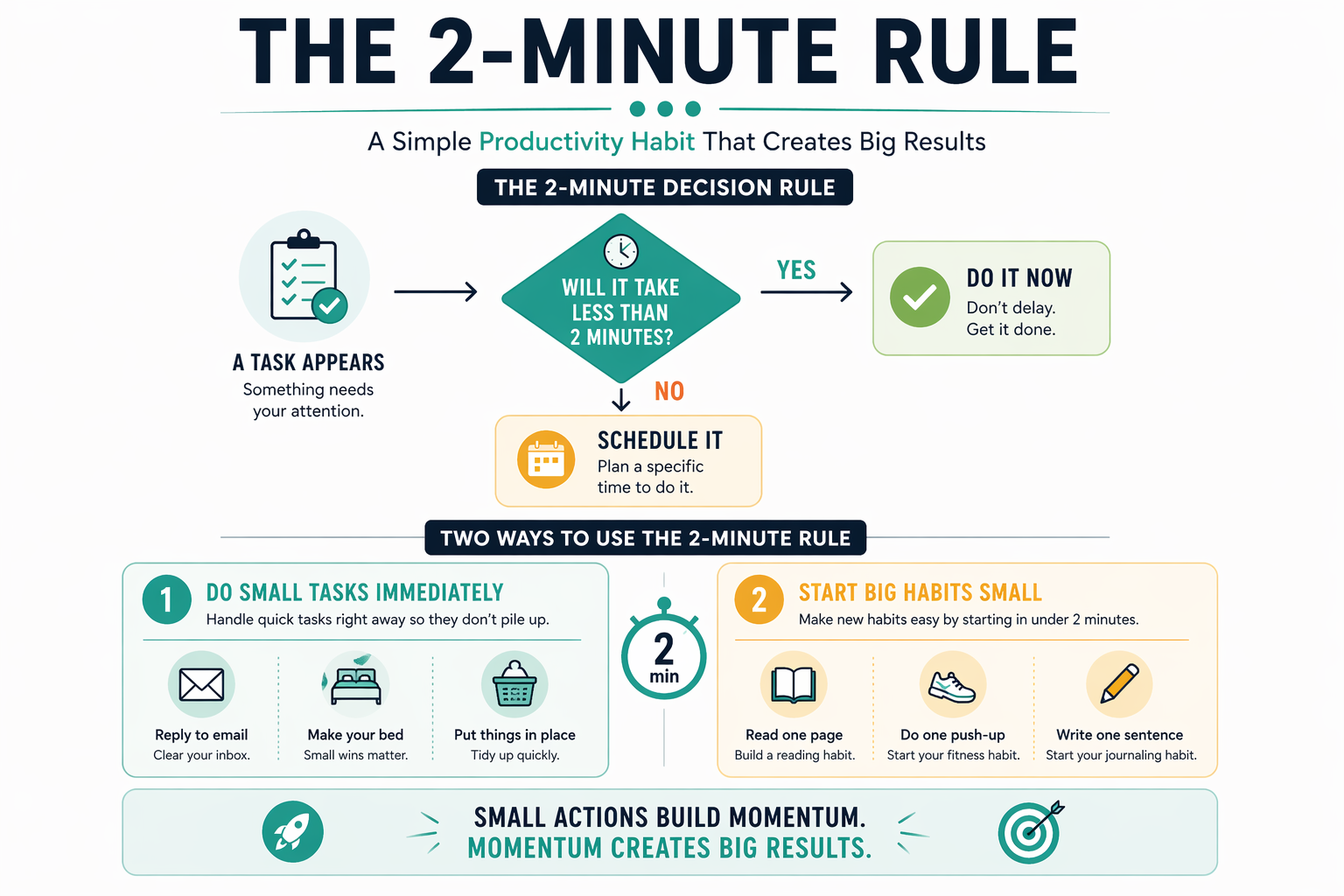
Save this infographic to remember the 2-Minute Rule.
Why the 2-Minute Rule Works
The magic is not in the two minutes. It’s in what those two minutes create.
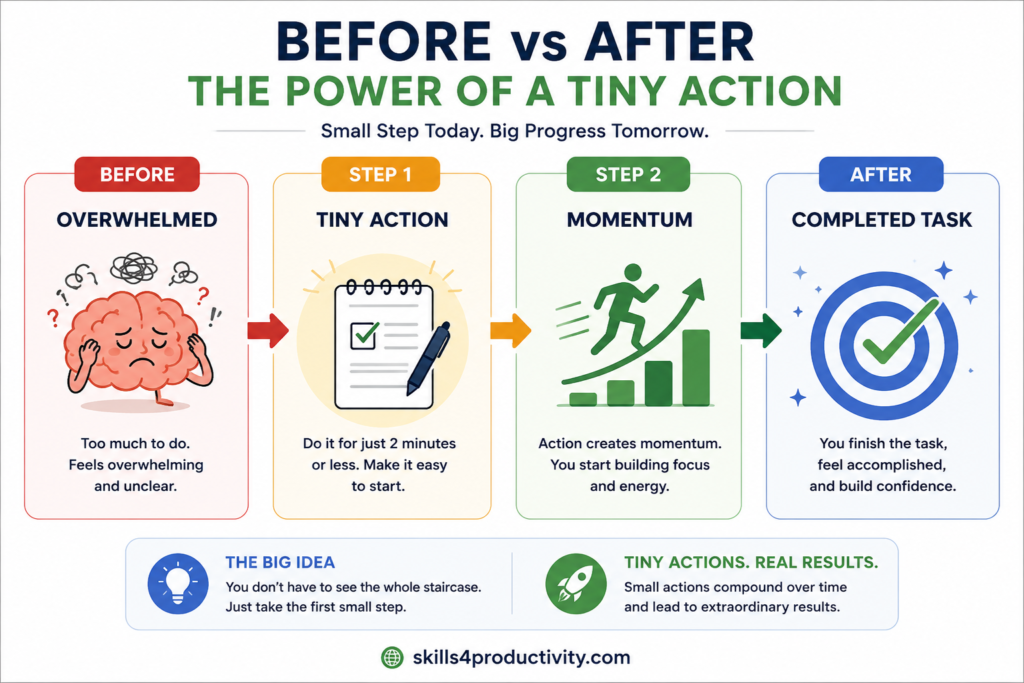
1. It Beats Procrastination
Big tasks feel intimidating. Small actions feel doable.
The rule lowers resistance.
2. It Builds Momentum
Action creates motion. And motion often leads to motivation.
Starting is usually the hardest part.
This aligns closely with the focusing principles discussed in The One Thing summary.
3. It Reduces Mental Clutter
Unfinished tiny tasks occupy mental space.
Completing them creates relief.
4. It Strengthens Consistency
Tiny actions repeated daily become habits.
And habits shape results.
James Clear also explains in our Atomic Habits summary how small habits compound over time.
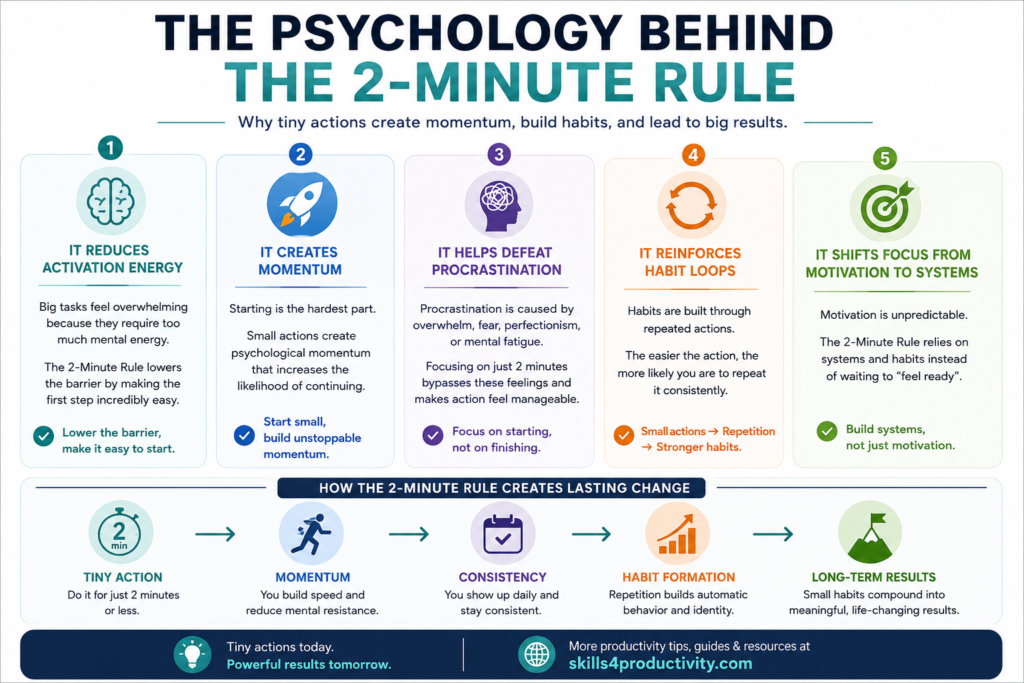
The Psychology Behind the 2-Minute Rule
The 2-Minute Rule works because it reduces the mental resistance associated with starting tasks.
Many people struggle with productivity not because tasks are difficult, but because getting started feels overwhelming.
By shrinking a task into something extremely small, the brain experiences less pressure and resistance.
This simple shift can create momentum and make consistent action much easier.
Research in behavioral psychology suggests that reducing friction and lowering activation energy can increase the likelihood of taking action consistently.
1. It Reduces Activation Energy
In psychology and behavioral science, activation energy refers to the mental effort required to begin a task.
Large tasks often feel intimidating because they require too much mental energy upfront.
The 2-Minute Rule lowers this barrier by making the first step incredibly easy.
For example:
- instead of “write a report”
- you simply “open the document”
- instead of “work out for an hour”
- you “put on your shoes”
Once you begin, continuing often feels easier.
2. It Creates Momentum
Starting is usually the hardest part of any task.
Small actions create psychological momentum, which increases the likelihood of continuing.
This is why many successful habit systems focus on consistency instead of intensity.
Even tiny actions can help reinforce a productive identity over time.
James Clear explains this concept well in Atomic Habits, where small repeated behaviors eventually lead to meaningful long-term results.
3. It Helps Defeat Procrastination
Procrastination is often caused by:
- overwhelm
- fear of failure
- perfectionism
- mental fatigue
The 2-Minute Rule bypasses these feelings by focusing only on the smallest possible action.
Instead of worrying about completing the entire task, you only focus on getting started.
This reduces stress and makes action feel manageable.
4. It Reinforces Habit Loops
According to behavioral psychology, habits are built through repeated actions.
The more frequently you perform a behavior, the stronger the habit becomes.
The 2-Minute Rule encourages repetition because the actions feel easy and achievable.
Over time: small actions → repeated behavior → stronger habits → long-term consistency
This is one reason why the rule works so well for building routines.
5. It Shifts Focus From Motivation to Systems
Many people wait to feel motivated before taking action.
The problem is that motivation is inconsistent.
The 2-Minute Rule works because it relies less on motivation and more on systems and automatic behavior.
Instead of asking: “Do I feel motivated?”
You ask: “Can I do this for two minutes:”
That small mental shift often leads to action.
Examples of the 2-Minute Rule in Daily Life
At Work
Instead of:
- Flagging a quick email for later
- Leaving notes scattered
- Delaying a short follow-up
Use the rule: Do it now.
For Productivity
- Plan tomorrow in two minutes
- Review your task list
- Clear your desktop
- Capture a new idea
Small resets prevent chaos.
You can also improve your systems using these productivity courses.
For Habits
Use two-minute starters:
- Read one paragraph
- Walk for two minutes
- Open your writing document
- Stretch briefly before bed
Start small. Grow naturally.
How the 2-Minute Rule Helps Build Better Habits
This is where it connects beautifully with habit formation.
Instead of saying: “I’ll read 30 books this year…”
Start with: “I’ll read one page.”
Instead of: “I’ll work out for an hour…”
Start with: “I’ll do one push-up.”
Tiny starts remove excuses. And consistency compounds.
This idea connects closely with the Habit Loop—small cues and easy routines make habits easier to repeat. Read our Habit Loop Explained guide to see how the cue-routine-reward cycle reinforces this.
You can explore more of this idea in our Atomic Habits Summary.
2-Minute Rule vs Pomodoro Technique
The 2-Minute Rule and the Pomodoro Technique are both popular productivity methods, but they solve different problems.
The 2-Minute Rule focuses on overcoming procrastination and reducing the mental resistance to starting tasks.
The Pomodoro Technique focuses on maintaining concentration and managing time during longer work sessions.
Key Difference
The 2-Minute Rule helps you start.
The Pomodoro Technique helps you continue.
For example:
- If you keep avoiding a task entirely, the 2-Minute Rule is usually more effective.
- If you already started but struggle to stay focused, Pomodoro works better.
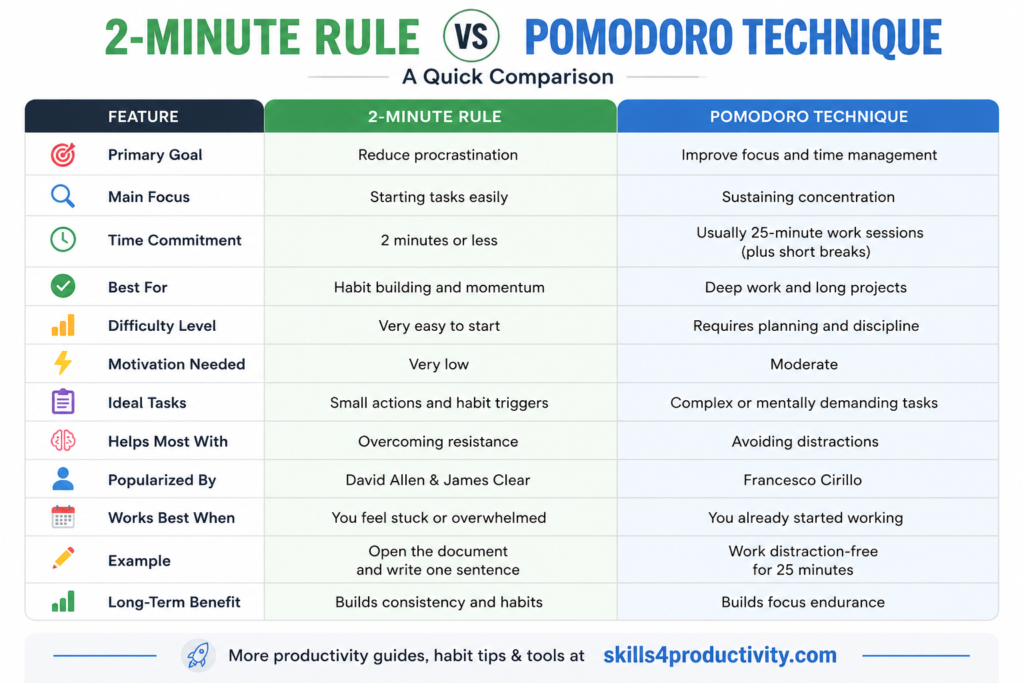
When to Use Each Method
Use the 2-Minute Rule when:
- you feel overwhelmed
- you keep delaying tasks
- you struggle to build habits
- motivation feels low
Use the Pomodoro Technique when:
- you need uninterrupted focus
- you’re working on long projects
- distractions are hurting productivity
- you want better time management
Combining Both Methods
Many productive people combine both systems together.
For example:
- Use the 2-Minute Rule to start writing
- Then switch into a 25-minute Pomodoro session
- Take a short break
- Repeat the cycle
This combination helps reduce friction while also improving focus and consistency.
How to Use the 2-Minute Rule Daily
Try this simple process:
Step 1: Spot Tasks Under Two Minutes
Ask: Can I finish this right now?
If yes, do it.
Step 2: Shrink Big Habits
Make habits so easy they feel impossible to skip.
Reduce friction. Lower the starting point.
Step 3: Focus on Starting, Not Finishing
The goal is not perfection. The goal is initiation.
Start first. Momentum follows.
Want more simple productivity frameworks like this? Explore our Habit Loop guide.
Common 2-Minute Habits You Can Start Today
Try these:
- Read one page
- Write one sentence
- Do one push-up
- Review tomorrow’s priorities
- Tidy one small space
- Drink a glass of water
- Practice one minute of deep breathing
Simple. Practical. Effective.
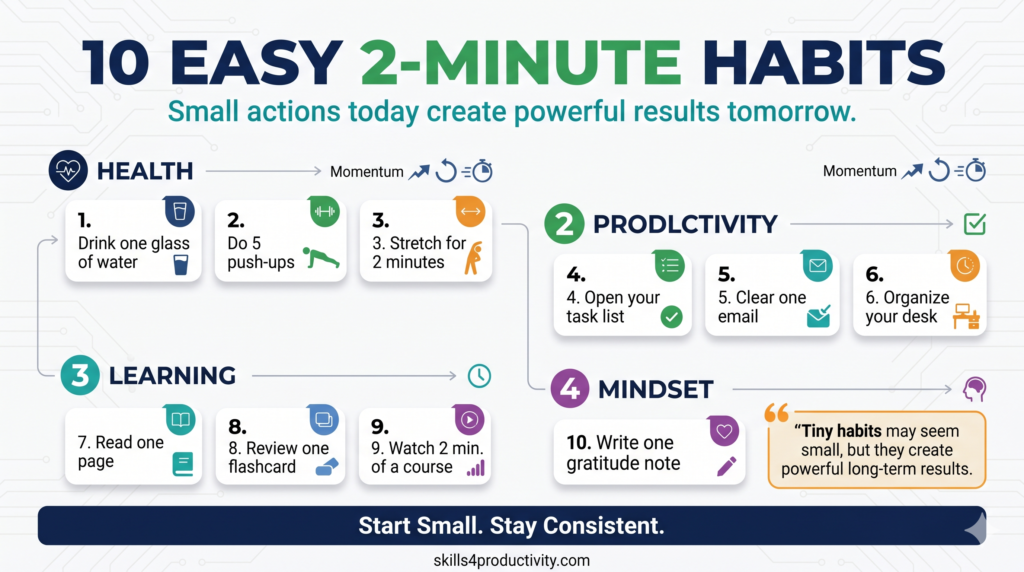
10 Easy 2-Minute Habits You Can Start Today
Health
- Drink one glass of water
- Do 5 pushups
- Stretch for 2 minutes
Productivity
- Open your task list
- Clear one email
- Organize your desk
Learning
- Read one page
- Review one flashcard
- Watch 2 minutes of a course
Mindset
- Write one gratitude note
Mistakes to Avoid
Don’t confuse tiny with trivial
Small actions can create big outcomes.
Don’t use it to avoid important work
The rule helps reduce friction.
It shouldn’t become busywork.
Don’t underestimate repetition
Tiny actions done daily outperform occasional heroic effort.
Final Thoughts
The 2-Minute Rule works because it makes action easier than avoidance.
It helps you:
- Stop procrastinating
- Build momentum
- Form better habits
- Reduce overwhelm
And often, that tiny first step is all you need.
Big progress doesn’t always begin with massive effort. Sometimes it begins with two minutes.
Start small. Start now.
*Based on ideas from David Allen (Getting Things Done) and James Clear (Atomic Habits).
FAQ
What is the 2-Minute Rule?
The rule says if something takes under two minutes, do it immediately.
Who created the 2-Minute Rule?
David Allen popularized it in Getting Things Done.
How does James Clear use the 2-Minute Rule?
He applies it to starting habits in less than two minutes.
Is the 2-Minute Rule effective for building habits?
Yes, because it reduces resistance and helps you start consistently.
Related Reading
You may also enjoy:
Disclosure: This article may contain affiliate links. If you purchase through these links, Skills4Productivity may earn a commission at no additional cost to you.