
Book Overview
Book: Getting Things Done
Author: David Allen
Category: Productivity / Time Management / Personal Development
This Getting Things Done summary covers practical ideas and timeless productivity lessons from David Allen’s classic book to help you organize your work, reduce overwhelm, and focus on what matters most.
Many productivity books promise better habits or faster results, but this one gives you a system.
At the heart of Getting Things Done is a simple idea: Stress often doesn’t come from having too much to do — it comes from trying to keep track of everything in your head.
David Allen believes productivity starts when your mind is clear.
Instead of using mental energy to remember unfinished tasks, he teaches you how to build a trusted system that captures commitments, clarifies actions, and keeps work moving.
This book has influenced professionals, entrepreneurs, and knowledge workers for decades because its ideas are practical, not theoretical.
And despite being written years ago, the advice still feels surprisingly relevant.
In this Getting Things Done summary, you’ll discover how simple systems can help you work with less stress and more control.
If you’re interested in habit systems and focus, also explore our Atomic Habits Summary and Deep Work Summary.
Quick Takeaways
- Capture everything in a trusted system
- Define the next action
- Use the 2-Minute Rule
- Review your system weekly
- Productivity comes from clarity, not busyness
Summary
Most people don’t struggle because they lack motivation. They struggle because everything feels scattered.
Too many ideas.
Too many unfinished tasks.
Too many things floating in the background.
David Allen calls these open loops — commitments that occupy mental space because they haven’t been captured or clarified.
His solution is not working harder. It’s building a better system.
One of the biggest lessons in Getting Things Done is to stop using your brain as storage.
Write things down.
Capture everything.
Trust a system instead of memory.
Another powerful idea in the book is defining the next action.
Many tasks feel heavy because they’re vague.
But when you turn “work on presentation” into “draft opening slide,” resistance often disappears.
Allen also introduces the 2-Minute Rule, one of the book’s most practical ideas: If something takes less than two minutes, do it immediately.
Simple.
Actionable.
Effective.
Another cornerstone of the system is the Weekly Review, where you step back, review projects, and reset priorities.
This prevents your system from becoming cluttered.
What makes the book powerful is that it doesn’t just help you get more done. It helps you feel more in control while doing it.
Key Lessons from Getting Things Done
1. Your Mind Is for Thinking, Not Remembering
One of the most memorable ideas in the book is: Your mind is for having ideas, not holding them.
Trying to remember every task creates mental noise. Instead, capture everything in a trusted place:
- Notebook
- Task manager
- Notes app
- Inbox system
When nothing is left floating in your head, focus improves. And so does calm.
2. Define the Next Action
Many projects stall because they are unclear.
We write: “Work on proposal”
But that isn’t an action.
Allen asks: What is the next physical action?
Maybe it’s:
- Open research notes
- Draft first paragraph
- Email client for feedback
Clarity reduces friction. And momentum often follows.
This idea pairs well with the focus principles in The One Thing Summary.
3. Use the 2-Minute Rule
This may be the most practical lesson in the book.
If a task can be completed in under two minutes — Do it now.
This principle is explored further in our 2-Minute Rule Explained guide.
Reply to the email.
File the document.
Make the quick call.
Small unfinished tasks create unnecessary mental weight. Handling them immediately keeps work flowing.
Simple rules often create outsized results.
4. Organize by Context, Not Chaos
Allen suggests grouping tasks by where they can be done.
Examples:
- Calls
- Computer
- Errands
- Waiting For
Instead of scanning one giant task list, you work from context.
It sounds simple. But it makes execution easier.
And easier often means more likely.
5. Review Weekly to Stay in Control
Most systems fail because they’re abandoned.
The Weekly Review prevents that. Once a week, review:
- Projects
- Open loops
- Priorities
- Follow-ups
It’s like maintenance for your productivity system.
Without review, systems decay.
With review, they stay trusted.
For another perspective on intentional work, see our Deep Work Summary.
6. Do a Brain Dump Regularly
One of the practical habits behind the GTD system is capturing loose ends before they pile up.
David Allen encourages getting everything out of your head and into a trusted system—tasks, ideas, reminders, and unfinished commitments.
This is often called a brain dump.
When everything is visible, it becomes easier to organize and prioritize.
Many people feel overwhelmed not because they have too much to do, but because too much is floating unprocessed in their mind.
Writing things down creates clarity. And clarity reduces stress.
A simple weekly brain dump can help you:
- Clear mental clutter
- Spot forgotten commitments
- Reduce overwhelm
- Regain focus
Sometimes productivity starts with emptying your mind.
7. Focus on Outcomes, Not Activity
Being busy is not always the same as making progress.
One of the deeper lessons in Getting Things Done is to focus on outcomes, not just activity.
Before asking what to do next, ask: What does done look like?
Defining the desired outcome creates direction.
Without that clarity, it’s easy to stay busy without moving important work forward.
Allen’s system is not about checking off more tasks. It’s about moving meaningful projects toward completion.
That shift matters.
Instead of reacting all day, you begin working with intention.
Productivity improves when action is connected to purpose.
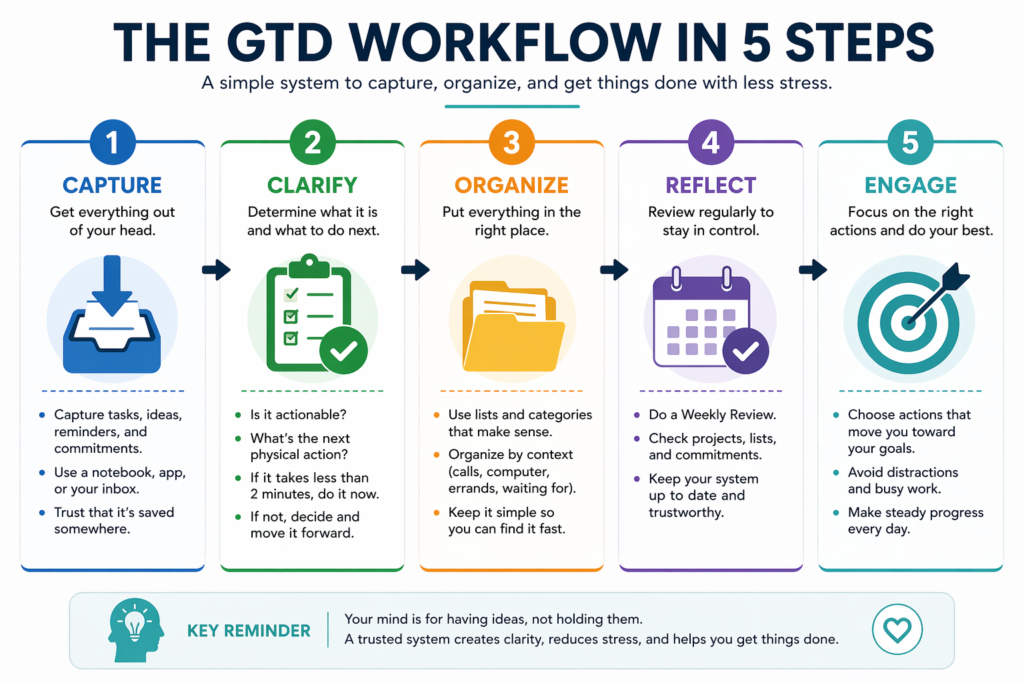
The GTD (Getting Things Done) Workflow in Five Steps
- Capture
- Clarify
- Organize
- Reflect
- Engage
Key Insights from the Book
What stands out in Getting Things Done is that productivity is framed less as efficiency and more as stress reduction.
That feels different. And important.
Allen suggests much of our stress comes from poorly managed commitments, not simply too much work.
That insight alone changes how you see productivity.
Another powerful idea: Productivity isn’t about cramming more into your day.
It’s about creating enough clarity to focus on what matters.
This connects with ideas from Essentialism Summary.
The book also reminds us that being busy and being organized are not the same.
One creates motion. The other creates progress.
That distinction matters.
Best Quotes from the Book
“Your mind is for having ideas, not holding them.”
“You can do anything, but not everything.”
“Much of stress comes from inappropriate management of commitments.”
“The next action is what moves a project forward.”
Who Should Read This Book
This book is worth reading if you:
- Feel overwhelmed by tasks and responsibilities
- Want a practical productivity system
- Manage multiple projects at once
- Struggle with mental clutter
- Prefer systems over motivation hacks
It’s especially useful for knowledge workers, creators, entrepreneurs, and anyone juggling many commitments.
Readers interested in building systems and habits may also like our Atomic Habits Summary.
If you’d like the full framework and practical GTD system, the original book is worth reading in full.
Get the Book
Final Thoughts
Getting Things Done isn’t really about doing more. It’s about thinking more clearly.
Working with less friction.And building a system you can trust.
That may be why this book has remained relevant for so long.
Tools change.
Apps change.
But the need for clarity never does. And that’s what this book delivers.
If productivity has ever felt overwhelming, Getting Things Done offers something rare — not motivation, but a system.
FAQs
What is the main idea of Getting Things Done?
The main idea of Getting Things Done is to capture tasks outside your mind, organize them into a trusted system, and focus on the next action instead of feeling overwhelmed.
What is the 2-Minute Rule in GTD?
The 2-Minute Rule says if a task takes less than two minutes to complete, do it immediately instead of putting it off.
Is Getting Things Done still worth reading?
Yes. Getting Things Done remains one of the most practical productivity books because its system for organizing work and reducing stress is still highly relevant today.
What are the 5 steps of the GTD workflow?
The five steps of the GTD workflow are: Capture, Clarify, Organize, Reflect, and Engage.
Related Book Summaries
If you liked this, you may also enjoy:
Disclosure: This article may contain affiliate links. If you purchase through these links, Skills4Productivity may earn a commission at no additional cost to you.