
What are productivity skills?
Productivity skills are abilities that help you manage focus, time, energy, and execution effectively so you can do meaningful work more efficiently.
The Skills4Productivity Framework
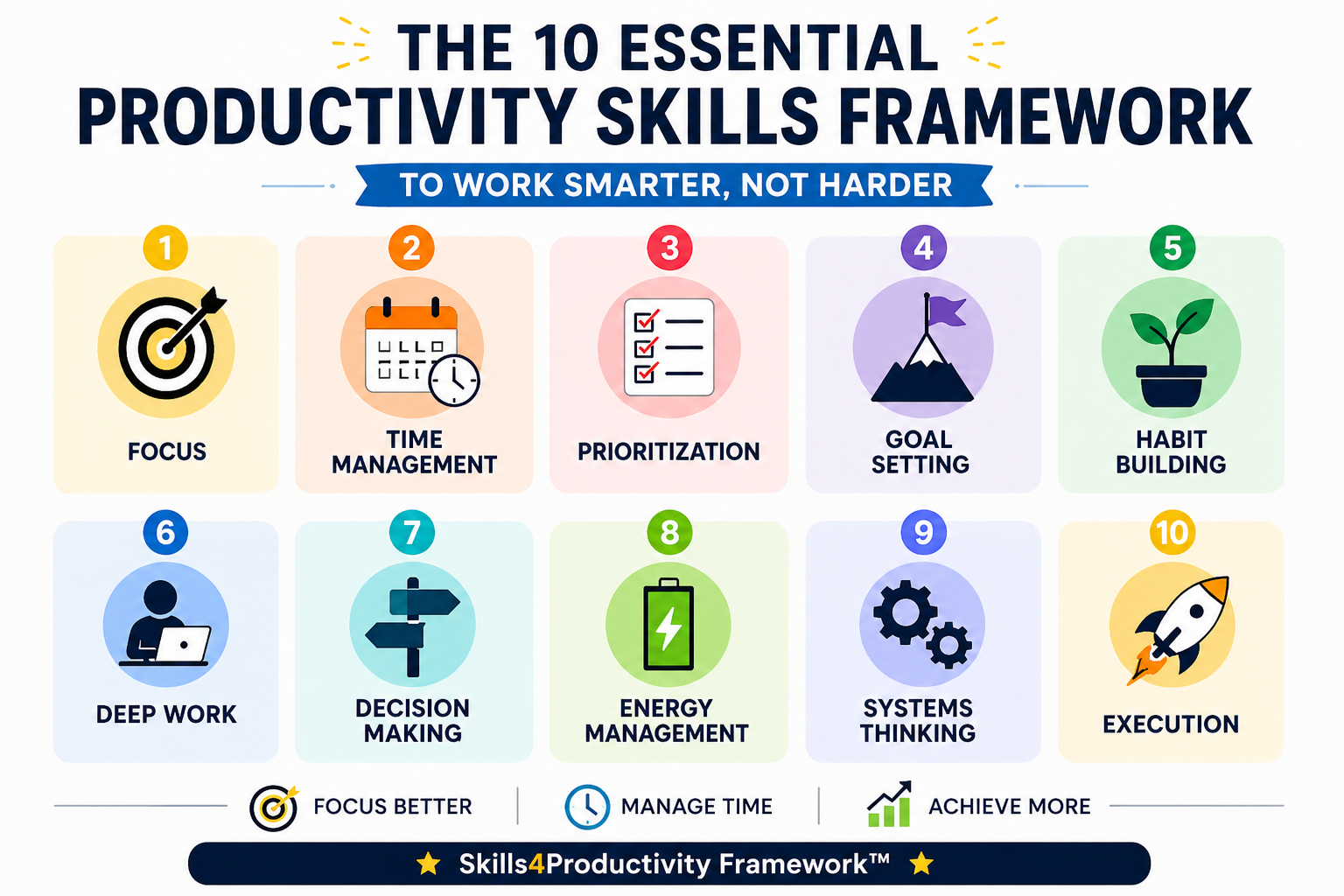
Productivity is easier to understand when viewed as a set of interconnected skills. This framework highlights the 10 core productivity skills that help you work smarter and achieve more consistently.
Productivity Is a Skill Set, Not a Hack
Most people treat productivity like a toolbox.
A better calendar app. A new planner. A task manager. Another morning routine.
But the truth is simpler.
Productivity is less about tools and much more about skills.
Apps can support you. Systems can help you. But skills are what make those systems work.
If your focus is weak, no app will save you. If you struggle to prioritize, the perfect to-do list won’t matter. If execution is inconsistent, even the best productivity system collapses.
That’s why high performers—from entrepreneurs to top students to elite professionals—tend to share something deeper than “productivity hacks.”
They’ve built foundational productivity skills.
In this guide, we’ll cover the 10 essential productivity skills that help you work smarter, improve performance, and get more done without burning out.
These are the same skills behind deep work, better decisions, stronger habits, and sustainable results.
And because productivity compounds, even improving one or two of them can change how you work.
What Are Productivity Skills?
Productivity skills are abilities that help you manage attention, time, energy, and execution effectively.
They help you:
- Focus on what matters
- Prioritize high-value work
- Avoid overwhelm
- Finish more meaningful tasks
- Build systems instead of relying on motivation
- Create consistent progress over time
Think of productivity less as “doing more” and more as doing the right things well.
That distinction changes everything.
10 Essential Productivity Skills You Need to Work Smarter
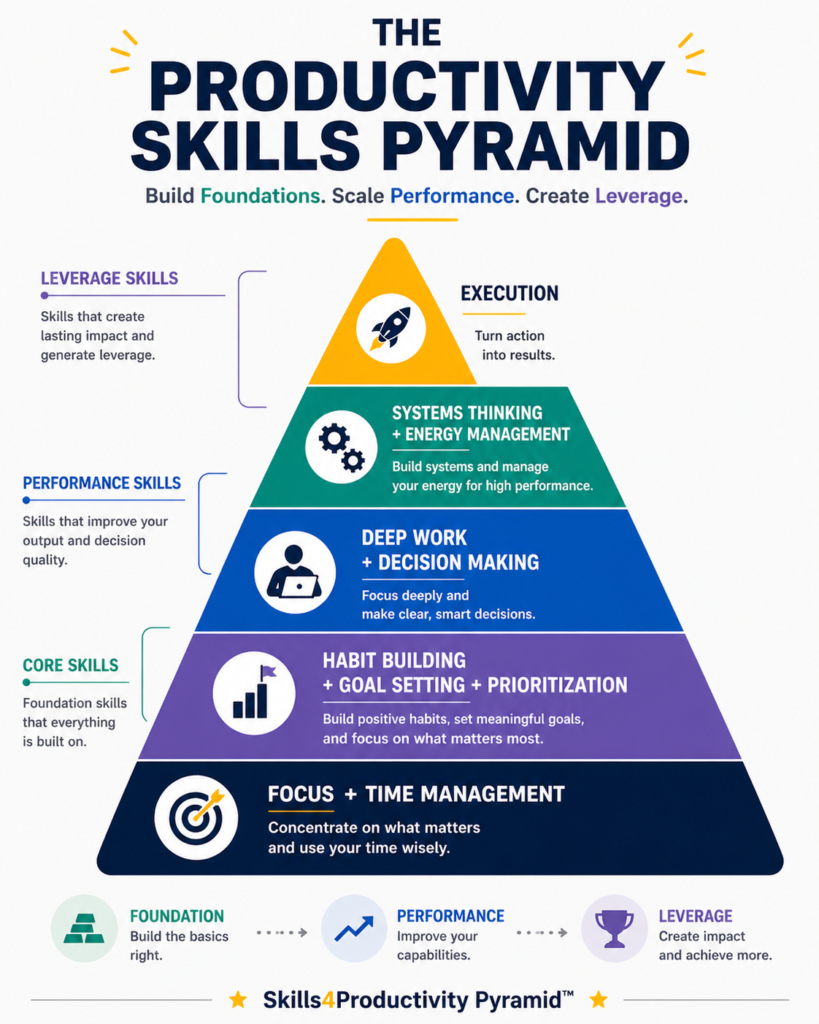
Rather than random tips, think of productivity as a stack of skills.
Each one strengthens the others.
Master them together, and your effectiveness compounds.
1. Focus: The Foundation of All Productivity
Deep Work by Cal Newport made one idea impossible to ignore:
The ability to focus without distraction is becoming increasingly valuable.
He was right.
Focus is the ability to direct attention intentionally. Not reactively. Not scattered. Intentionally.
Without focus:
- Work takes longer
- Mistakes increase
- Mental fatigue grows
- Important work gets replaced by shallow tasks
Ways to improve focus
Use distraction friction
Keep your phone away. Close extra tabs. Make distractions harder.
Work in focus blocks
Try 50-minute deep work sessions.
Single-task
Multitasking is usually task-switching. And task-switching is expensive.
Protect attention like a resource
Because it is.
Related reading:
- Deep Work summary
- How to Improve Focus and Concentration
2. Time Management: Directing Time With Intention
Everyone has 24 hours. Productive people simply allocate them differently.
Time management isn’t cramming more into a day.
It’s making time match priorities.
Core time management skills include:
Time blocking – Assign work to calendar blocks. Don’t leave priorities to open space.
Planning – Spend 10 minutes planning tomorrow. It saves hours later.
Estimation – Most people underestimate how long things take. Productive people get better at forecasting.
Deadline discipline – Self-imposed deadlines often create momentum.
A simple rule: Schedule priorities first. Fit everything else around them.
If you want structured training, a productivity or time management course on Coursera can fit naturally here as an affiliate recommendation.
Related reading:
- Time Management Skills Everyone Should Learn
- Best Online Courses for Productivity
3. Prioritization: Knowing What Matters Most
Being busy is easy. Being productive is selective.
Prioritization is choosing what deserves attention.
And often, what doesn’t.
Useful prioritization frameworks
The 80/20 Rule – Often 20% of effort creates 80% of outcomes. Find that 20%.
Eisenhower Matrix – Urgent vs important. Simple. Powerful. Still relevant.
MIT Method – Choose your Most Important Tasks before the day starts.
Ask daily:
- What moves the needle most?
- What can wait?
- What can be eliminated?
Productivity often improves not when you add more…
…but when you remove the trivial.
Related reading:
- Prioritization Skills for Busy Professionals
4. Goal Setting: Turning Effort Into Direction
Hard work without direction becomes drift.
Goals create direction.
But productive people don’t just set outcome goals. They use process goals too.
Outcome goal: Write a book.
Process goal: Write 500 words every weekday.
Process goals create momentum.
Helpful goal-setting models
SMART goals
Still useful when applied thoughtfully.
Systems-based goals
Focus on repeatable behaviors.
Quarterly planning
Long enough for progress. Short enough to stay real.
Good productivity often comes from connecting: Vision → Projects → Weekly priorities → Daily action
That chain matters.
5. Habit Building: Make Productivity Automatic
Willpower is unreliable. Habits are scalable.
That’s why habit-building is a core productivity skill.
Atomic Habits by James Clear popularized a powerful truth: You do not rise to the level of your goals. You fall to the level of your systems.
Exactly.
Small repeated behaviors create outsized results.
Productivity habits worth building
- Daily planning
- Weekly review
- Focus sessions
- Inbox processing routine
- End-of-day shutdown ritual
Use habit design:
Cue → Routine → Reward
Or start even simpler: Make good habits obvious. Make bad habits difficult.
Related reading:
6. Deep Work: Producing High-Value Output
Busy work creates motion. Deep work creates value.
There’s a difference.
Deep work means sustained concentration on cognitively demanding tasks.
Writing. Problem-solving. Strategy. Learning. Creation.
This is where breakthroughs happen.
Why deep work matters
Context switching destroys momentum. Meetings fragment thinking. Notifications fracture attention.
Deep work protects quality.
Build a deep work practice
Try:
- 90-minute focus sessions
- No-message blocks
- Theme days
- Morning deep work before reactive work
Even two real deep work blocks a week can outperform endless shallow busyness.
Related reading:
7. Decision Making: Reduce Friction and Move Faster
Poor decisions create hidden productivity costs.
So does overthinking.
Decision-making is an underrated productivity skill.
Every unnecessary decision drains attention.
That’s why productive people simplify.
Ways to improve decisions
Use checklists
Repeatable choices shouldn’t require fresh thinking every time.
Create default rules
Examples:
- Meetings only after noon
- Email twice daily
- If task takes under two minutes, do it now
Rules reduce decision fatigue.
Use principles, not endless deliberation
Simple principles speed judgment.
Good productivity often looks like reduced cognitive clutter.
That starts with fewer decisions.
8. Energy Management: Productivity Is Biological Too
This is where many productivity articles stop too early.
Time matters. Focus matters.
But energy may matter even more.
You don’t manage output well when exhausted.
Productivity improves when you manage:
Physical energy
- Sleep
- Movement
- Nutrition
Mental energy
- Breaks
- Recovery
- Cognitive load
Peak energy windows
Do your hardest work when your brain is strongest.
For many people:
Morning = thinking work
Afternoon = meetings/admin
Match task to energy.
That alone can change output dramatically.
9. Systems Thinking: Build Processes, Not Constant Rescue
This may be the most overlooked productivity skill.
Most people solve recurring problems repeatedly.
Systems thinkers solve them once.
Big difference.
Example
Problem: You keep forgetting deadlines.
Hack solution: Try harder.
Systems solution: Build a weekly review plus deadline dashboard.
Problem solved structurally.
That scales.
Systems beat motivation. Repeatedly.
Look for:
- Workflows
- Templates
- Checklists
- Automation
- Standard operating routines
This is where productivity starts becoming leverage.
And leverage compounds.
10. Execution: The Ultimate Productivity Skill
Ideas don’t create results. Execution does.
Execution means: Starting. Following through. Finishing.
Simple. Hard. Essential.
Many people know what to do. Far fewer consistently do it.
Execution closes that gap.
Improve execution with:
Lower start resistance
Make starting easier.
Write one paragraph. Open the document. Do five minutes.
Motion creates momentum.
Break work smaller
Clarity reduces avoidance.
Finish before optimizing
Done often beats perfect.
If I had to choose one productivity skill that multiplies all others…Execution might be it.
How to Improve Productivity Skills
Knowing these skills is useful. Practicing them is what creates results.
The mistake many people make is trying to improve everything at once—better focus, better habits, better planning, better systems.
That usually leads to overwhelm.
A better approach is to improve one productivity skill at a time.
1. Start With Your Biggest Bottleneck
Find the one skill currently limiting your performance most.
Ask yourself:
- Do I struggle to focus?
- Do I waste time on low-value tasks?
- Do I start projects but fail to finish?
- Do I have systems, or am I relying on memory and motivation?
Fix the constraint first.
That often produces the biggest gains.
2. Build Systems, Not Just Good Intentions
Productivity improves faster when behaviors become systems.
Examples:
- Use time blocking instead of vague to-do lists
- Run a weekly review instead of reacting all week
- Use checklists for recurring tasks
- Create routines that reduce decision fatigue
Systems reduce friction.
And less friction means better execution.
3. Practice One Skill for 30 Days
Treat productivity like skill training.
Choose one area.
Work on it consistently for 30 days.
Examples:
- 30 days of daily focus blocks
- 30 days of time blocking
- 30 days of weekly reviews
- 30 days improving prioritization
Small improvements compound quickly.
4. Learn From Books, Courses and Tools
Sometimes progress accelerates when you learn from proven frameworks.
A few excellent starting points:
Recommended Books
- Atomic Habits (habit building and systems)
- Deep Work (focus and concentration)
- The One Thing (prioritization)
Recommended Courses
If you prefer structured learning, productivity courses can help reinforce these skills.
Popular options include:
Productivity Skills at a Glance
Here’s a quick recap of the 10 essential productivity skills:
- Focus
- Time Management
- Prioritization
- Goal Setting
- Habit Building
- Deep Work
- Decision Making
- Energy Management
- Systems Thinking
- Execution
If you only start with one skill, start with the one that feels weakest.
That’s usually where your biggest opportunity is.
Frequently Asked Questions
What are the most important productivity skills?
Focus, prioritization, time management, and execution are some of the highest-leverage productivity skills.
They improve nearly everything else.
Can productivity skills be learned?
Yes.
Productivity is not something you’re born with.
It is a set of skills developed through practice, systems, and repetition.
Which productivity skill matters most?
It depends on where you struggle.
But focus and execution often have the biggest impact.
Without focus, effort gets scattered.
Without execution, nothing gets finished.
What is the difference between productivity and efficiency?
Efficiency is doing things well.
Productivity is doing the right things well.
Both matter, but productivity starts with priorities.
Final Thoughts
Productivity is not about doing more.
It’s about building the skills to do what matters better.
Focus creates clarity.
Prioritization creates direction.
Execution creates results.
And those skills compound over time.
Start with one.
Practice it consistently.
Then build the next.
That’s how real productivity grows.
Not through hacks.
Through skills.
Continue Building Your Productivity Skills
If you found this guide helpful, explore these next:
- How to Improve Focus and Concentration
- Time Management Skills Everyone Should Learn
- Prioritization Skills for Busy Professionals
- Productivity vs Efficiency
- Productivity Killers to Avoid
These guides expand on the skills covered here and help you go deeper.
Disclosure: This article may contain affiliate links. If you purchase through these links, Skills4Productivity may earn a commission at no additional cost to you.