
Why businesses, professionals, and content creators must learn when AI can be confidently wrong.
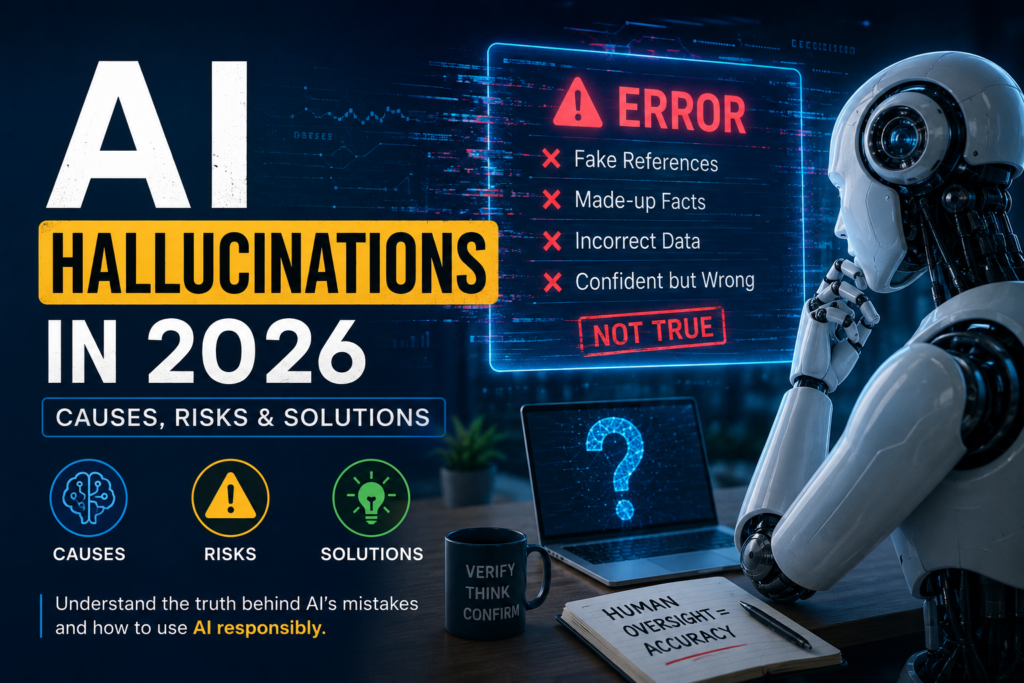
Artificial Intelligence has become part of everyday work.
From writing emails and generating marketing content to analyzing data and answering customer queries, AI tools are helping businesses move faster than ever before. What once required hours of manual work can now be done in minutes.
But as AI adoption continues to rise in 2026, so does one of its biggest problems: hallucinations.
AI can sound convincing, confident, and professional while delivering information that is completely inaccurate. In many cases, the response looks so polished that users fail to question it.
That is where the real danger begins.
For businesses, students, marketers, researchers, and professionals, understanding AI hallucinations is no longer optional. It has become an essential part of using AI responsibly.
In This Article
• What Are AI Hallucinations?
• Why AI Hallucinations Happen
• Real-World Examples
• Risks of AI Hallucinations
• How to Reduce AI Hallucinations
• Best AI Courses
• FAQs
• Final Thoughts
What Are AI Hallucinations?
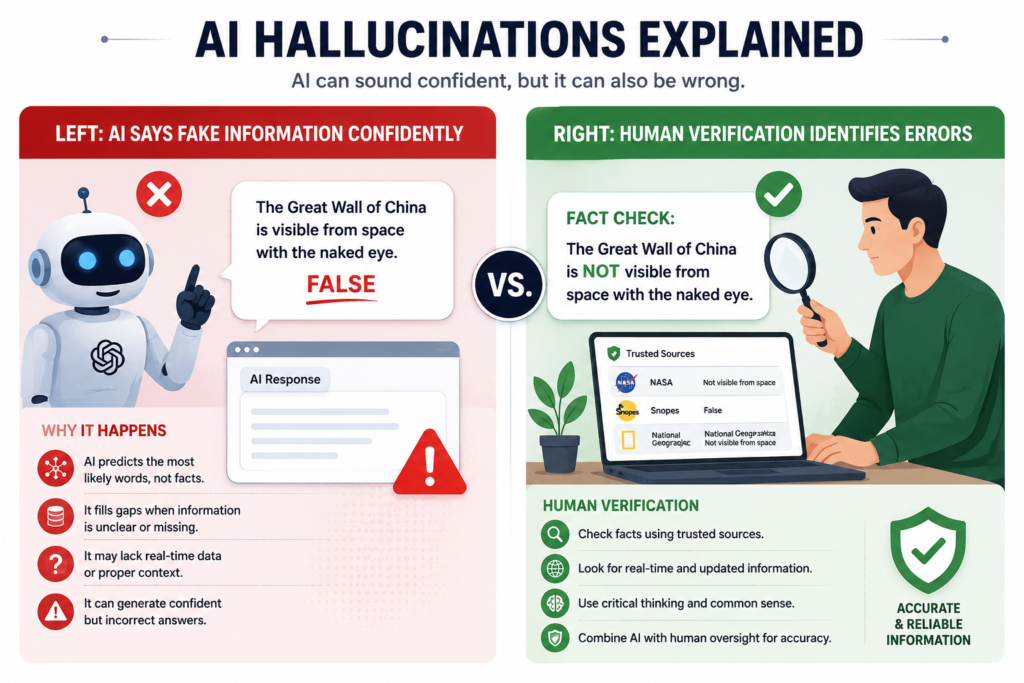
An AI hallucination occurs when an AI system generates false, misleading, or fabricated information and presents it as if it were factual.
In simple terms, the AI “makes things up.”
This could include:
- Inventing statistics
- Creating fake references or citations
- Providing incorrect legal or medical advice
- Misrepresenting company information
- Generating non-existent research sources
- Producing inaccurate summaries
What makes hallucinations especially concerning is that the responses often appear highly confident and professionally written. Unlike obvious mistakes or broken outputs, hallucinations can look believable at first glance.
For example, a user may ask an AI tool for:
- a business statistic
- a book summary
- a legal reference
- or market research data
and receive an answer that sounds perfectly accurate — even though parts of it may be entirely fabricated.
This is one of the biggest misconceptions surrounding AI today: people often confuse confidence with correctness.
Why AI Hallucinations Happen
To understand hallucinations, it helps to understand how generative AI actually works.
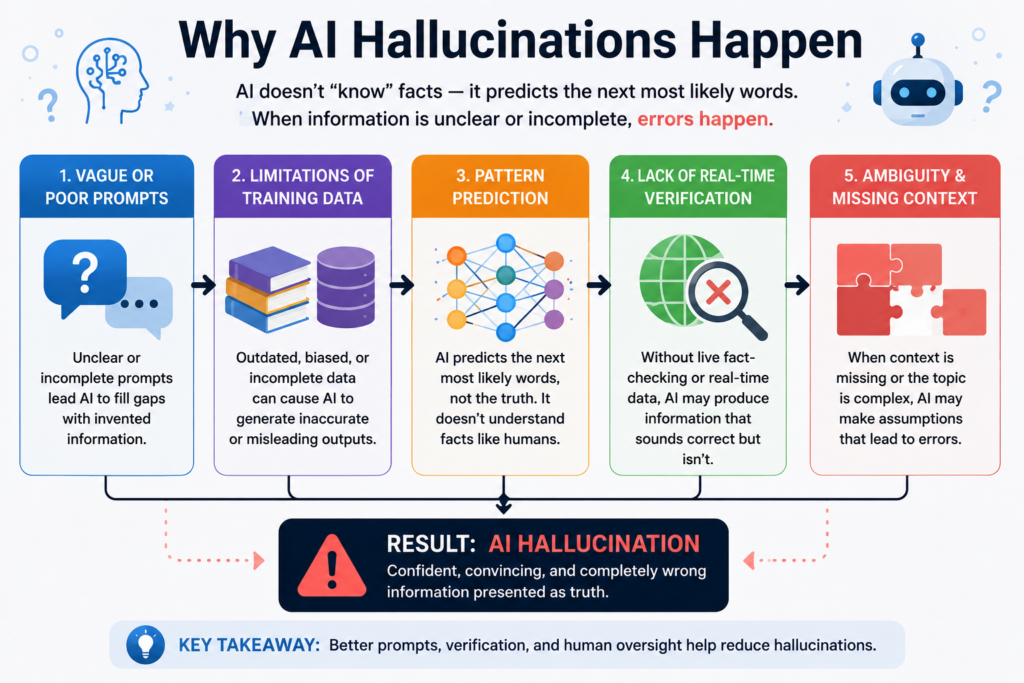
AI models do not “think” like humans. They do not understand truth, facts, or reality in the way people do. Instead, they predict patterns based on enormous amounts of training data.
The goal of most language models is to generate the most likely next word in a sequence based on patterns learned from previous text.
That means AI is optimized for producing plausible responses — not necessarily accurate ones.
Several factors contribute to hallucinations.
1. Predictive Language Generation
AI models are designed to generate fluent responses. When the model lacks complete information, it may still attempt to produce an answer rather than admit uncertainty.
As a result, the AI fills gaps with probable-sounding information.
2. Weak or Vague Prompts
The quality of output often depends on the quality of input.
Broad or unclear prompts increase the chances of hallucinations because the AI has more room to make assumptions.
For example: “Give me statistics about remote work”
is much weaker than: “Provide verified remote work statistics from 2025 research reports.”
Specific prompts reduce ambiguity and improve reliability.
3. Outdated Training Data
Some AI systems may rely on data that is not fully current. If recent information is unavailable or incomplete, the AI may generate outdated or inaccurate responses.
This becomes especially problematic in fast-changing industries like technology, finance, healthcare, and law.
4. Lack of Real-Time Verification
Not every AI tool verifies information against live sources before responding.
Without verification mechanisms, inaccurate content can easily slip into outputs.
5. Overconfidence in AI Outputs
Another major factor is human behavior.
People naturally trust polished language. When AI responses sound professional, users often assume the information must be correct.
This overreliance on AI is becoming one of the biggest workplace risks in the modern digital environment.
Real-World Examples of AI Hallucinations
AI hallucinations are not just theoretical concerns. Several real-world incidents have already demonstrated their potential consequences.
In one widely discussed case, lawyers submitted legal documents containing fake case citations generated by AI. The citations appeared authentic but did not actually exist.
There have also been examples of AI tools:
- inventing academic references
- generating inaccurate financial information
- creating false company histories
- and producing misleading health-related advice.
Content creators have also faced issues where AI-generated articles included fabricated statistics or incorrect factual claims, leading to credibility problems and misinformation.
As businesses increasingly automate workflows, even small inaccuracies can create significant downstream consequences.
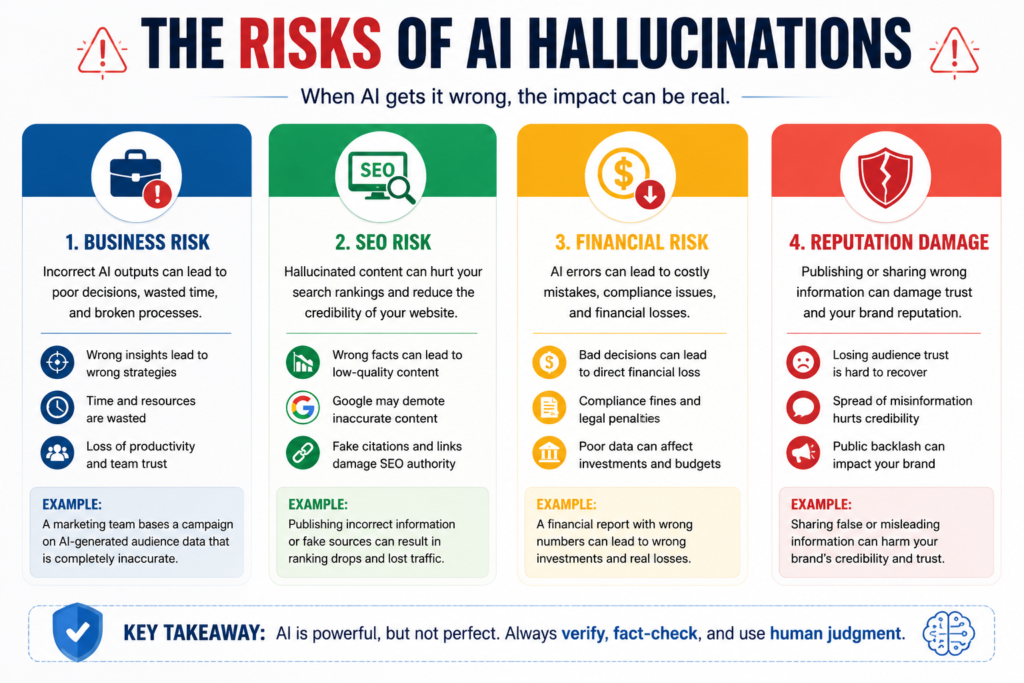
Why AI Hallucinations Are a Serious Business Risk
Many organizations are now integrating AI into daily operations without fully understanding its limitations.
This creates several risks.
Business Decision Risks
Executives and teams may unknowingly rely on inaccurate AI-generated insights while making strategic decisions.
A false statistic or misleading analysis can affect:
- marketing strategies,
- investment decisions,
- customer targeting,
- or operational planning.
Brand Reputation Damage
Publishing inaccurate information can damage trust.
Whether it is a blog post, social media update, product description, or customer communication, factual errors can reduce brand credibility quickly.
In the digital world, trust is difficult to build and easy to lose.
SEO and Content Marketing Problems
Many businesses now use AI for content generation. While AI can improve productivity, publishing unverified content can create SEO and credibility issues.
Search engines increasingly prioritize content quality, accuracy, and expertise.
AI-generated misinformation may hurt long-term search performance rather than improve it.
Workplace Productivity Issues
Ironically, AI hallucinations can reduce productivity when employees spend extra time fixing incorrect outputs.
Instead of accelerating work, inaccurate AI responses may create:
- confusion,
- rework,
- poor reporting,
- and communication errors.
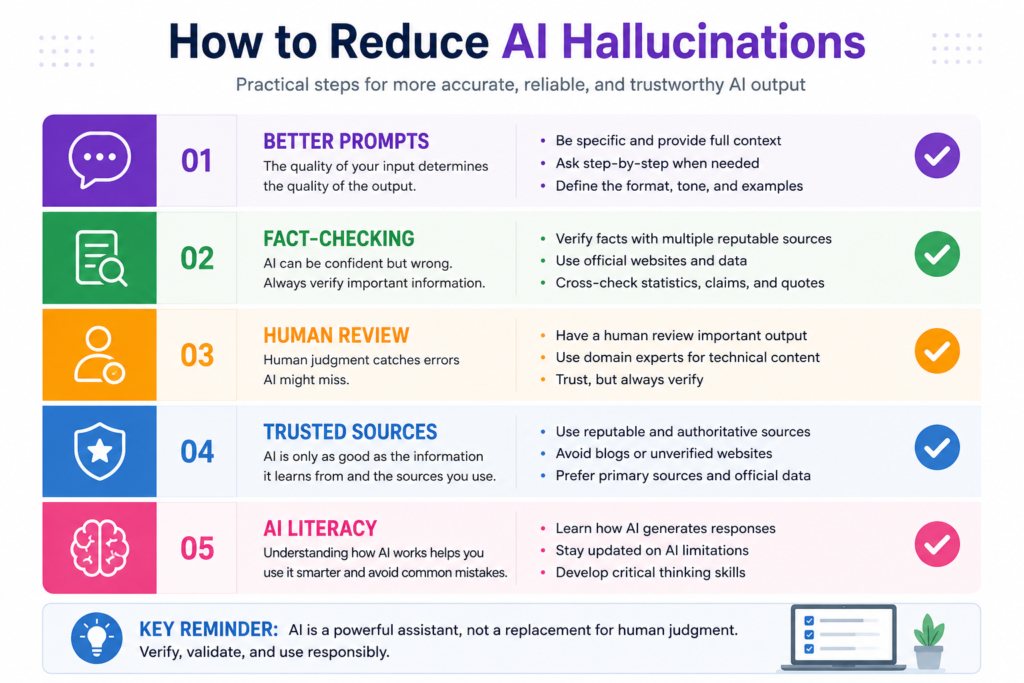
How to Reduce AI Hallucinations
AI hallucinations may never disappear entirely, but they can be reduced significantly with better practices and responsible usage.
1. Treat AI as an Assistant, Not an Authority
AI should support human decision-making — not replace it completely.
The most effective professionals use AI as a productivity tool while maintaining critical thinking and oversight.
2. Verify Important Information
Fact-checking remains essential.
Users should always verify:
- statistics,
- legal references,
- financial data,
- research citations,
- and sensitive information.
Reliable sources still matter.
3. Improve Prompt Quality
Clear prompts produce better results.
Instead of asking: “Tell me about AI.”
Ask: “Explain the main causes of AI hallucinations in business environments with practical examples.”
Detailed prompts improve context and reduce assumptions.
4. Use Multiple Sources
Cross-checking information across trusted websites, reports, and expert sources reduces the chances of relying on inaccurate AI-generated content.
5. Keep Human Review in the Workflow
Human oversight is still one of the best defenses against hallucinations.
Businesses should establish review systems for:
- content publishing,
- customer communication,
- research summaries,
- and strategic reporting.
6. Learn Responsible AI Usage
As AI tools become more common, AI literacy is becoming an important professional skill.
Understanding both the strengths and limitations of AI helps users work more effectively and responsibly.
The Future of AI Hallucinations
AI systems are improving rapidly.
Modern models are becoming better at reasoning, retrieval, source attribution, and contextual understanding. Future AI tools will likely reduce hallucination rates significantly.
However, no AI system is likely to become perfect.
Even advanced AI models can still produce inaccurate information under certain conditions.
That means the future workplace will not simply reward people who know how to use AI. It will reward people who know how to use AI responsibly.
Critical thinking, verification, and judgment will remain valuable human skills.
Final Thoughts
Artificial Intelligence is one of the most powerful productivity technologies of our time. It can save hours of work, accelerate creativity, improve communication, and support better workflows.
But productivity without accuracy can become dangerous.
AI hallucinations remind us that technology should assist human intelligence — not replace it blindly.
As AI becomes more deeply integrated into education, business, marketing, and daily work, understanding its limitations is just as important as understanding its capabilities.
The smartest professionals in 2026 will not be the ones who trust AI the most.
They will be the ones who know when not to.
Best AI Courses to Learn Responsible AI Usage
As Artificial Intelligence becomes a core part of modern work, learning how to use AI responsibly is becoming just as important as learning how to use the tools themselves.
Many professionals focus only on speed and automation. But responsible AI usage involves something deeper — understanding AI limitations, verifying outputs, improving prompts, protecting data privacy, and recognizing when human judgment is still necessary.
The good news is that several high-quality online courses now focus not only on AI productivity, but also on practical and ethical AI usage.
Below are some of the best AI courses professionals, students, marketers, and business owners can explore in 2026.
1. 2026 Fixing AI Errors & Hallucinations, And Fact-Checking – Coursera
2. Hallucination Management for Generative AI – Udemy
3. AI Errors & Hallucinations: Debugging & Fact-Checking – Udemy
4. Google AI Essentials – Coursera
5. Prompt Engineering for ChatGPT – Coursera
6. Generative AI for Business Leaders – LinkedIn Learning
Frequently Asked Questions
What are AI hallucinations?
AI hallucinations occur when an AI tool generates incorrect, misleading, or completely fabricated information while presenting it confidently as accurate.
Why do AI hallucinations happen?
AI hallucinations happen because AI models predict language patterns rather than truly understanding facts, logic, or real-world accuracy.
Can ChatGPT and other AI tools hallucinate?
Yes. Tools like ChatGPT, Gemini, and other generative AI platforms can sometimes provide wrong answers, fake references, or inaccurate summaries.
Are AI hallucinations a serious problem?
Yes, especially when people trust AI outputs without verification. Hallucinations can lead to misinformation, poor decisions, and loss of credibility.
How can businesses reduce AI hallucinations?
Businesses can reduce hallucinations by using better prompts, verifying important information, and combining AI outputs with human review.
Can AI hallucinations be completely eliminated?
No. AI systems are improving rapidly, but hallucinations cannot be fully removed. Human oversight will still remain important.
Which industries are most affected by AI hallucinations?
Industries like healthcare, finance, education, legal services, marketing, and research are more vulnerable because they rely heavily on accurate information.
Is AI still useful despite hallucinations?
Absolutely. AI is a powerful productivity tool for content creation, research, automation, and communication when used responsibly.
How can I fact-check AI-generated content?
You can verify AI-generated information by checking trusted websites, official reports, research papers, and multiple reliable sources.
Should students rely completely on AI for learning?
No. AI should be used as a learning assistant, not a replacement for understanding concepts and developing critical thinking skills.S
Disclosure: This article may contain affiliate links. If you purchase through these links, Skills4Productivity may earn a commission at no additional cost to you.