
In a world filled with constant distractions, endless notifications, and growing demands on our time, productivity has become one of the most valuable skills anyone can develop. Whether you’re a student, entrepreneur, professional, or lifelong learner, improving your ability to focus, manage time, and execute consistently can dramatically improve both your personal and professional life.
While productivity apps and tools can certainly help, some of the most powerful lessons come from books. The right productivity book can change the way you think about habits, priorities, focus, decision-making, and goal achievement. Many of the world’s highest performers—from CEOs and entrepreneurs to athletes and creators—credit specific books for helping them develop better systems and achieve extraordinary results.
The challenge is that there are thousands of productivity books available today. Some offer timeless principles that have remained relevant for decades, while others introduce modern frameworks designed for today’s fast-paced digital world. Finding the books that genuinely deliver value can be overwhelming.
To make your search easier, we’ve compiled a list of the best productivity books of all time. These books have helped millions of readers build better habits, improve focus, overcome procrastination, and accomplish meaningful goals. Whether you’re looking to create lasting routines, manage your workload more effectively, or simply become more intentional with your time, you’ll find a book on this list that can help.
1. Atomic Habits by James Clear
Why Read It?
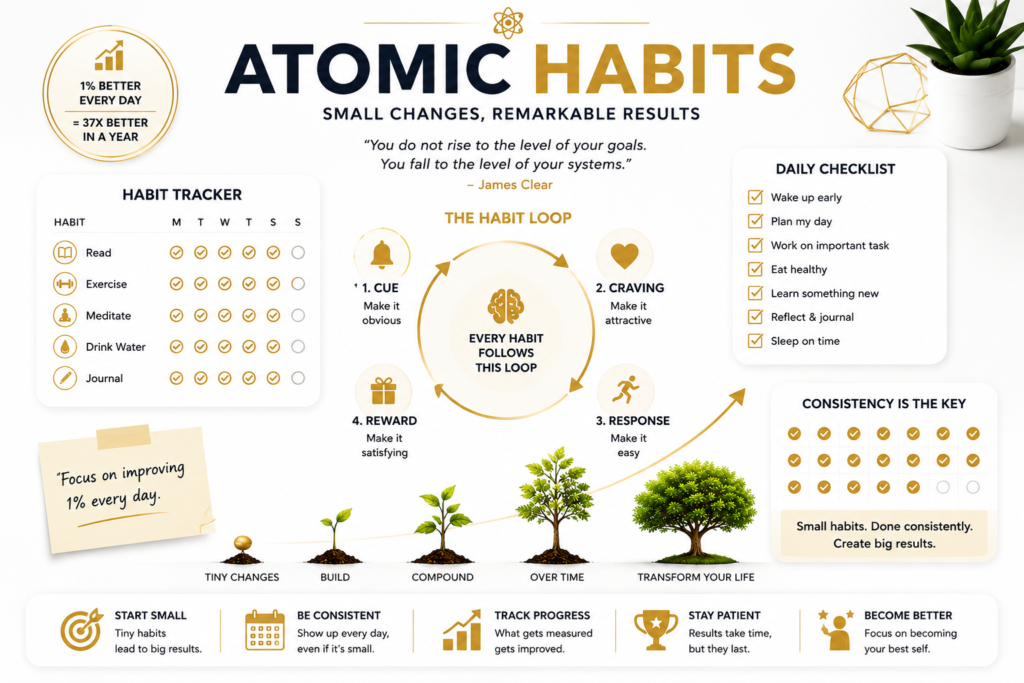
Few productivity books have had as much impact in recent years as Atomic Habits. James Clear takes a practical and science-backed approach to behavior change, showing readers that remarkable results don’t come from massive transformations overnight. Instead, they come from small improvements repeated consistently over time.
One of the book’s most powerful ideas is that goals alone rarely create lasting success. While goals provide direction, systems determine results. By focusing on the daily actions that move you forward, you can create sustainable habits that lead to long-term growth.
The book is filled with real-world examples, actionable strategies, and easy-to-understand concepts that make habit formation less intimidating and far more achievable.
Key Lessons
- Focus on systems rather than goals.
- Use habit stacking to build new routines.
- Design your environment for success.
- Small improvements compound over time.
- Identity-based habits create lasting change.
Best For
People who struggle with consistency, motivation, or maintaining positive habits over the long term.
Read Summary
Buy on Amazon
If you’re serious about building better habits and improving productivity, this is one of the best investments you can make in yourself.
2. Deep Work by Cal Newport
Why Read It?
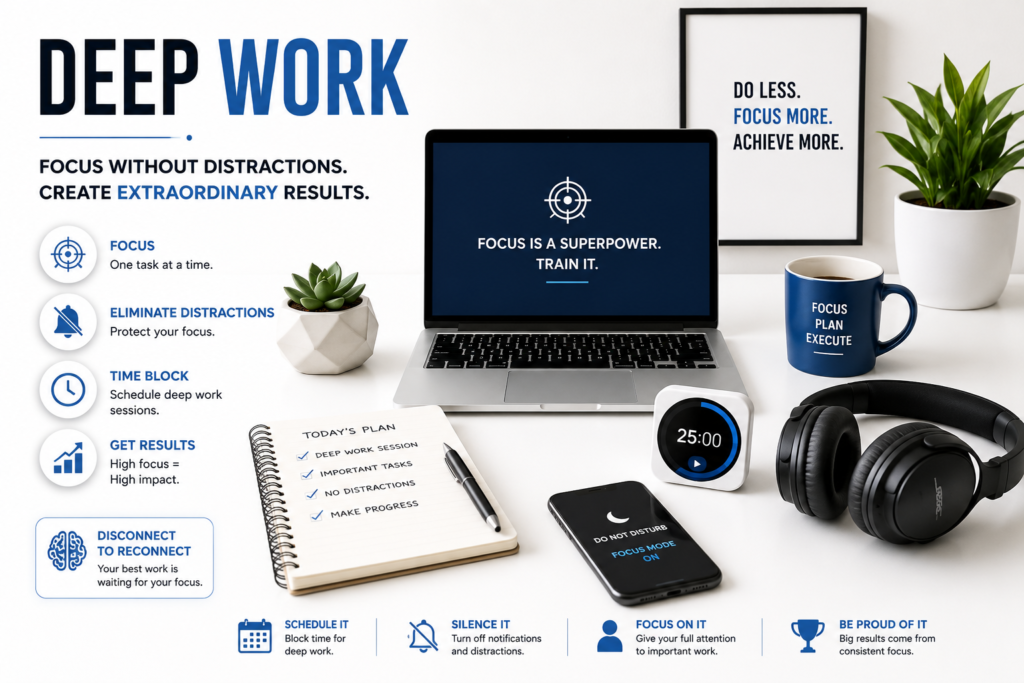
In today’s attention economy, the ability to focus deeply has become increasingly rare—and increasingly valuable. In Deep Work, Cal Newport argues that focused, distraction-free work is one of the most important skills for success in the modern world.
Newport explains how constant interruptions, social media, email notifications, and multitasking are reducing our ability to produce meaningful work. He provides practical strategies for training your brain to concentrate for longer periods and produce higher-quality results.
Unlike many productivity books that focus primarily on time management, Deep Work focuses on attention management. It teaches readers how to create an environment where deep concentration becomes possible.
Key Lessons
- Deep work creates a competitive advantage.
- Minimize distractions and context switching.
- Schedule focused work sessions intentionally.
- Protect your attention like a valuable asset.
- Shallow work should not dominate your day.
Best For
Knowledge workers, students, writers, developers, and anyone who needs uninterrupted focus to perform at their best.
Read Summary
Buy on Amazon
For anyone who feels constantly distracted, this book offers a practical roadmap to reclaiming focus and producing better work.
3. Essentialism by Greg McKeown
Why Read It?
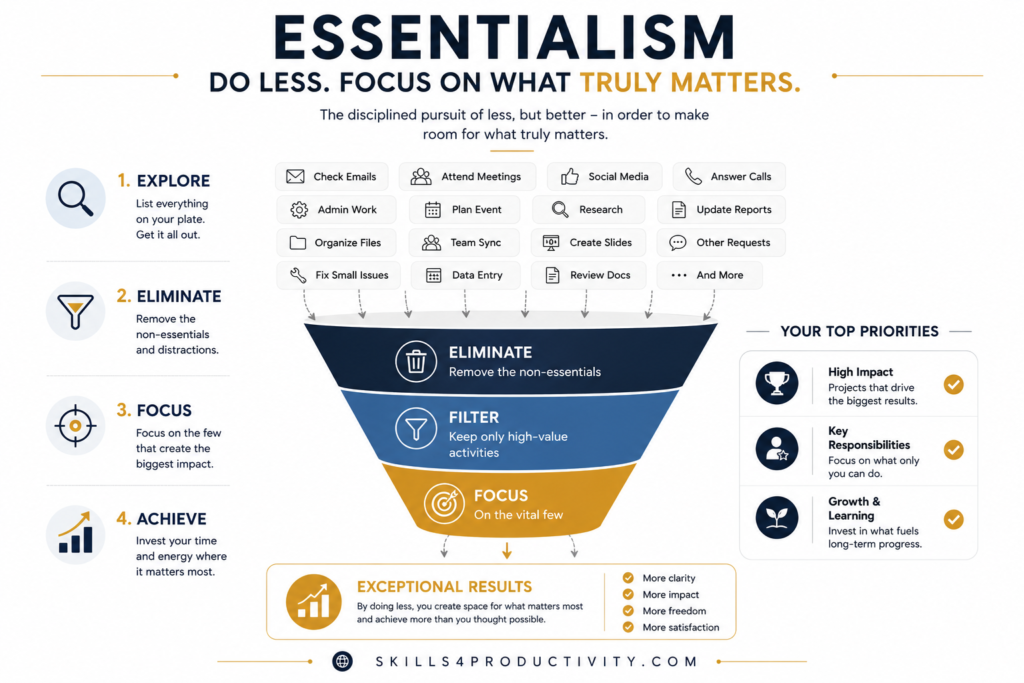
Many people believe productivity is about doing more. Greg McKeown argues the opposite. In Essentialism, he explains that true productivity comes from doing fewer things—but doing the right things exceptionally well.
The book encourages readers to identify what is truly important and eliminate everything that doesn’t contribute meaningfully to their goals. Instead of spreading your time and energy across countless commitments, Essentialism teaches you how to focus on your highest-value activities.
In a world that rewards busyness, this book serves as a reminder that effectiveness matters more than activity.
Key Lessons
- Less but better.
- Learn to say no more often.
- Focus on high-impact activities.
- Eliminate non-essential commitments.
- Create space for what matters most.
Best For
Professionals who feel overwhelmed, overcommitted, or constantly busy without making meaningful progress.
Read Summary
Buy on Amazon
This book is ideal for anyone looking to simplify their life and focus on what truly matters.
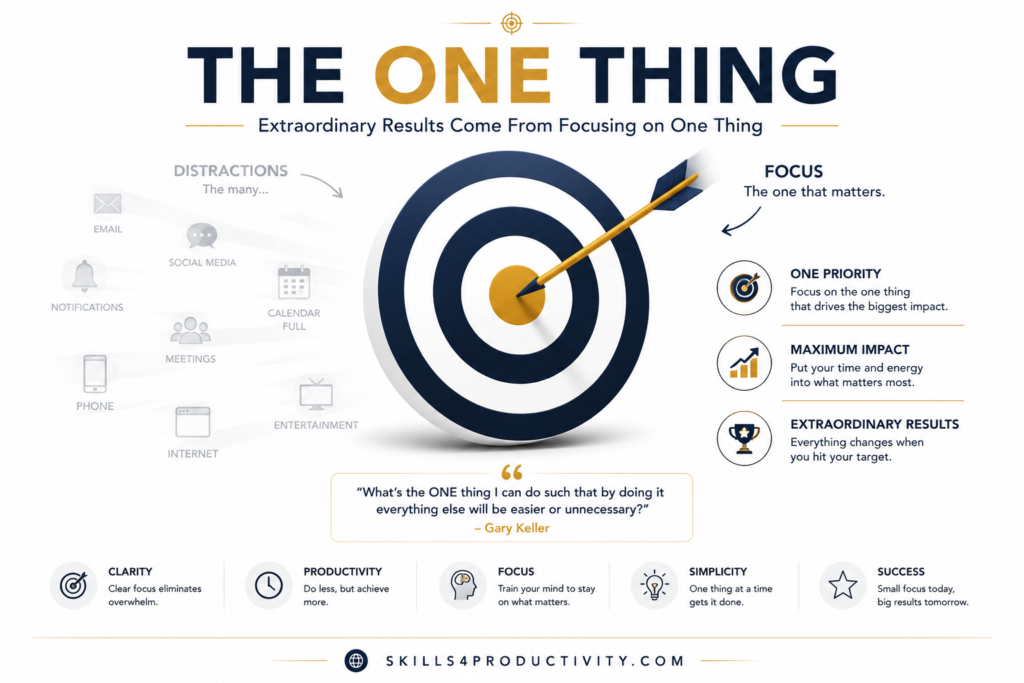
4. The One Thing by Gary Keller and Jay Papasan
Why Read It?
One of the biggest reasons people fail to achieve their goals is that they try to do too many things at once. Between work responsibilities, personal commitments, side projects, and endless distractions, it’s easy to lose focus on what truly matters.
In The One Thing, Gary Keller introduces a simple but powerful question:
“What’s the ONE thing I can do such that by doing it everything else will be easier or unnecessary?”
This question forces readers to identify their highest-priority task and focus their energy where it will create the greatest impact.
The book challenges the common belief that multitasking leads to higher productivity. Instead, it argues that extraordinary results come from concentrated effort on the most important activity.
Key Lessons
- Focus on one priority at a time.
- Success is built sequentially, not simultaneously.
- Multitasking reduces effectiveness.
- Small daily actions create extraordinary results.
- Time blocking improves productivity.
Best For
Entrepreneurs, professionals, students, and anyone feeling overwhelmed by too many priorities.
Read Summary
Buy on Amazon
If you’re constantly busy but rarely feel productive, this book can completely change how you approach work and goals.
5. Getting Things Done by David Allen
Why Read It?
For many people, productivity problems aren’t caused by laziness—they’re caused by mental clutter.
When your brain is trying to remember dozens of tasks, deadlines, meetings, and responsibilities, it becomes difficult to focus on any one thing effectively.
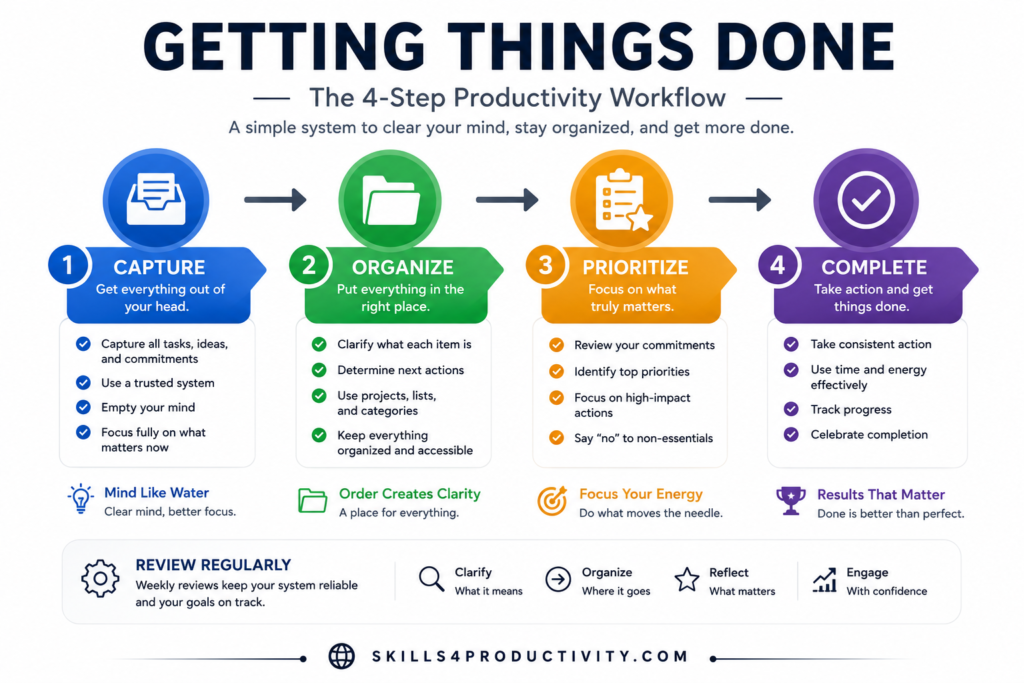
David Allen’s Getting Things Done (GTD) provides a complete productivity system designed to help you capture, organize, and execute tasks more efficiently.
The GTD methodology has become one of the most influential productivity systems in the world because it helps people move tasks out of their minds and into a trusted system.
Instead of constantly worrying about what needs to be done, you gain clarity about what action should be taken next.
Key Lessons
- Capture everything that has your attention.
- Organize tasks into actionable categories.
- Define the next physical action.
- Conduct regular reviews.
- Free your mind from unnecessary stress.
Best For
Professionals managing multiple projects, teams, deadlines, and responsibilities.
Read Summary
Buy on Amazon
This book is ideal for people who feel overwhelmed by task lists and want a proven organizational system.
6. Eat That Frog! by Brian Tracy
Why Read It?
Procrastination is one of the biggest obstacles to productivity.
Most people delay difficult, uncomfortable, or important tasks and spend their time on easier activities that provide immediate satisfaction but little long-term value.
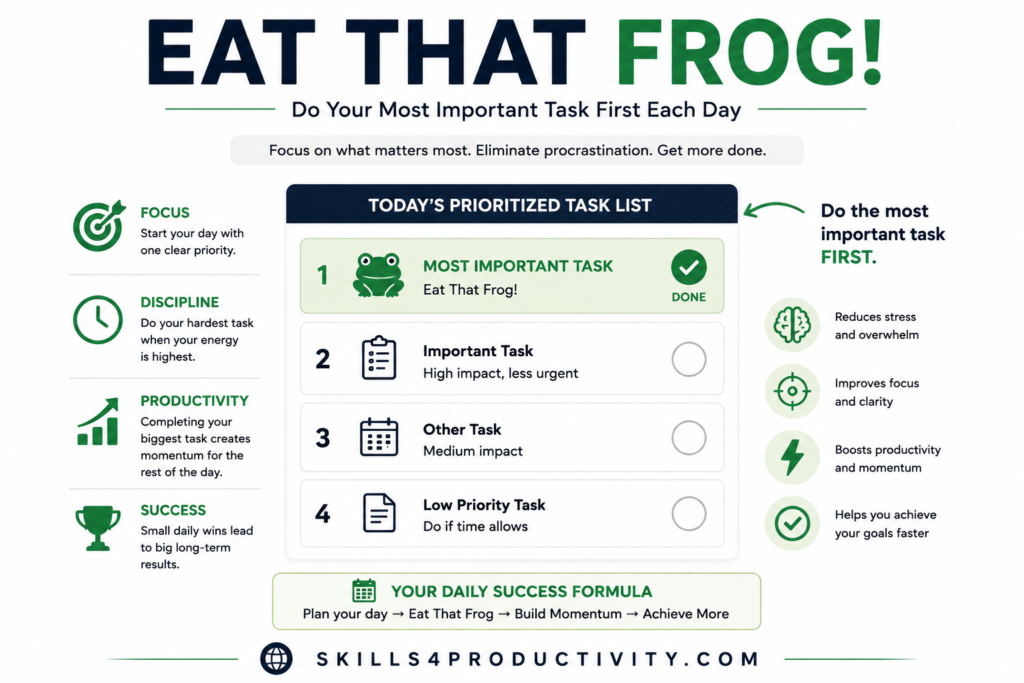
In Eat That Frog!, Brian Tracy presents a simple principle: Do your most important task first.
The title comes from the idea that if you had to eat a frog every morning, you should do it first so the hardest part of your day is already behind you.
The book provides practical strategies for prioritization, planning, and execution.
Key Lessons
- Start with your most important task.
- Apply the 80/20 Principle.
- Plan your day in advance.
- Avoid low-value activities.
- Develop a bias toward action.
Best For
People who struggle with procrastination and inconsistent execution.
Read Summary
Buy on Amazon
This is one of the easiest productivity books to implement immediately.
7. The 7 Habits of Highly Effective People by Stephen R. Covey
Why Read It?
Originally published in 1989, The 7 Habits of Highly Effective People remains one of the most influential personal development and productivity books ever written.
Rather than focusing on quick hacks or shortcuts, Covey emphasizes character, principles, and long-term effectiveness.
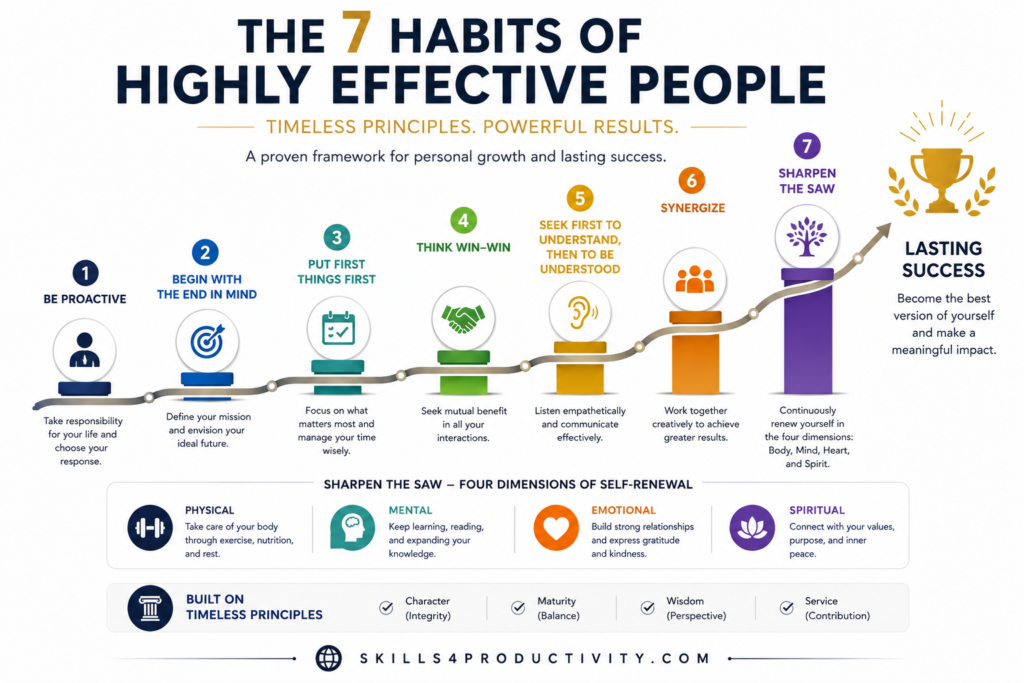
The book teaches readers how to take responsibility for their lives, prioritize what matters most, improve relationships, and create sustainable success.
Many modern productivity frameworks trace their roots back to concepts introduced in this book.
Key Lessons
- Be proactive.
- Begin with the end in mind.
- Put first things first.
- Think win-win.
- Seek first to understand.
- Synergize with others.
- Sharpen the saw through continuous improvement.
Best For
Anyone looking for a holistic approach to productivity, leadership, and personal growth.
Read Summary
Buy on Amazon
If you only read one personal effectiveness book in your lifetime, this should be on your shortlist.
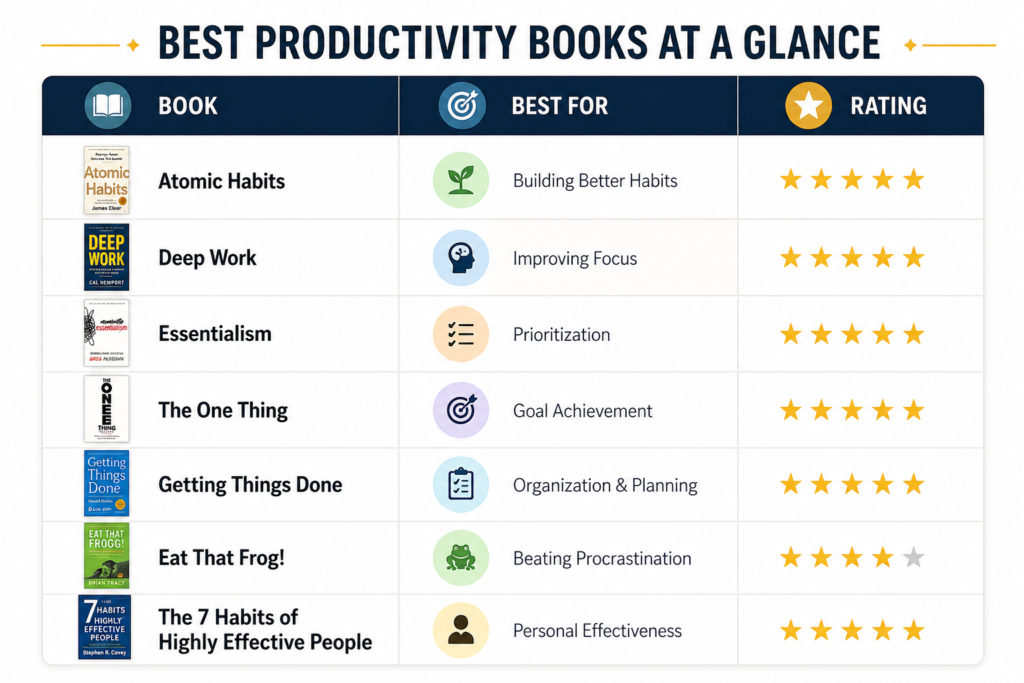
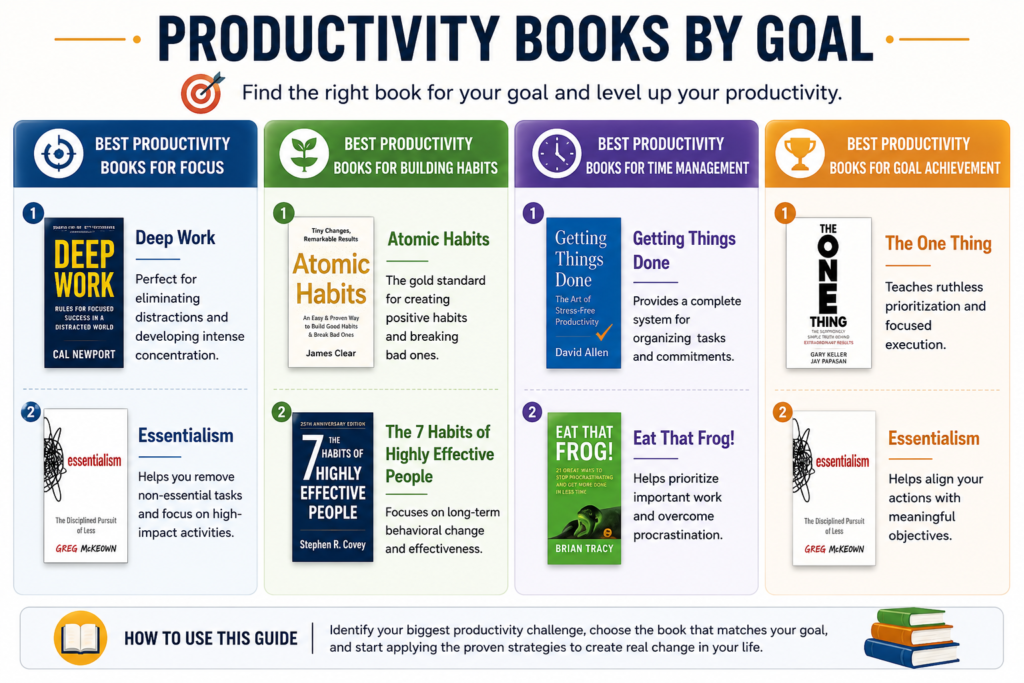
Productivity Books by Goal
Not every productivity book solves the same problem. Here’s a quick guide based on your specific goal.
Best Productivity Books for Focus
Deep Work
Perfect for eliminating distractions and developing intense concentration.
Essentialism
Helps you remove non-essential tasks and focus on high-impact activities.
Best Productivity Books for Building Habits
Atomic Habits
The gold standard for creating positive habits and breaking bad ones.
The 7 Habits of Highly Effective People
Focuses on long-term behavioral change and effectiveness.
Best Productivity Books for Time Management
Getting Things Done
Provides a complete system for organizing tasks and commitments.
Eat That Frog!
Helps prioritize important work and overcome procrastination.
Best Productivity Books for Goal Achievement
The One Thing
Teaches ruthless prioritization and focused execution.
Essentialism
Helps align your actions with meaningful objectives.
Related Book Summaries
If you’d like a deeper understanding before purchasing any of these books, check out our detailed summaries:
- Atomic Habits Summary
- Deep Work Summary
- Essentialism Summary
- The One Thing Summary
- Getting Things Done Summary
- Eat That Frog Summary
- The 7 Habits of Highly Effective People Summary
These summaries highlight the core lessons, key takeaways, and actionable insights from each book.
Where to Read These Books
Most of the books on this list are available in multiple formats, allowing you to learn in the way that suits you best.
Amazon Kindle
Kindle editions are often more affordable than physical copies and can be accessed across multiple devices.
Kindle Unlimited
If you’re an avid reader, Kindle Unlimited may provide excellent value by giving access to thousands of books through a monthly subscription.
👉 Read: Kindle Unlimited Review – Is It Worth It?
Listen to These Productivity Books on Audible
For busy professionals, entrepreneurs, and lifelong learners, reading isn’t always possible. That’s where Audible can be incredibly useful.
Many of the productivity books featured in this guide—including Atomic Habits, Deep Work, Essentialism, The One Thing, and Getting Things Done—are available as audiobooks on Audible.
With an Audible membership, you can learn while Commuting, Walking or exercising, Traveling, Doing household tasks or Taking breaks between work sessions.
Try Audible Free for 30 Days
If you’re new to Audible, you can start with a 30-day free trial and explore audiobooks risk-free.
Trial benefits include 30-Day Free Trial, Get Free Audiobooks During the Trial, Access Thousands of Audiobooks and Podcasts, Cancel Anytime
Frequently Asked Questions
What is the best productivity book of all time?
While the answer depends on your goals, Atomic Habits is often considered the best productivity book of all time because of its practical advice, scientific foundation, and broad applicability.
Which productivity book should I read first?
If you’re new to productivity books, start with Atomic Habits. It provides actionable strategies that most readers can implement immediately.
Are productivity books worth reading?
Yes. The best productivity books provide proven frameworks, systems, and mental models that can help you improve focus, manage time more effectively, and achieve meaningful goals.
What book is similar to Atomic Habits?
If you enjoyed Atomic Habits, consider reading The 7 Habits of Highly Effective People, The One Thing, or Essentialism. These books explore behavior change, personal effectiveness, and long-term success from different perspectives.
How many productivity books should I read each year?
Quality matters more than quantity. Even reading and implementing the lessons from three to five excellent productivity books each year can create significant improvements in your personal and professional life.
Final Thoughts
Productivity is not about doing more tasks, working longer hours, or staying busy all day. It’s about consistently focusing on the activities that create the greatest results.
The books on this list have helped millions of people build better habits, improve focus, manage time effectively, and achieve meaningful goals. Whether you’re trying to overcome procrastination, develop stronger routines, or maximize your potential, these books provide timeless lessons that can transform the way you work and live.
If you’re unsure where to begin, start with Atomic Habits and Deep Work. Together, they provide a powerful foundation for building habits and maintaining focus—two of the most important ingredients for long-term productivity success.
What’s Your Favorite Productivity Book?
Have you read any of the books on this list? Let us know which productivity book has had the biggest impact on your life and work.
If you’re just getting started, begin with Atomic Habits and Deep Work—two of the most influential productivity books of the modern era.
Disclosure: This article may contain affiliate links. If you purchase through these links, Skills4Productivity may earn a commission at no additional cost to you.