
If you’ve been thinking about taking an online course, chances are you’ve come across both Coursera and Udemy.
And if you’re like most people, you’re probably wondering:
Which one is actually worth my time (and money)?
I’ve personally taken courses on both platforms—some great, some average, and a few that made me question my life choices. So this isn’t a theoretical comparison. It’s based on real usage, real outcomes, and what actually matters when you’re trying to learn something useful.
If you’re trying to decide between Coursera and Udemy, you’re not just choosing a platform—you’re choosing how you learn, how fast you grow, and whether your time actually pays off.
Let’s break it down.
Quick Comparison: Coursera vs Udemy
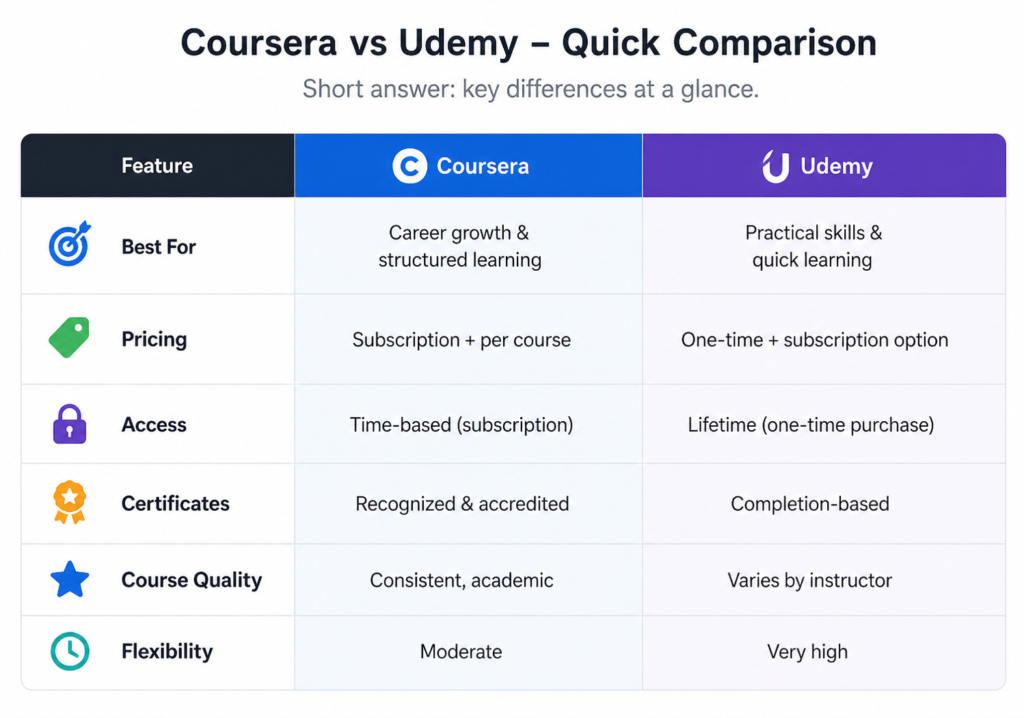
Quick Verdict
- Choose Coursera if you want career growth, structured learning, and recognized certificates
- Choose Udemy if you want fast, practical skills at a low cost
Now let’s go deeper.
What Coursera and Udemy Actually Are
Coursera: Structured, Career-Focused Learning
Coursera is built around partnerships with universities and companies like:
This matters more than it sounds.
Courses here feel like mini college programs—organized, structured, and often tied to real-world career paths.
When I took my first Coursera course, it didn’t feel like “watching videos.” It felt like enrolling in something serious.
Udemy: A Massive Skill Marketplace
Udemy is completely different.
It’s a marketplace where instructors—from industry professionals to solo creators—publish courses on almost anything.
Want to learn:
Udemy probably has 20+ options for each.
This is both its biggest strength… and its biggest weakness.
Coursera vs Udemy: By the Numbers
Numbers don’t tell the full story—but they do reveal how these platforms are built very differently.
Let’s look at the scale of both platforms:
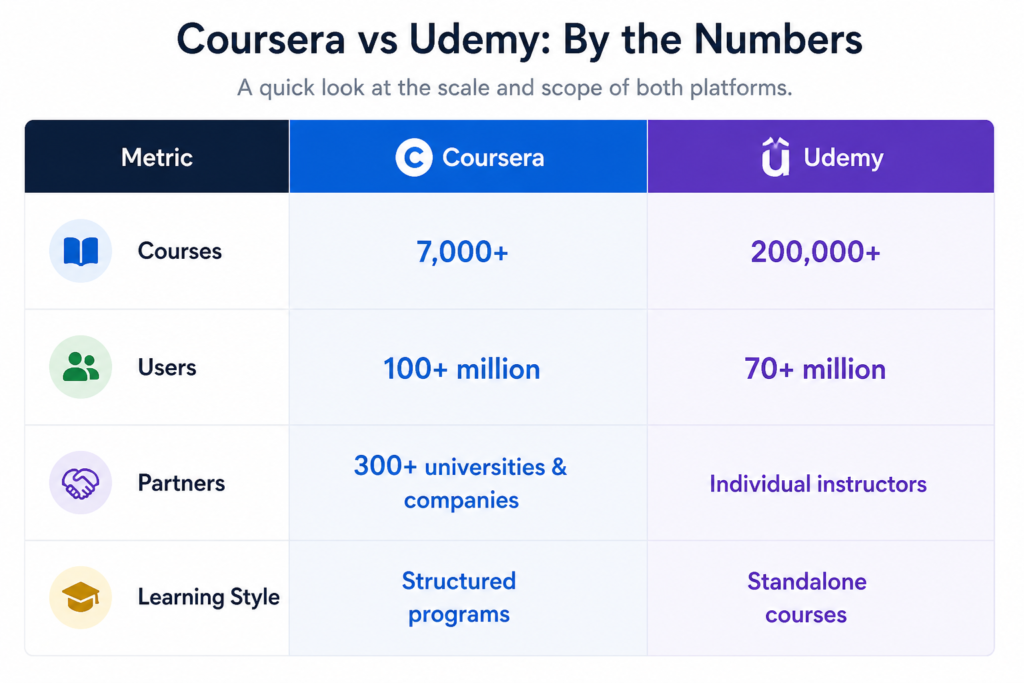
What this tells you:
- Coursera = depth + structure
- Udemy = variety + accessibility
- Udemy wins in quantity. Coursera wins in structure and credibility.
Brand Partnerships: Why It Actually Matters
This is one of the biggest differences—and most people overlook it.
Coursera
Courses are created with institutions like:
- IBM
- Stanford University
That means:
- Better curriculum design
- More credibility
- Stronger resume value
Udemy
Courses are created by:
- Independent instructors
- Industry professionals
- Content creators
That means:
- More practical insights
- Less consistency
- Hit-or-miss quality
This is why Coursera courses often feel like mini-degrees, while Udemy courses feel like targeted skill workshops.
My take: If you care about who created the course, Coursera wins easily.
Course Quality: Structured vs Practical
This is where your learning style matters.
Coursera
- Organized into modules
- Includes quizzes, assignments
- Sometimes peer-reviewed work
- Feels like a guided journey
Udemy
- Mostly video-based
- Straight to the point
- Minimal structure
- Learn at your own pace
Real insight:
Coursera teaches you why things work
Udemy teaches you how to do things quickly
Pricing: Subscription vs One-Time Payment
Coursera Pricing
- Individual courses or subscriptions
- Coursera Plus (access to many courses)
Good if you plan to learn consistently
Check out the latest pricing and offers for Coursera
Udemy Pricing
- Pay once, lifetime access
- Frequent discounts (huge ones)
Good if you want a specific skill quickly.
Most people will still use Udemy for one-time purchases—but the subscription is useful if you’re actively learning multiple skills.
Check out the latest pricing and offers for Udemy
Certificates: Do They Actually Matter?
Let’s be honest—this is why many people compare these platforms.
Coursera Certificates
- Recognized by employers
- Often tied to real programs
- Adds weight to your resume
Udemy Certificates
- Proof of completion
- Not widely recognized professionally
Simple truth:
If your goal is career advancement → Coursera
If your goal is learning a skill → Udemy
If your goal is to impress an employer, Coursera has a clear advantage.
Learning Experience: Discipline vs Flexibility
Coursera
- Deadlines (sometimes flexible)
- Assignments
- Structured progress
Udemy
- Fully self-paced
- No pressure
- No deadlines
This is important:
- If you need structure → Coursera
- If you prefer freedom → Udemy
Best Use Cases (This Will Help You Decide Fast)
Choose Coursera if:
- You want career growth
- You value structured learning
- You want recognized certificates
Choose Udemy if:
- You want to learn a specific skill fast
- You’re on a budget
- You prefer flexible learning
My Experience Using Both Platforms
Here’s the honest part.
When I used Coursera, I felt like I was investing in my future. The courses required focus, consistency, and effort—but they paid off in terms of understanding.
With Udemy, the experience was more casual—but incredibly useful. I could pick a course, learn something specific, and apply it immediately.
One mistake I made early on was choosing Udemy courses purely based on price. I later realized instructor quality matters far more than discounts.
If I had to summarize:
- Coursera = long-term growth
- Udemy = immediate results
And honestly, I still use both depending on what I need.
Best Courses on Each Platform
On Coursera
On Udemy
Final Verdict: Which One Should You Choose?
Here’s the honest answer:
Choose Coursera if you want structured, career-focused learning
Choose Udemy if you want fast, practical skill-building
If you’re investing in your career, go with Coursera.
If you’re solving a problem quickly, go with Udemy.
There’s no universal “better” platform.
It depends on what you need right now.
FAQ
Is Coursera better than Udemy?
It depends. Coursera is better for structured, career-oriented learning. Udemy is better for quick skill acquisition.
Are Udemy certificates worth it?
They’re useful for personal learning but not highly valued professionally.
Is Coursera free?
Some courses are free to audit, but certificates usually require payment.
Which is better for beginners?
Udemy is often easier for beginners due to its simplicity and flexibility.
Disclosure: This article may contain affiliate links. If you purchase through these links, Skills4Productivity may earn a commission at no additional cost to you.