
Artificial intelligence is no longer just a trend discussed by tech companies and software engineers. It has quietly become part of everyday work, learning, communication, research, and content creation.
Whether you are writing emails, managing projects, brainstorming ideas, creating marketing campaigns, or improving productivity, AI tools are changing how people work.
The challenge is not access to AI anymore. The real challenge is learning how to use it effectively.
That is why Google’s AI courses on Udemy are getting attention. Instead of overwhelming learners with technical jargon or coding-heavy lessons, these courses focus on practical applications of AI for real-world use.
I recently explored Google’s AI course collection on Udemy, and what stood out most was how approachable and useful the courses feel for beginners, professionals, creators, marketers, and students.
In this guide, I’ll walk you through the best Google AI courses on Udemy, what each course teaches, who it’s best for, and which ones are worth starting with first.
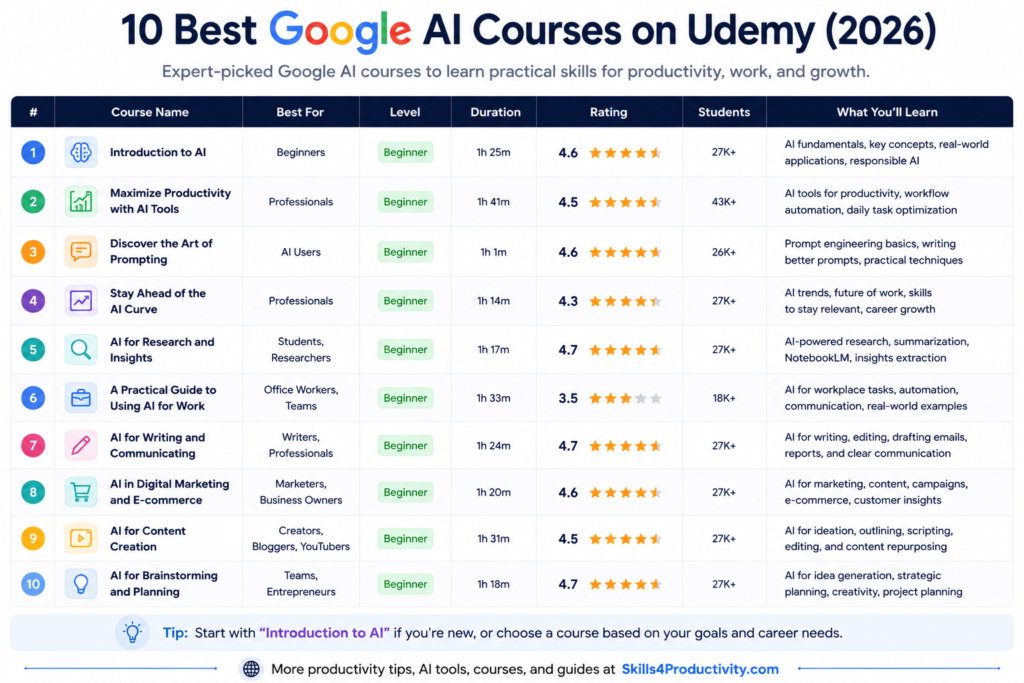
Why Google AI Courses on Udemy Are Worth Exploring
There are thousands of AI courses online today, but many of them fall into one of two categories:
- Too technical for beginners
- Too generic to provide real value
Google’s AI courses strike a better balance.
Most of the courses are:
- Beginner-friendly
- Short and practical
- Focused on real-world productivity
- Designed around modern AI workflows
- Useful even if you have zero technical background
Another advantage is that these courses focus on practical AI tools like Google Gemini and NotebookLM rather than abstract theory.
That makes them especially useful for:
- Professionals
- Students
- Creators
- Marketers
- Freelancers
- Entrepreneurs
- Productivity enthusiasts
If your goal is to actually use AI in daily work, these courses are a solid starting point.
1. Introduction to AI
Best for: Complete beginners
If you are new to artificial intelligence, this is the course to start with.
“Introduction to AI” explains the fundamentals in a simple and approachable way without making the subject feel intimidating. Instead of diving deep into coding or machine learning math, the course focuses on understanding how AI works and where it can be applied.
You’ll learn:
- What artificial intelligence actually means
- How modern AI tools work
- Common AI applications
- Responsible AI usage
- Real-world productivity use cases
One thing I liked about this course is that it removes a lot of the confusion beginners usually have around AI.
Many people hear terms like machine learning, generative AI, neural networks, or large language models and immediately feel lost. This course simplifies those ideas and focuses on practical understanding.
If you are building an AI learning roadmap, this should be your foundation before moving into prompting, productivity, or AI marketing courses.
2. Maximize Productivity with AI Tools
Best for: Professionals and productivity-focused users
This course fits perfectly for anyone interested in productivity systems and workflow improvement.
Instead of discussing AI in theory, “Maximize Productivity with AI Tools” focuses on how AI can help you save time, reduce repetitive work, and improve daily efficiency.
The course explores:
- AI-assisted workflows
- Task management with AI
- Productivity automation
- Using Gemini for workplace tasks
- AI-powered organization systems
This is one of the most practical courses in Google’s AI collection because the lessons immediately translate into real work scenarios.
If you spend hours every week writing repetitive emails, organizing information, summarizing notes, or planning projects, this course shows how AI can simplify those tasks.
For readers of Skills4Productivity.com, this course is especially relevant because it combines productivity principles with modern AI tools.
3. Discover the Art of Prompting
Best for: Learning prompt engineering
Prompting is quickly becoming one of the most valuable AI skills.
No matter which AI tool you use — ChatGPT, Gemini, Claude, or Copilot — the quality of your results often depends on the quality of your prompts.
That’s where this course becomes valuable.
“Discover the Art of Prompting” teaches how to communicate effectively with AI systems so you can generate better outputs consistently.
You’ll learn:
- Prompt engineering basics
- Prompt structures
- How to improve AI responses
- Writing clear instructions
- Practical prompting techniques
One of the biggest misconceptions about AI is that you simply type random questions and expect amazing results.
In reality, effective prompting is a skill.
The better your prompts, the better your:
- AI-generated writing
- Research
- brainstorming
- productivity workflows
- marketing outputs
- content ideas
This course is particularly useful for creators, writers, marketers, students, and professionals who plan to use AI regularly.
4. Stay Ahead of the AI Curve
Best for: Future-focused professionals
AI is changing industries faster than most people expected.
Many professionals are now asking:
- Which jobs will AI affect?
- What skills should I learn?
- How do I stay competitive?
- How can AI improve my career?
“Stay Ahead of the AI Curve” focuses on those bigger-picture questions.
Instead of teaching individual tools only, the course explores:
- AI trends
- Workplace transformation
- Future AI opportunities
- Adapting to AI-driven work environments
- Long-term AI thinking
What makes this course interesting is that it encourages strategic thinking rather than fear.
A lot of online discussions about AI focus heavily on panic or hype. This course feels more balanced and practical.
It helps learners think about how AI can become a useful advantage rather than something to avoid.
5. AI for Research and Insights
Best for: Students, researchers, and knowledge workers
Research is one of the strongest use cases for AI today.
Whether you are a student, writer, analyst, or creator, AI can dramatically improve how you collect, organize, summarize, and understand information.
This course focuses on:
- AI-powered research workflows
- Information organization
- Summarization techniques
- Knowledge management
- Using NotebookLM effectively
One thing I appreciated about this course is that it emphasizes practical research productivity rather than generic AI demonstrations.
If you regularly deal with:
- PDFs
- articles
- reports
- notes
- academic research
- long-form content
this course can save you significant time.
For students especially, learning how to use AI responsibly for research may become an essential academic skill over the next few years.
6. A Practical Guide to Using AI for Work
Best for: Office professionals and teams
This course is designed for people who want to integrate AI into everyday professional work.
The lessons focus on practical implementation instead of technical theory.
You’ll learn:
- How AI can improve workplace productivity
- Ways to automate repetitive tasks
- AI-assisted communication
- Workflow optimization
- Daily professional applications of AI
What makes this course valuable is its simplicity.
Many professionals know AI is important but don’t know where to begin. This course bridges that gap by focusing on realistic workplace examples.
If you work in:
- business
- administration
- project management
- operations
- communication
- remote work
you’ll likely find immediate use cases from this course.
7. AI for Writing and Communicating
Best for: Writers and communication-heavy roles
Communication remains one of the most important professional skills, even in the AI era.
This course explores how AI can support:
- writing
- editing
- drafting
- professional communication
- workplace messaging
The course covers:
- AI-assisted writing workflows
- Improving communication clarity
- Faster drafting
- Editing and rewriting
- AI support for emails and reports
One thing worth mentioning is that this course doesn’t position AI as a replacement for human communication.
Instead, it treats AI as a support tool that helps people communicate more efficiently.
That’s an important distinction.
Good communication still requires human judgment, empathy, clarity, and context. AI simply helps speed up parts of the process.
8. AI in Digital Marketing and E-commerce
Best for: Marketers and online business owners
AI is transforming digital marketing rapidly.
From content generation and customer research to campaign optimization and automation, marketers are using AI tools in almost every area of modern marketing.
This course focuses on:
- AI-powered marketing workflows
- E-commerce applications
- Marketing productivity
- AI-assisted campaigns
- Content optimization
For bloggers, affiliate marketers, creators, and online entrepreneurs, this course is particularly useful because it connects AI directly to business growth.
If you manage:
- websites
- online stores
- email campaigns
- social media
- SEO content
- digital ads
you’ll likely discover practical ways to use AI more effectively.
9. AI for Content Creation
Best for: Bloggers, YouTubers, and creators
Content creation has become one of the biggest AI use cases.
Creators are now using AI tools for:
- brainstorming
- outlining
- scripting
- editing
- summarizing
- content repurposing
This course focuses on how AI can improve creative workflows while helping creators produce content faster.
You’ll learn:
- AI-assisted content systems
- Creative workflows
- Faster publishing processes
- Content ideation
- Productivity techniques for creators
What I liked about this course is that it doesn’t encourage lazy content creation.
Instead, it focuses more on improving workflow efficiency while keeping creativity involved.
That balance matters.
The best creators are not replacing creativity with AI. They are using AI to remove friction from the process.
10. AI for Brainstorming and Planning
Best for: Entrepreneurs, teams, and planners
This course focuses on one of the most underrated AI skills: thinking with AI.
Most people use AI only for writing or answering questions. But AI can also become a powerful brainstorming and planning partner.
This course explores:
- Idea generation
- Strategic brainstorming
- Project planning
- Creative thinking
- AI-assisted organization
I found this course especially interesting because brainstorming is often where AI feels most collaborative.
Used correctly, AI can help:
- expand ideas
- organize thoughts
- generate alternatives
- refine plans
- improve creativity
For entrepreneurs, creators, and project managers, this can be incredibly useful.
Which Google AI Course Should You Start With?
If you feel overwhelmed by the number of options, here’s a simple recommendation path.
If You’re a Beginner
Start with:
- Introduction to AI
- Discover the Art of Prompting
- Maximize Productivity with AI Tools
If You’re a Professional
Start with:
- A Practical Guide to Using AI for Work
- AI for Writing and Communicating
- Stay Ahead of the AI Curve
If You’re a Creator or Blogger
Start with:
- AI for Content Creation
- AI for Brainstorming and Planning
- AI in Digital Marketing and E-commerce
If You’re a Student or Researcher
Start with:
- AI for Research and Insights
- Introduction to AI
- Discover the Art of Prompting
Final Thoughts
AI tools are evolving quickly, but practical AI education is still surprisingly rare.
That’s why Google’s AI courses on Udemy stand out.
They avoid unnecessary complexity and focus instead on real-world applications that people can actually use in daily work and life.
Whether your goal is:
- improving productivity
- learning prompt engineering
- creating content faster
- researching efficiently
- preparing for future work
- integrating AI into your career
these courses provide a practical starting point.
The best part is that you don’t need a technical background to begin.
You simply need curiosity, consistency, and a willingness to experiment with modern AI tools.
And in today’s world, that may already be a competitive advantage.
FAQ
Are Google AI courses on Udemy beginner friendly?
Yes, most courses are designed for beginners and working professionals.
Do these courses include certificates?
Yes, most courses include certificates of completion.
Which Google AI course is best for productivity?
Maximize Productivity with AI Tools is one of the best productivity-focused courses.
Which course is best for prompt engineering?
Discover the Art of Prompting is the best prompt engineering course in this collection.
Are these courses worth it?
Yes, especially for professionals who want practical AI skills quickly.
Disclosure: This article may contain affiliate links. If you purchase through these links, Skills4Productivity may earn a commission at no additional cost to you.