
Learning well is not a talent reserved for a few. It is a skill anyone can improve.
Introduction: Most People Don’t Need More Effort — They Need Better Learning Strategies
Most of us were taught what to learn. Very few of us were taught how to learn.
So when studying feels hard, we often assume the solution is simple:
- Spend more hours.
- Push harder.
- Read the material again.
- Take more notes.
But effective learning doesn’t usually come from brute force. It comes from using methods that work with your brain, not against it.
That was one of the biggest insights I took from exploring cognitive science research—and from taking Barbara Oakley’s Learning How to Learn course, which helped popularize several of the ideas in this article.
The encouraging part?
Learning is not fixed. It is trainable.
And once you improve how you learn, almost every other skill gets easier to build.
The goal isn’t to study more. It’s to learn smarter.
In this guide, we’ll cover 7 science-backed strategies that can help you learn better, remember more, and improve how you study, think, and grow.
Quick Takeaways
- Learning improves with retrieval, not rereading
- Chunking helps real understanding
- Rest is part of learning
- Small systems beat motivation
1. Use Focused and Diffuse Thinking Together
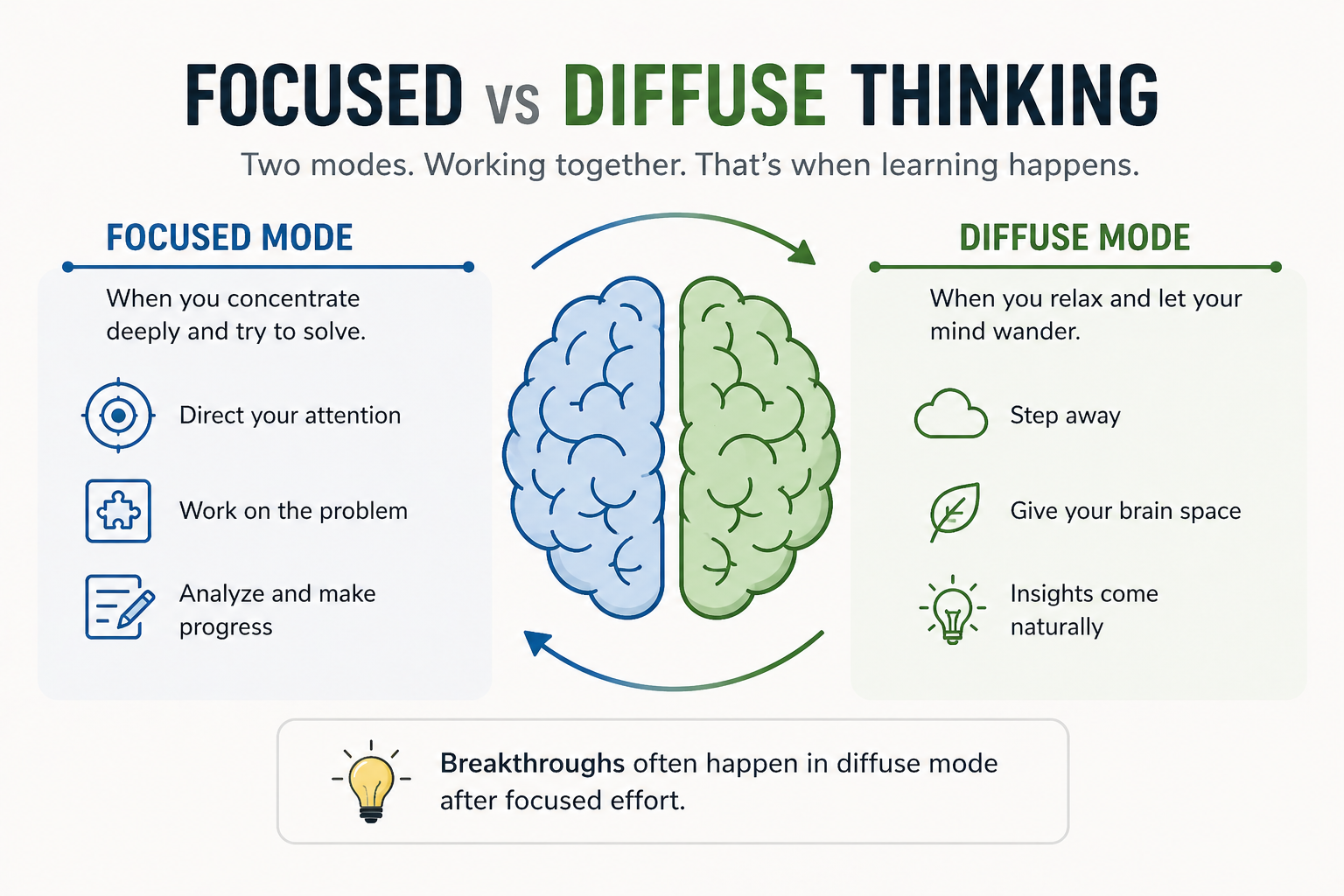
One of the most fascinating ideas in learning science is that deep understanding often comes from moving between two modes of thinking.
Focused Mode
This is deliberate concentration.
It’s the mental mode you use when:
- Solving a difficult problem
- Studying a concept step-by-step
- Learning a technical skill
- Working through something unfamiliar
It feels effortful. Structured. Intentional.
Diffuse Mode
Diffuse mode is different.
It’s what happens when your mind relaxes and starts making broader connections.
This often shows up:
- During a walk
- While showering
- During rest
- After stepping away from a problem
Ever struggle with something for hours… and suddenly see the answer later?
That’s not random. That’s often diffuse thinking at work.
Sometimes stepping away is part of solving.
How to use both modes
Try this simple rhythm: Work deeply → Step away → Return fresh
For example:
- Focus for 30 minutes
- Take a short break
- Walk or rest
- Revisit the problem
This is one reason the Pomodoro method can be so effective.
2. Use Chunking to Build Real Understanding
Memorization alone is fragile.
Understanding lasts.
And one powerful way understanding develops is through chunking.
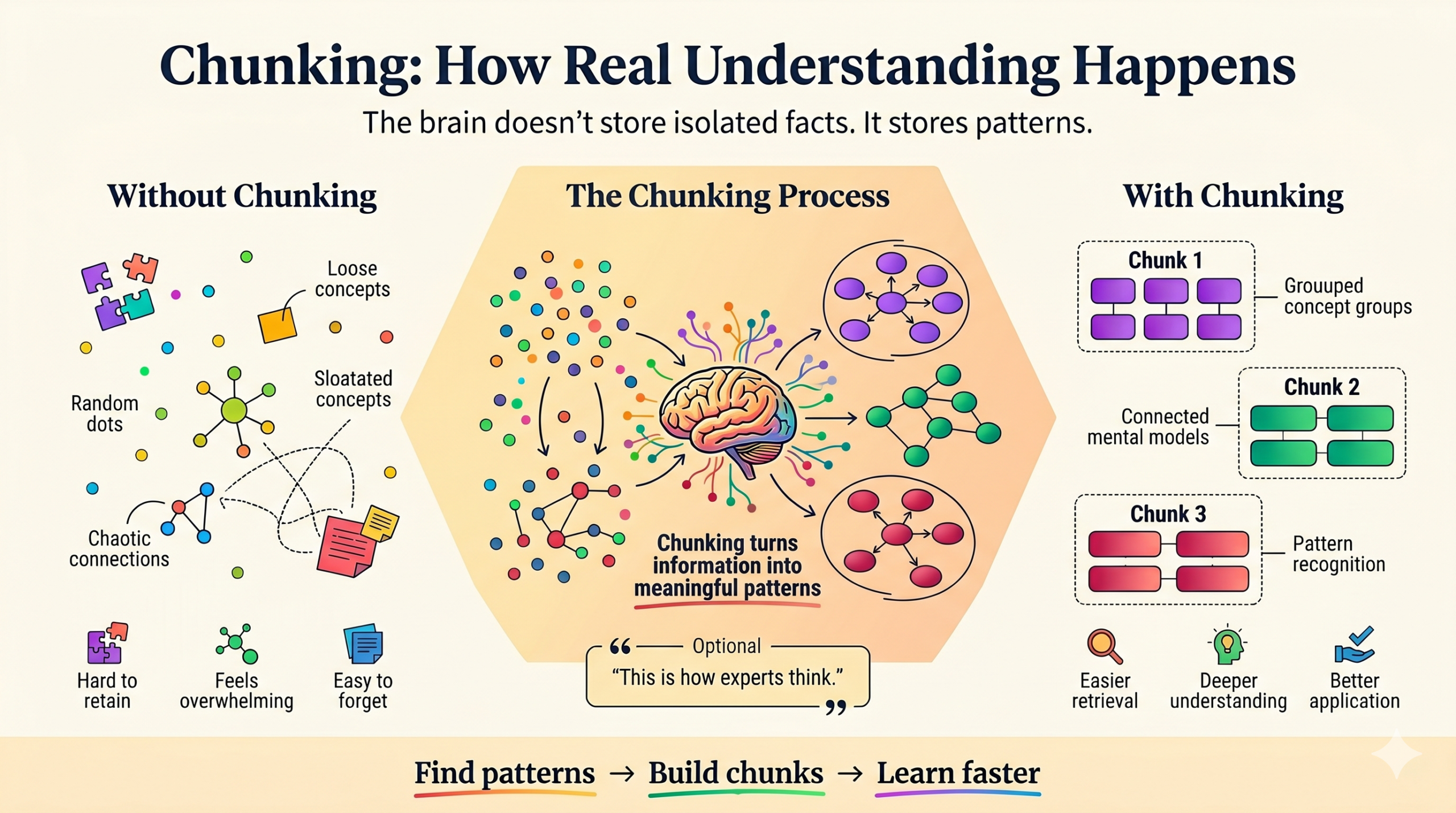
Chunking is the process of grouping information into meaningful patterns.
That’s how experts think.
A beginner may see scattered facts. An expert sees structure.
Patterns. Relationships. Mental models.
That’s chunking.
A simple example
Think of a phone number. It’s easier to remember: 123-456-7890
than: 1234567890
Same information. Different structure.
That’s the power of chunking.
How to build chunks
Understand before memorizing – Don’t rush to repeat information. Understand what it means.
Practice retrieval – Chunks strengthen through use.
Connect ideas – Ask:
- What does this relate to?
- What bigger pattern does this fit into?
- How can I explain this simply?
When information becomes interconnected, it becomes easier to retain.
Experts often don’t know more facts. They organize facts better.
3. Practice Active Recall Instead of Passive Review
One of the most common study habits is also one of the weakest: Rereading.
It feels productive. Often it isn’t.
A stronger strategy is active recall.
Instead of repeatedly putting information in, you pull information out.
That retrieval strengthens memory.
Examples of active recall
- Self-quizzing
- Flashcards
- Teaching the idea aloud
- Closing notes and recalling key points from memory
Simple. Powerful. Evidence-backed.
Try this instead of rereading
After reading a chapter, ask:
- What were the main ideas?
- Can I explain them without looking?
- What do I remember poorly?
That process builds memory.
Recognition can feel like learning.
Recall often is learning.
Testing yourself is not just measuring learning. It strengthens learning.
4. Use Spaced Repetition to Remember More
Cramming can help you remember something tomorrow.
Spaced repetition can help you remember it months later.
Huge difference.
The principle is simple: Review material over increasing intervals.
Example:
- Day 1
- Day 3
- Day 7
- Day 14
- Day 30
This combats the forgetting curve.
Why it works
Every successful retrieval reinforces memory.
Spacing also introduces a little struggle.
And that struggle often strengthens retention.
Psychologists sometimes call this desirable difficulty.
Harder in the short term. Better in the long term.
Helpful tools
- Anki
- Quizlet
- A simple review calendar
If you remember only one study upgrade from this article—make it active recall + spaced repetition.
That combination is powerful.
5. Beat Procrastination With Process, Not Motivation
Most people think procrastination is laziness.
Often it’s discomfort.
A difficult task feels unpleasant. So we avoid starting.
That’s human.
The solution is often simpler than we think: Lower the barrier to begin.
Use tiny starts
Instead of: “I need to study all afternoon.”
Try: “I’ll do one 25-minute focus block.”
Much easier.
Starting creates momentum.
And momentum often creates motivation.
Use the Pomodoro Method
25 minutes focused work. 5-minute break. Repeat.
Simple. Effective.
Small rule I love:
Make starting absurdly easy.
Read one page. Write one paragraph. Solve one problem.
Just begin.
Action often creates motivation more often than motivation creates action.
6. Interleave What You Learn
Most people practice in blocks.
One topic. Then more of the same.
This is called blocked practice.
A more effective approach can be interleaving.
Mix related topics.
Instead of: 20 problems of one type
Try mixing:
- Problem type A
- Problem type B
- Problem type C
It feels harder. That’s often why it works.
It helps you learn when to apply ideas, not just how.
That builds flexibility. And real understanding.
This strategy is especially useful for:
- Math
- Language learning
- Skill development
- Exam preparation
Often what feels harder during practice works better during performance.
7. Treat Rest as Part of Learning
This may be the most underrated strategy on this list.
Rest is not the opposite of learning.
It supports learning.
Sleep helps:
- Consolidate memory
- Strengthen patterns
- Improve problem-solving
- Support creative insight
That’s why “sleeping on a problem” sometimes works.
Your brain may still be processing.
Use recovery strategically
After studying:
- Walk
- Sleep well
- Take breaks
- Let ideas incubate
Sometimes another hour of grinding adds less than good recovery.
That’s a hard lesson high achievers often learn late.
A Simple Learning System You Can Start This Week
If all of this feels like a lot, start here:
Daily
- One focused study block
- Use active recall
- Review yesterday’s material
Weekly
- Spaced repetition review
- Interleave topics
- Reflect on what you’re learning
Simple systems beat complicated intentions.
Quick Summary: 7 Ways to Learn Better
Here are the strategies again:
- Use focused and diffuse thinking
- Build understanding through chunking
- Practice active recall
- Use spaced repetition
- Beat procrastination with process
- Interleave what you learn
- Use rest as part of learning
Even adopting two or three can transform how you learn.
Why Learning May Be the Ultimate Meta-Skill
Some skills improve one area of life.
Learning improves almost all of them.
Career growth. Creativity. Adaptability. Confidence. Problem solving.
That’s why I increasingly think: Learning is the ultimate meta-skill.
Learn better, and many other things compound.
Want to go deeper?
Many of the ideas in this article are explored beautifully in the Learning How to Learn course review and summary. It remains one of the most practical courses I’ve taken on improving how we think and learn.
Explore the course
Further reading:
Final Thoughts
Most people try to improve learning by increasing effort.
Often the bigger upgrade is improving method.
That’s good news.
Methods can be learned.
Start with one strategy from this list. Practice it this week. Build from there.
Because learning well compounds.
And those returns can last a lifetime.
Frequently Asked Questions
What is the best way to learn better?
Some of the most effective methods include active recall, spaced repetition, chunking, and focused practice.
How can I learn faster and remember more?
Use retrieval practice, spaced review, and connect ideas into meaningful patterns instead of relying on passive rereading.
What is chunking in learning?
Chunking is grouping information into patterns that make it easier to understand and recall.
How can I stop procrastinating while studying?
Use small starts, Pomodoro sessions, and focus on process rather than overwhelming outcomes.
Related Articles
- Focused vs Diffuse Thinking Explained
- What Is Chunking in Learning?
- How to Stop Procrastinating While Studying
- Learning How to Learn Course Summary
Disclosure: This article may contain affiliate links. If you purchase through these links, Skills4Productivity may earn a commission at no additional cost to you.