
It’s 10 AM. You’ve been at your desk for almost an hour, and the important task you planned to finish hasn’t even been started.
You’ve checked your email twice, rearranged your desk, and decided you need another coffee. The strange part? You know exactly what needs to be done.
That’s what makes procrastination so frustrating. It’s rarely about having too much work. Often, the hardest part is simply getting started.
The good news: you don’t need to become a productivity machine. A few small, practical changes are usually enough. Here are 5 strategies you can try today.
Try This Right Now: The 5-Minute Start
Pick one task you’ve been avoiding.
Write down the smallest action you can take,
set a timer for five minutes, and begin.
For example:
Instead of “Finish my report,” try
“Open the document and write three bullet points.”
Remember: Your goal isn’t to
finish everything. It’s to make starting easier.
Quick Check: What’s Really Stopping You?
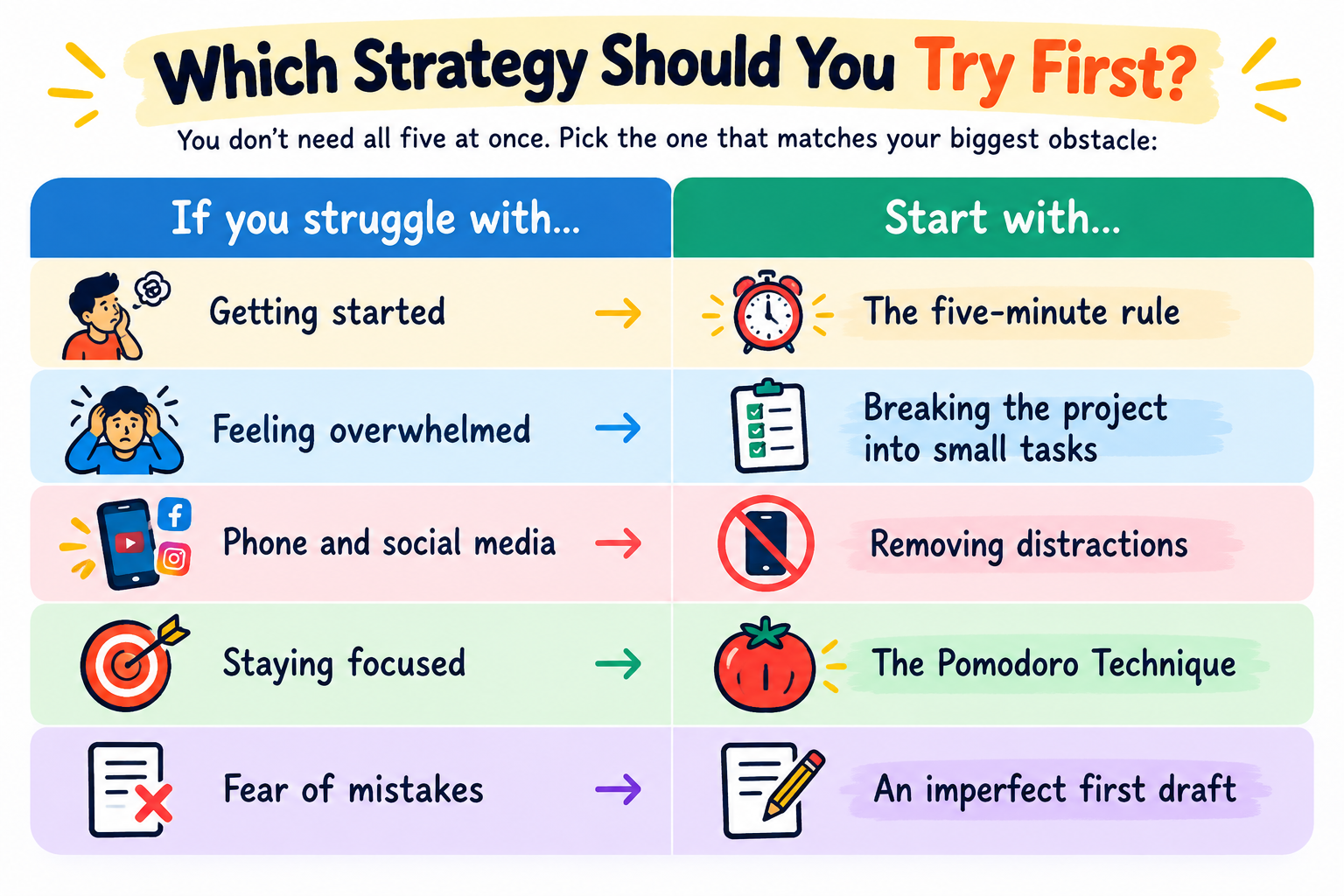
Before you pick a strategy, spend ten seconds on this. Which sentence sounds most like you right now?
- “I just can’t get myself to sit down and begin.” Go to Strategy 1.
- “This task is huge and I don’t know where to start.” Go to Strategy 2.
- “I keep getting pulled away by my phone or tabs.” Go to Strategy 3.
- “I can’t focus for long stretches.” Go to Strategy 4.
- “I want it to be perfect first.” Go to Strategy 5.
Why Do We Procrastinate? (It’s Not Laziness)
Here’s something that changes how most people think about this. Procrastination is rarely about time management. It’s about emotion. We put off tasks that feel boring, confusing, stressful or scary, because avoiding them gives us instant relief.
The most common triggers are:
- Overwhelm: the task feels too big.
- Perfectionism: you’re waiting for the perfect moment or mood.
- Fear of failure: you’re worried the result won’t be good enough.
- Unclear next step: you honestly don’t know what to do first.
- Distraction: your phone is simply more rewarding than your work.
There’s also a well-known idea in psychology called the Zeigarnik effect: unfinished tasks tend to stick in our minds, and starting one makes us more likely to want to finish it. That’s exactly why the first strategy works so well.
1. Try the Five-Minute Rule
Tell yourself you’ll work on the task for just five minutes. That’s it. You’re allowed to stop afterwards.
- Pick one task you’ve been avoiding.
- Set a timer for five minutes.
- Work without distractions.
- When the timer ends, decide whether to keep going.
Instead of “I need to finish this whole report today,” try “I’ll just write the first paragraph.” The goal isn’t to finish. The goal is to get past the resistance that kept you from starting. Most of the time, you’ll keep going, because beginning is the hard part.
Try it now (60 seconds): Name the one task you’ve been avoiding this week. Say it out loud or write it down. Then set a five-minute timer.
2. Break Big Projects Into Small Tasks
“Write a 2,000-word article” sounds exhausting. “Write five bullet points for the introduction” sounds easy.
Same project, very different feeling.
So don’t put “Study for the exam” on your to-do list. Write this instead:
- Review chapter one
- Make flashcards for key concepts
- Complete ten practice questions
- Revise one difficult topic
Now you have a clear starting point, and every finished step shows real progress.
Rule of thumb: split your next big project into pieces that take 15 to 30 minutes. If one still feels heavy, split it again.
3. Remove Distractions Before You Start
You sit down to work, your phone lights up, and 20 minutes later you’re watching a video has nothing to do with anything.
That’s usually not a discipline problem. Your environment just makes distraction too easy.
Before your next work session:
- Silence nonessential notifications
- Put your phone in another room, or at least out of reach
- Close unrelated browser tabs
- Use a website blocker if you need one
Quick challenge: Write down the three things that distract you most, and reduce or remove each one for the next hour.
A quick note: if distractions and focus are your biggest struggle, there’s a book of 100 short tips on motivation, time management and beating procrastination.
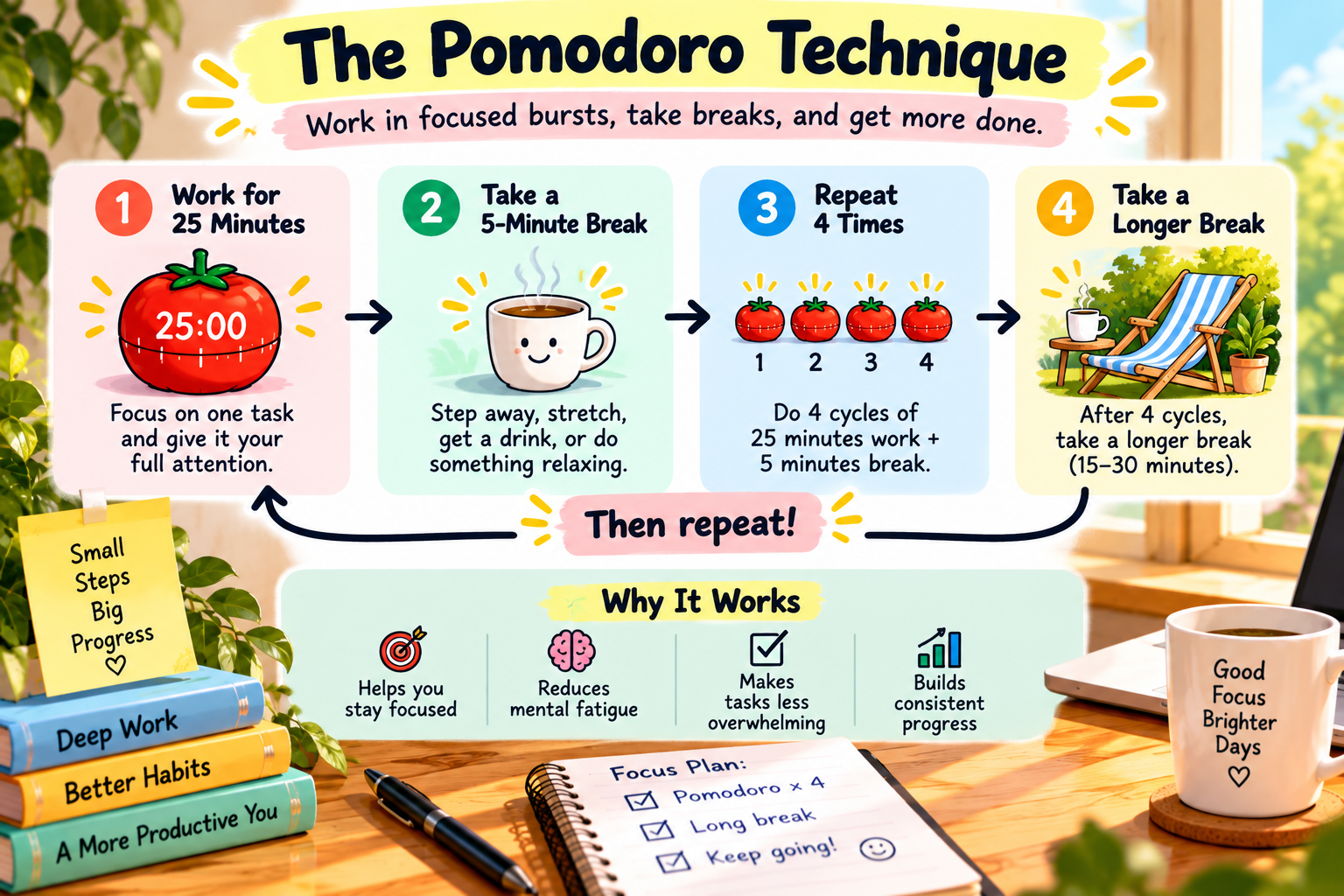
4. Use the Pomodoro Technique
The thought of working for hours can make you avoid a task completely. The Pomodoro Technique shrinks that thought to 25 minutes.
- Choose one task.
- Set a timer for 25 minutes and work without interruptions.
- Take a five-minute break.
- Repeat. After four rounds, take a longer break.
You don’t have to think about the whole project, only the next 25 minutes. If you do deep work like writing or programming, longer sessions of 45 to 90 minutes may suit you better, so experiment.
5. Give Yourself Permission to Be Imperfect
Perfectionism disguises itself as high standards. You plan, research and polish everything in your head, but the work never begins.
Your first attempt doesn’t have to be your final version. You can edit a rough draft. You can improve a messy presentation. You can’t improve something that was never started.
Next time perfectionism slows you down, do this on purpose: create a bad first version. Make it ugly. Then improve it.
Want More Than 5 Ideas?
These five strategies are a solid start, but procrastination looks different for everyone. Sometimes the fix is simply a strategy you haven’t tried yet.
If you’d like more to experiment with, Stop Procrastinating Now: 100 Powerful Tips is a digital ebook covering productivity, motivation, time management and overcoming procrastination.
Best for: people who like short, quick-to-apply tips instead of long theory.
📘 ADDITIONAL PRODUCTIVITY RESOURCE
Stop Procrastinating Now: 100 Powerful Tips
Explore a digital ebook featuring 100 practical tips on productivity, motivation, time management and overcoming procrastination.
This ebook is an additional resource for readers who want more procrastination strategies.We haven’t independently reviewed the complete book, so I recommend checking the seller’s description, sample information and purchase terms before deciding.
Frequently Asked Questions
What’s the fastest way to stop procrastinating?
Make the task smaller and commit to five minutes. Remove distractions and decide on one clear first step before you begin.
Is procrastination the same as laziness?
No. Procrastination means delaying something you intend to do, often because of stress, perfectionism or uncertainty. If it’s seriously affecting your work, studies or daily life, consider talking to a qualified mental health professional.
How long does it take to stop procrastinating?
There’s no fixed timeline. Many people notice a difference within a week of using one small strategy consistently. Habits take longer to build, so keep it small and repeatable.
Can I use more than one strategy at the same time?
Yes, but start with one. The Five-Minute Rule and the Pomodoro Technique combine especially well.
Final Thoughts
You don’t need to wake up at 5 AM or reinvent yourself. Sometimes one small action is enough to break the cycle.
So here’s your challenge: pick one strategy from this post and use it today. Don’t wait for the perfect moment , because it isn’t coming.
And if you’d like 95 more ideas to experiment with, you can take a look at the ebook here.
Affiliate disclosure: This article contains an affiliate link. Skills4Productivity may earn a commission from qualifying purchases, at no additional cost to you.