
Artificial Intelligence has moved far beyond being just a tech trend.
In 2026, AI models are becoming everyday work partners for writers, marketers, developers, students, founders, and creators. After spending months testing different AI platforms for research, writing, productivity, brainstorming, and automation, one thing became very clear: Most people are focusing on AI tools.
But the real power lies in understanding the AI models behind those tools.
Because once you know which model is best at what, you stop wasting time jumping between random apps and start building smarter workflows.
Some AI models are excellent for deep thinking. Others are better for research, coding, creativity, or real-time information.
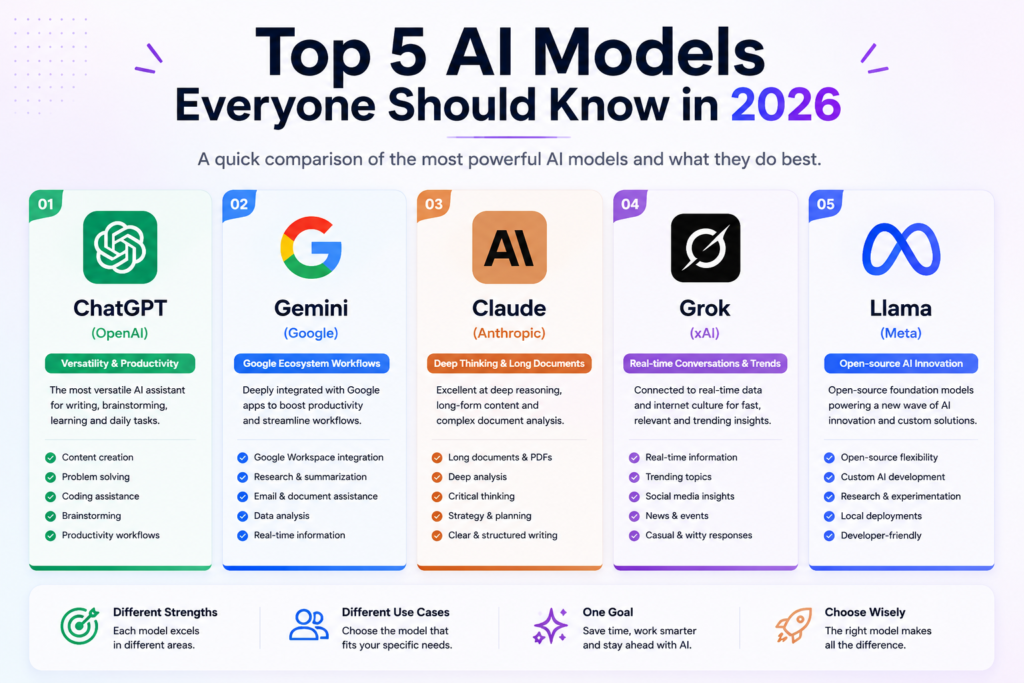
Here are the 5 AI models that genuinely stand out in 2026 — based on practical use, strengths, and real-world productivity.
1. OpenAI ChatGPT — The Most Complete AI Experience
If I could keep only one AI model for daily work, it would probably be ChatGPT.
What makes ChatGPT different is not just its intelligence — it is the flexibility. Over time, it has evolved from a simple chatbot into a complete productivity ecosystem.
I’ve personally used it for:
- Writing blog articles
- Brainstorming business ideas
- Planning marketing campaigns
- Creating social media content
- Learning new topics
- Improving workflows
- Basic coding and automation tasks
The biggest advantage of ChatGPT is how naturally it adapts to different kinds of work. One moment it feels like a writing assistant, the next moment like a research partner or productivity coach.
Another major strength is the ecosystem around it. Features like custom GPTs, memory, multimodal support, and integrations make it incredibly versatile for both beginners and advanced users.
Where ChatGPT Performs Best
- Content writing
- Productivity workflows
- Brainstorming
- Learning and research
- General-purpose assistance
Best For
- Content creators
- Students
- Marketers
- Freelancers
- Entrepreneurs
ChatGPT is currently the closest thing to an “all-in-one AI assistant.”
Official website: ChatGPT
Helpful ChatGPT Courses and Reviews:
- ChatGPT Masterclass: ChatGPT Guide for Beginners to Experts
- Prompt Engineering for ChatGPT
- ChatGPT for Business & Marketing Content
2. Google Gemini — The Productivity Powerhouse Inside Google
Gemini feels less like a standalone AI tool and more like an AI layer built directly into your daily workflow.
What impressed me most while using Gemini was how deeply integrated it is with the Google ecosystem. If your work already revolves around Gmail, Docs, Sheets, Drive, and Search, Gemini becomes extremely convenient.
I found it especially useful for:
- Summarizing emails
- Organizing research
- Drafting documents
- Pulling information from Google tools
- Quick productivity tasks
Google also has a strong advantage in search and information retrieval, which makes Gemini very practical for research-oriented work.
While ChatGPT often feels more conversational and creative, Gemini feels highly workflow-focused.
Where Gemini Performs Best
- Google Workspace integration
- Research assistance
- Everyday productivity
- Search-related tasks
Best For
- Professionals using Google Workspace
- Students
- Teams
- Researchers
For people deeply connected to Google products, Gemini can save an enormous amount of time.
Official website: Google Gemini
Helpful Google Gemini Courses and Reviews:
- Introduction to Google Workspace with Gemini
- Gemini for Data Scientists and Analysts
- Google Gemini Masterclass: A Complete Gemini AI Zero to Hero
3. Anthropic Claude — The Best AI for Deep Thinking
Claude surprised me the most.
The first time I used it for analyzing a long document, I immediately noticed the difference in how structured and thoughtful the responses felt.
Claude is excellent at maintaining context across lengthy conversations. Instead of giving shallow answers, it often responds in a calm, organized, and analytical way.
I’ve personally found Claude extremely valuable for:
- Long-form writing
- Reading PDFs and reports
- Strategy discussions
- Deep analysis
- Breaking down complex ideas
One area where Claude stands out is clarity. It tends to produce cleaner and more structured outputs compared to many AI systems.
It feels less like a “quick-answer machine” and more like a thoughtful research assistant.
Where Claude Performs Best
- Long-document analysis
- Research
- Strategic thinking
- Detailed writing
Best For
- Analysts
- Researchers
- Writers
- Consultants
- Professionals handling large amounts of information
If your work involves deep focus and complex thinking, Claude is incredibly powerful.
Official website: Claude AI
Helpful Claude Courses and Reviews:
- AI Fundamentals with Claude Course Review
- Real-World AI for Everyone Specialization
- The Complete Claude Code & Claude Cowork Masterclass [2026]
4. xAI Grok — The Real-Time Internet AI
Grok feels fundamentally different from most AI models because it is heavily connected to live internet culture and real-time conversations.
While testing Grok, I noticed it performs especially well when discussing:
- Trending topics
- Breaking news
- Social media conversations
- Real-time events
Its connection with X (formerly Twitter) gives it an advantage in fast-moving discussions.
Another interesting aspect is its tone. Grok often feels more casual, direct, and socially aware compared to more formal AI systems.
This makes it useful for creators, trend watchers, and people who want live context instead of static information.
Where Grok Performs Best
- Real-time information
- Social trends
- News monitoring
- Internet culture discussions
Best For
- Content creators
- Journalists
- Social media professionals
- Trend researchers
Grok is less about polished productivity and more about staying connected to what is happening right now.
Official website: xAI Grok
Helpful Grok Courses and Reviews:
- Grok Comprehensive Guide: From Basics to Advanced Features
- Unlocking Grok: AI for Business and Marketing
- Grok AI Mastery | Long & Short AI Video Creation with Grok
5. Meta Llama — The Open-Source AI Revolution
Llama is one of the most important AI models in the industry — even though many everyday users may not realize it.
Developed by Meta, Llama helped push open-source AI into the mainstream and gave developers around the world access to powerful foundation models.
What makes Llama different is flexibility.
Unlike closed AI systems that mainly operate through official apps or subscriptions, Llama models are widely used by developers, startups, researchers, and companies to build custom AI applications.
While testing Llama-powered tools, I noticed that many newer AI platforms and assistants are quietly built on top of the Llama ecosystem.
It has become one of the foundations of modern open AI development.
Where Llama Performs Best
- Open-source AI development
- Custom AI applications
- Research and experimentation
- Local AI deployments
- Developer-focused workflows
Best For
- Developers
- AI startups
- Researchers
- Technical teams
- Businesses building custom AI systems
Llama represents something bigger than just another chatbot.
It represents the growing shift toward open and accessible AI innovation.
Official website: Meta AI and Llama
Helpful Llama Courses and Reviews:
Final Thoughts
After testing multiple AI models across different workflows, one thing became obvious: No single AI model is perfect for everything.
Each one has its own strengths, personality, and ideal use cases.
A simple way to think about them:
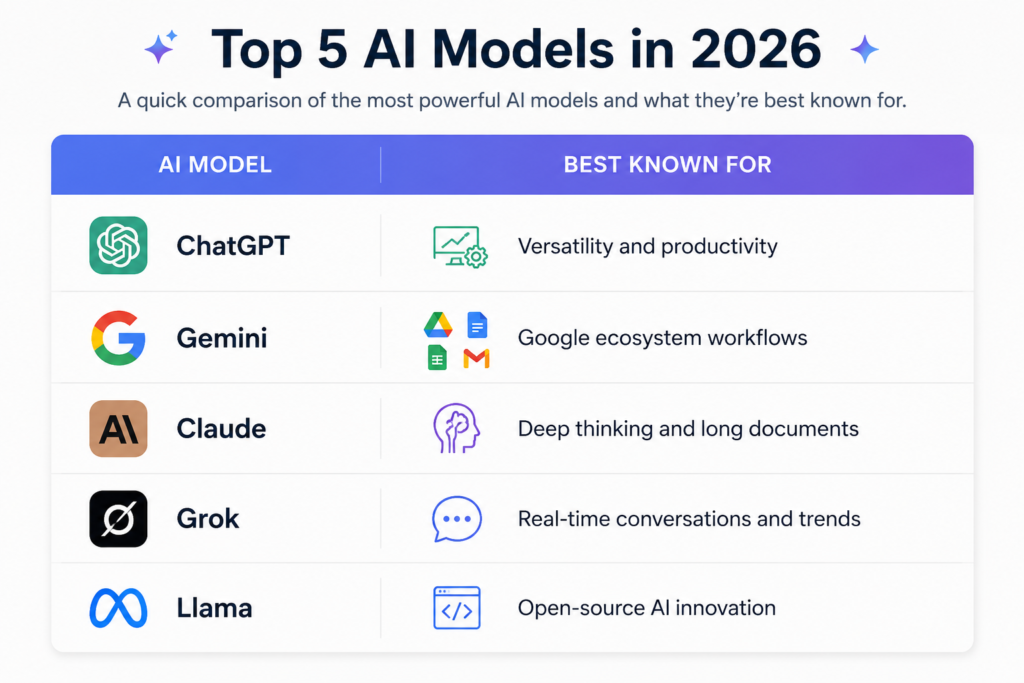
The biggest mistake people make with AI is constantly chasing new tools.
The smarter approach is understanding the major AI models and learning where each one fits best in your workflow.
Because productivity is not about using more AI.
It is about using the right AI for the right task.
Frequently Asked Questions
Which AI model is best overall in 2026?
ChatGPT is considered one of the best all-round AI models for productivity, writing, research, brainstorming, and everyday workflows.
Is ChatGPT better than Gemini?
ChatGPT is stronger for creativity and flexible conversations, while Gemini works especially well inside the Google ecosystem.
Which AI model is best for research and long documents?
Claude is one of the best AI models for deep research, PDFs, summaries, and long-form analysis.
Which AI model is best for real-time information?
Grok is best for real-time trends, news, and live internet conversations.
What makes Llama different from other AI models?
Llama is known for open-source AI innovation and is widely used by developers to build custom AI applications.
Are AI models and AI tools the same?
No. AI models are the core technologies, while AI tools are applications built using those models.
Which AI model is best for productivity?
ChatGPT and Gemini are among the best AI models for productivity and daily workflows.
Will AI replace human jobs completely?
AI is more likely to assist human work and improve productivity rather than completely replace people.
Disclosure: This article may contain affiliate links. If you purchase through these links, Skills4Productivity may earn a commission at no additional cost to you.