
If you’ve recently started exploring AI, chances are you’ve run into a familiar problem.
You open an article hoping to understand one simple thing—how modern AI actually works—and within minutes you’re hit with terms like LLMs, RAG, AI agents, vector databases, context windows, and MCP.
At first, everything sounds important.
But after reading for a while, it starts feeling like everyone is speaking a language you somehow missed learning.
The interesting thing is that these concepts are not as complicated as they sound. The problem is usually the explanation.
Instead of thinking about AI as a collection of technical systems, think about it as a human body.
Suddenly, things become much easier to understand.
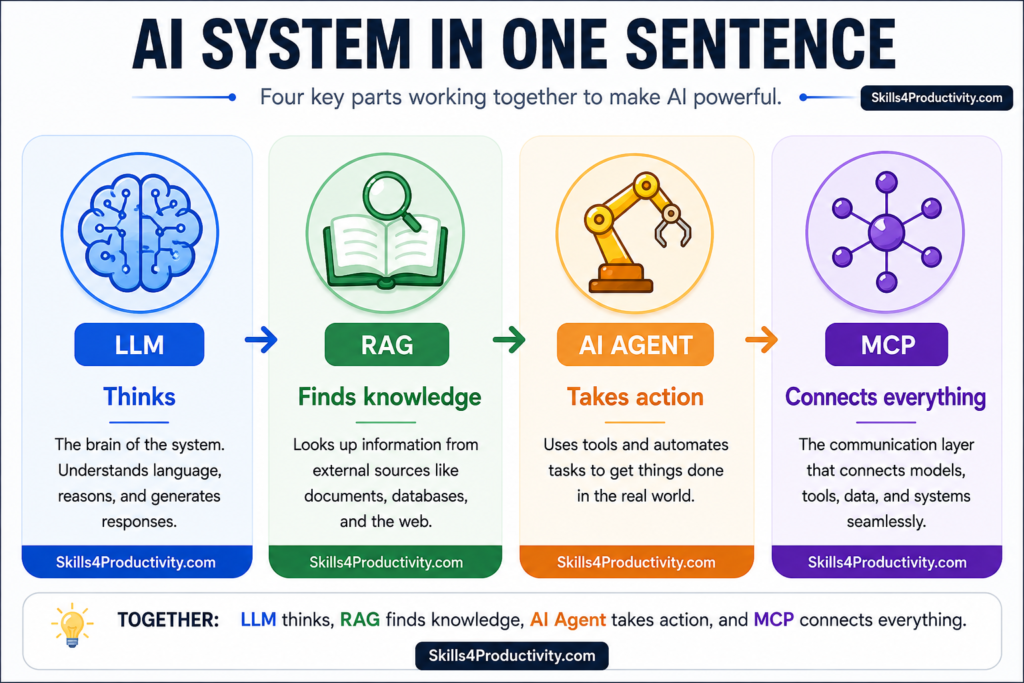
How AI Actually Evolves
Think of AI systems as layers.
First, AI learns how to think.
Then it learns how to access information.
Then it learns how to act.
Finally, everything becomes connected.
Let’s start with the most obvious part: the brain.
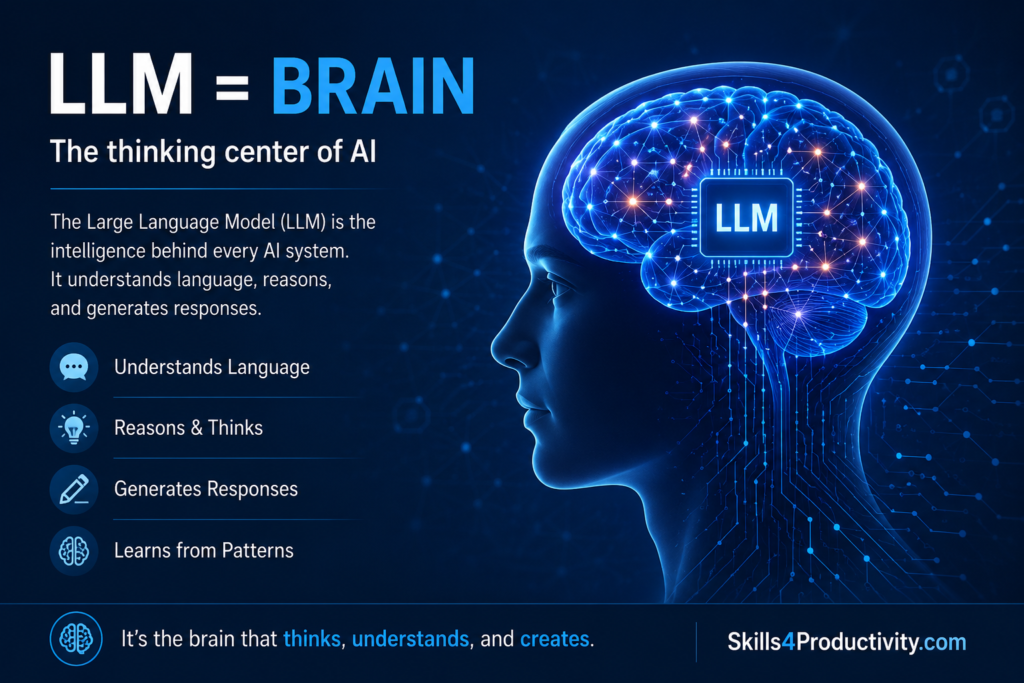
LLM: The Brain Behind Everything
Imagine meeting someone who has spent years reading books, watching videos, learning patterns, understanding language, and absorbing information.
You ask them a question, and within seconds they form an answer.
That’s essentially what a Large Language Model, or LLM, does.
The LLM is the thinking layer of an AI system. It processes language, understands context, and generates responses.
When you ask ChatGPT something like: “Give me ideas for improving productivity while working from home.“
The model begins connecting patterns and ideas it has learned before. It predicts what information makes the most sense and creates a response.
From a user’s perspective, it feels almost like talking to another person.
But even the smartest people in the world have limitations.
You might remember ideas from a book you read years ago, but you probably won’t remember every page word for word. You also won’t instantly know the latest information published online five minutes ago.
LLMs have a similar challenge.
They’re intelligent, but intelligence alone doesn’t automatically mean access to current or specialized knowledge.
And that’s where the next piece enters the picture.
You may also like: ChatGPT Masterclass for Productivity
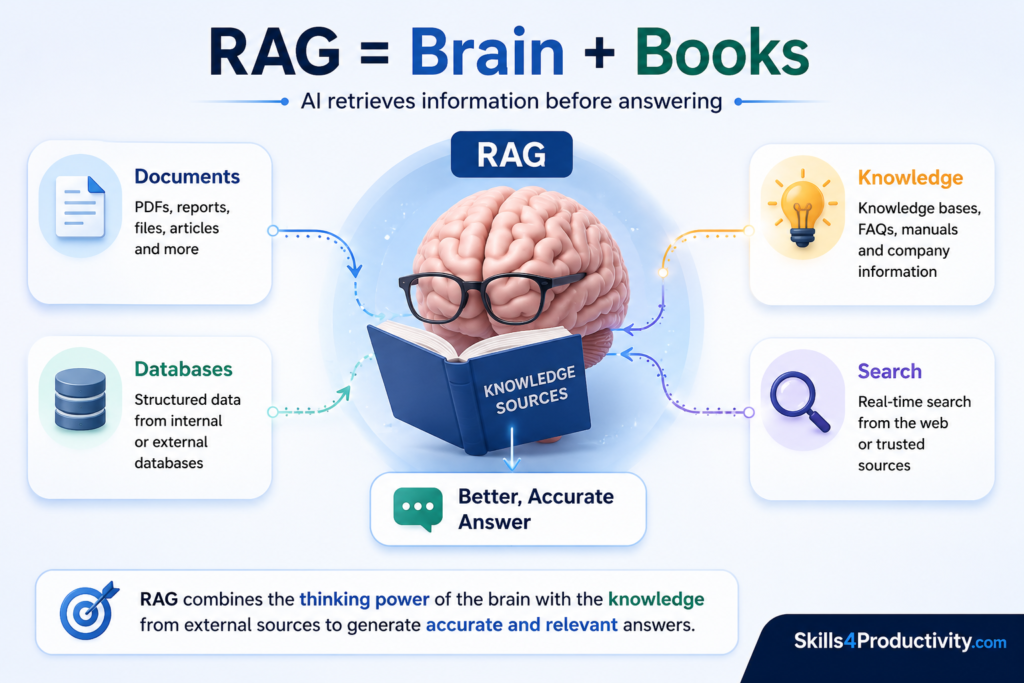
RAG: Giving the Brain Access to Knowledge
Imagine asking someone a difficult question.
Instead of trying to answer immediately, they walk over to a bookshelf, pull out a few books, read the relevant pages, and then return with a much stronger answer.
That feels normal because it’s how people work.
We don’t rely entirely on memory. We look things up.
RAG works in exactly the same way.
RAG stands for Retrieval-Augmented Generation, but the complicated name isn’t important. The simple idea behind it is this: AI first retrieves information and then creates an answer.
Suppose you ask an AI assistant: “What is our company’s leave policy?”
Without access to your company’s information, the AI may try to fill gaps or make assumptions.
With RAG, the system first searches the relevant documents, reads the information it needs, and then responds based on actual data.
The difference can be huge.
Instead of depending only on what the AI already knows, it gains access to information that is specific, current, and relevant.
Think of it as giving the brain access to books whenever it needs them.
So far, we have a brain that can think and access information. But intelligence alone doesn’t create value. Eventually something has to take action.
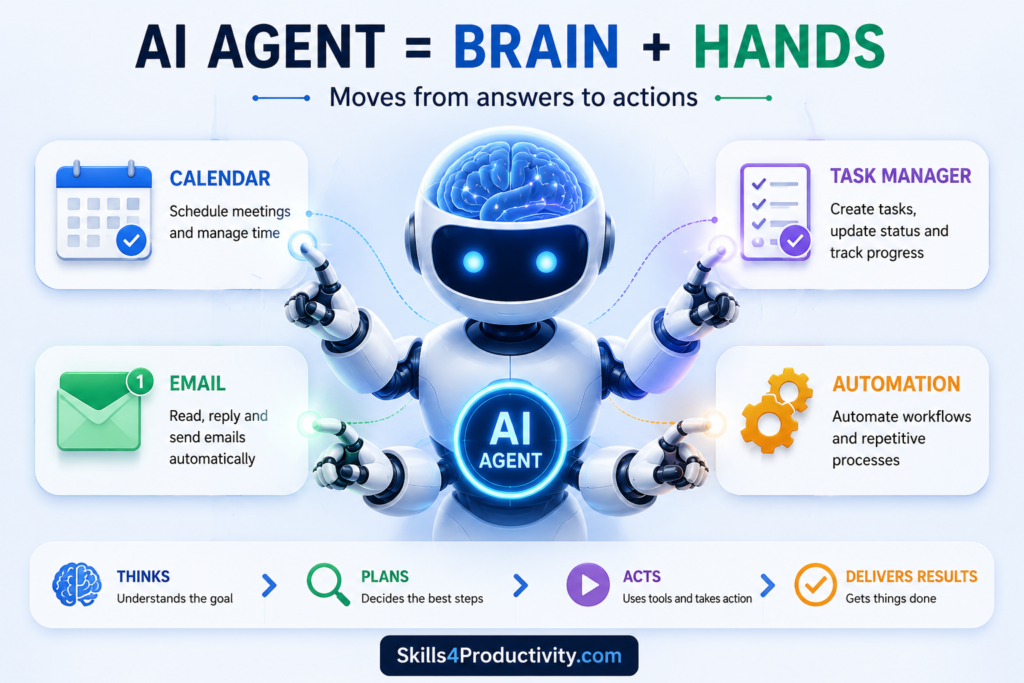
AI Agents: When AI Stops Talking and Starts Working
For a long time, AI systems mostly worked like assistants that gave suggestions.
You asked a question.
They answered.
The conversation ended.
But things are starting to change.
Imagine asking: “Help me organize my week.”
A traditional AI assistant might create a beautiful list of recommendations.
Wake up at this time.
Complete these tasks.
Schedule these meetings.
Useful? Absolutely.
But you still have to do everything yourself.
You still need to open your calendar, create tasks, send emails, and set reminders.
Now imagine something different.
Imagine asking for help and seeing those tasks automatically appear in your calendar. Imagine reminders getting created, meetings getting scheduled, and updates being sent without you touching anything.
That’s where AI agents become interesting.
An AI agent doesn’t simply provide information.
It acts on information.
The difference sounds small at first, but it’s enormous.
It’s the difference between someone giving you directions to a destination and someone getting in the car and driving with you.
One tells.
The other helps get things done.
And that shift—from answers to actions—is becoming one of the most important developments in AI.
Related: Best AI Productivity Tools
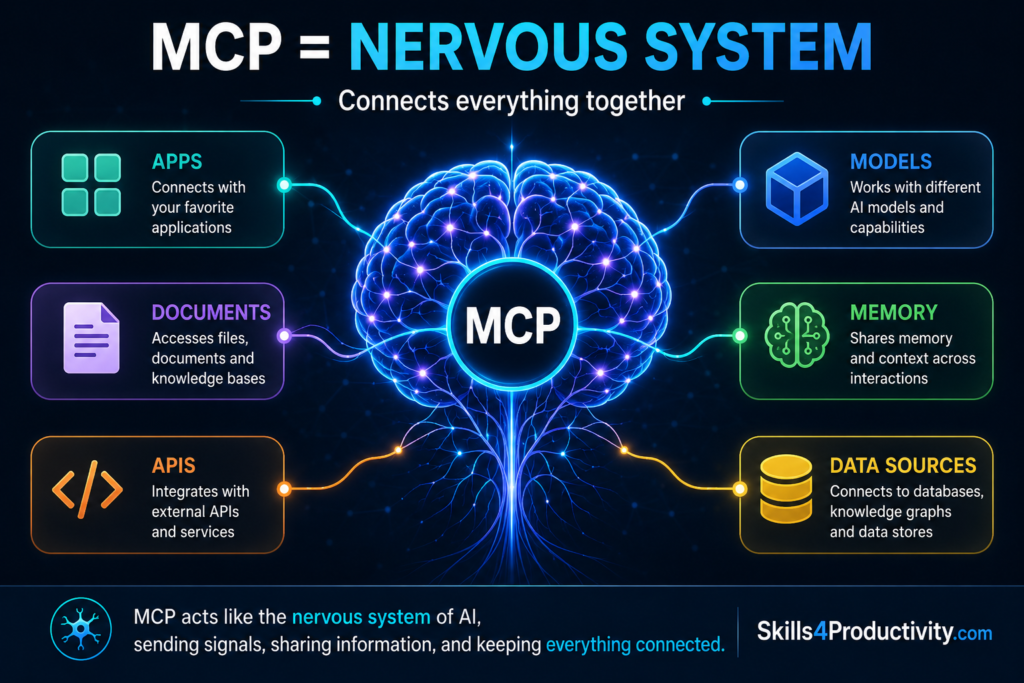
MCP: The Invisible Nervous System
At this point we have a brain that can think, knowledge sources it can read from, and hands that can perform actions.
But one question still remains.
How does everything stay connected?
Your body doesn’t function because the brain works alone. Your brain constantly sends signals throughout your nervous system so different parts of the body can coordinate.
Without that communication, nothing works smoothly.
AI systems face the same challenge.
Today’s tools often need to communicate with documents, databases, applications, memory systems, calendars, APIs, and many other services at the same time.
This is where MCP comes in.
MCP, which stands for Model Context Protocol, acts like the communication layer connecting everything together.
Most users will never notice it directly.
And that’s usually a good sign.
Because the best infrastructure often stays invisible.
You don’t think about your nervous system every time you pick up a cup of coffee.
You simply expect everything to work together.
MCP plays a similar role in modern AI systems.
Bringing It All Together
Once you step back and look at the bigger picture, everything starts connecting naturally.
The LLM acts as the brain that thinks and understands language. RAG gives that brain access to information whenever it needs more context. AI agents become the hands that turn decisions into actions, while MCP works quietly in the background, making sure every part of the system can communicate and work together.
Individually, each component solves a specific problem. But when these pieces come together, something interesting happens.
The system begins to feel less like a chatbot and more like an intelligent assistant that can understand, retrieve knowledge, make decisions, and actually help complete tasks.
And that’s why these ideas matter.
For many people, AI still means typing a question into ChatGPT and receiving an answer. But modern AI is evolving into something much larger. We’re moving toward systems that can understand context, access the right information at the right time, take action across tools, and coordinate entire workflows.
Once you start looking at AI through the lens of a human body, the technical terms stop feeling overwhelming.
You no longer see random buzzwords like LLM, RAG, AI Agents, and MCP.
You see a brain that thinks, knowledge that informs, hands that act, and a nervous system that connects everything together.
And suddenly, AI becomes much easier to understand.
Frequently Asked Questions
What is an LLM in simple words?
An LLM (Large Language Model) is the thinking engine behind AI systems. It understands language, recognizes patterns, and generates human-like responses based on the information it has learned.
What is RAG in AI?
RAG (Retrieval-Augmented Generation) allows AI systems to retrieve information from external sources before creating responses. This helps AI provide more accurate and context-aware answers.
What is the difference between AI agents and chatbots?
Traditional chatbots mainly answer questions and provide information. AI agents go further by taking actions such as scheduling meetings, creating tasks, sending emails, and automating workflows.
What does MCP do in AI systems?
MCP (Model Context Protocol) connects models, tools, memory, and external data sources so AI systems can communicate and work together efficiently.
Can AI systems work without RAG?
Yes, AI systems can work without RAG, but they may rely only on their existing knowledge and can miss recent or specific information. RAG improves accuracy by allowing AI to access external data when needed.
Why are AI agents becoming important?
AI agents are becoming important because they move beyond simply answering questions. They can perform actions, automate repetitive work, and help users complete real-world tasks more efficiently.
How do LLM, RAG, AI agents, and MCP work together?
LLMs provide intelligence, RAG retrieves knowledge, AI agents take action, and MCP connects everything together. Together, they form a complete AI system that can understand, learn, act, and coordinate tasks.
Disclosure: This article may contain affiliate links. If you purchase through these links, Skills4Productivity may earn a commission at no additional cost to you.