
There are plenty of self-help books that promise happiness.
Far fewer help you understand why people flourish.
That’s one reason I keep coming back to positive psychology books. The best ones don’t offer motivational shortcuts. They explore research-backed ideas about well-being, resilience, meaning, habits, and what contributes to a better life.
If you enjoyed courses like The Science of Well-Being or you’re curious about practical psychology you can apply, these five books are worth reading.
I chose books that balance research, readability, and practical insight—books I’d recommend even beyond positive psychology circles.
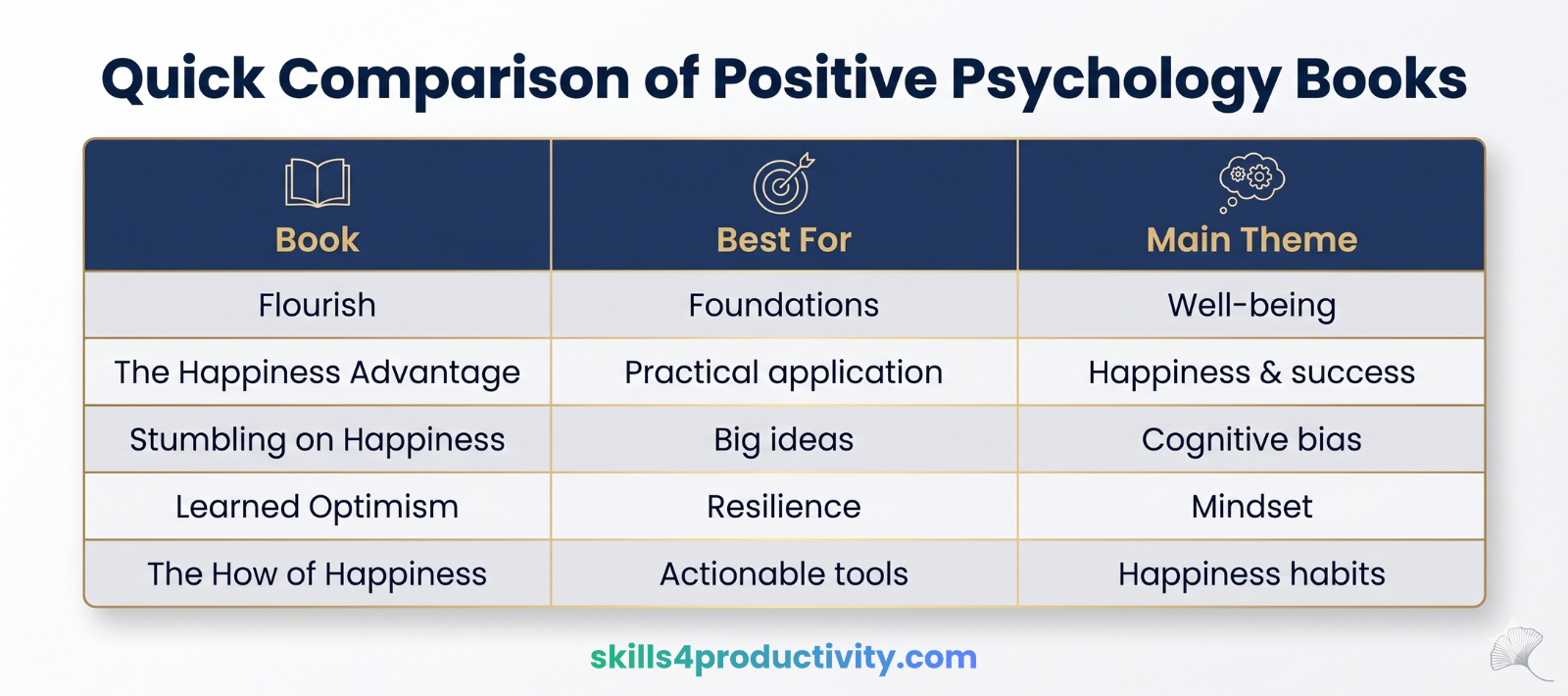
1. Flourish — Martin Seligman
If you want one book that captures the foundations of positive psychology, this is where I’d start.
One of the book’s biggest ideas is that well-being is bigger than happiness.
Seligman introduces the PERMA model — positive emotion, engagement, relationships, meaning, and accomplishment — as pillars of flourishing.
What I like about this book is that it balances science with practical insight.
Why it’s worth reading
- Great introduction to positive psychology
- Challenges narrow ideas of success
- Offers a richer model of well-being
Best for: Readers interested in foundational ideas.
2. The Happiness Advantage — Shawn Achor
This is one of the most practical books in this space.
Its core argument is simple but powerful: Success doesn’t necessarily create happiness. Often happiness fuels success.
That reversal makes the book memorable.
Achor combines research with actionable habits in a very readable way.
Why it’s worth reading
- Practical and engaging
- Full of small experiments and habits
- Strong bridge between psychology and productivity
Best for: Readers who like applied ideas.
3. Stumbling on Happiness — Daniel Gilbert
This book is fascinating because it explores how often we misunderstand what will make us happy.
And we do it constantly.
Gilbert blends psychology, humor, and behavioral science in a way few writers can.
This isn’t a typical self-improvement book—it changes how you think.
Why it’s worth reading
- Thought-provoking and original
- Explains why our minds mispredict happiness
- One of the most interesting psychology books I’ve read
Best for: Readers who enjoy Thought-provoking psychology.
4. Learned Optimism
This classic explores one of positive psychology’s most enduring ideas: Optimism can be learned.
That idea alone makes the book worth reading.
I especially like how it connects thought patterns with resilience.
Why it’s worth reading
- Classic positive psychology work
- Practical ideas for reframing thinking
- Strong book on resilience
Best for: Anyone interested in mindset and mental habits.
5. The How of Happiness — Sonja Lyubomirsky
If you like evidence-backed, actionable books, this belongs on the list.
It focuses less on abstract happiness theory and more on practices supported by research.
Very practical.
Why it’s worth reading
- Research-driven but accessible
- Includes exercises and experiments
- Great blend of science and application
Best for: Readers who want science-backed practices.
If You Read Only One…
If you’re new to positive psychology, I’d start with Flourish.
If you want something more practical right away, start with The Happiness Advantage.
Both are excellent entry points.
Big Ideas These Positive Psychology Books Share
One thing I like about these books is how often they point toward similar themes:
- Happiness often grows through habits, not major milestones
- Meaning matters as much as pleasure
- Optimism can be cultivated
- Relationships matter more than we often realize
- Flourishing is broader than feeling good
That overlap says something.
Why Positive Psychology Still Matters Today
I like positive psychology most when it isn’t treated as “be positive.”
At its best, it asks deeper questions:
What helps people flourish?
What supports resilience?
What contributes to a meaningful life?
These books explore those questions well.
Final Thoughts
If you’re exploring psychology books that can influence how you think and live, I’d start with any of these.
Each offers a different doorway into a better understanding of well-being.
And that makes them worth reading.
What I like about these books is they don’t reduce happiness to optimism slogans.
Frequently Asked Questions
What is the best positive psychology book for beginners?
I’d start with Flourish or The Happiness Advantage.
What are the best books on happiness and well-being?
These five are excellent starting points.
Are positive psychology books practical or academic?
The best ones combine both.
Also Explore
- The Science of Well-Being Course Review
- Learning How to Learn Review
- Best Books on Discipline
- Deep Work Summary
Disclosure: This article may contain affiliate links. If you purchase through these links, Skills4Productivity may earn a commission at no additional cost to you.