
Sometimes the best way to solve a problem is to stop trying so hard.
Focused vs. Diffuse Thinking: Why Sometimes You Need to Stop Thinking
Have you ever been stuck on something for so long that you feel like you’re getting nowhere?
You keep looking at the same problem. You reread the same information. You try harder, but somehow your thoughts keep going in circles.
Then you finally stop.
You go for a walk. Make a cup of coffee. Take a shower. Do something completely unrelated.
And suddenly, an idea comes to you.
“Why didn’t I think of that earlier?”
We’ve all experienced this.
It can happen while studying, writing, planning a project, solving a work problem, or trying to come up with a new idea.
The interesting thing is that sometimes working harder isn’t what we need. We need to change how we’re thinking.
This is where the ideas of focused thinking and diffuse thinking can be useful.
They describe two different ways of approaching a problem:
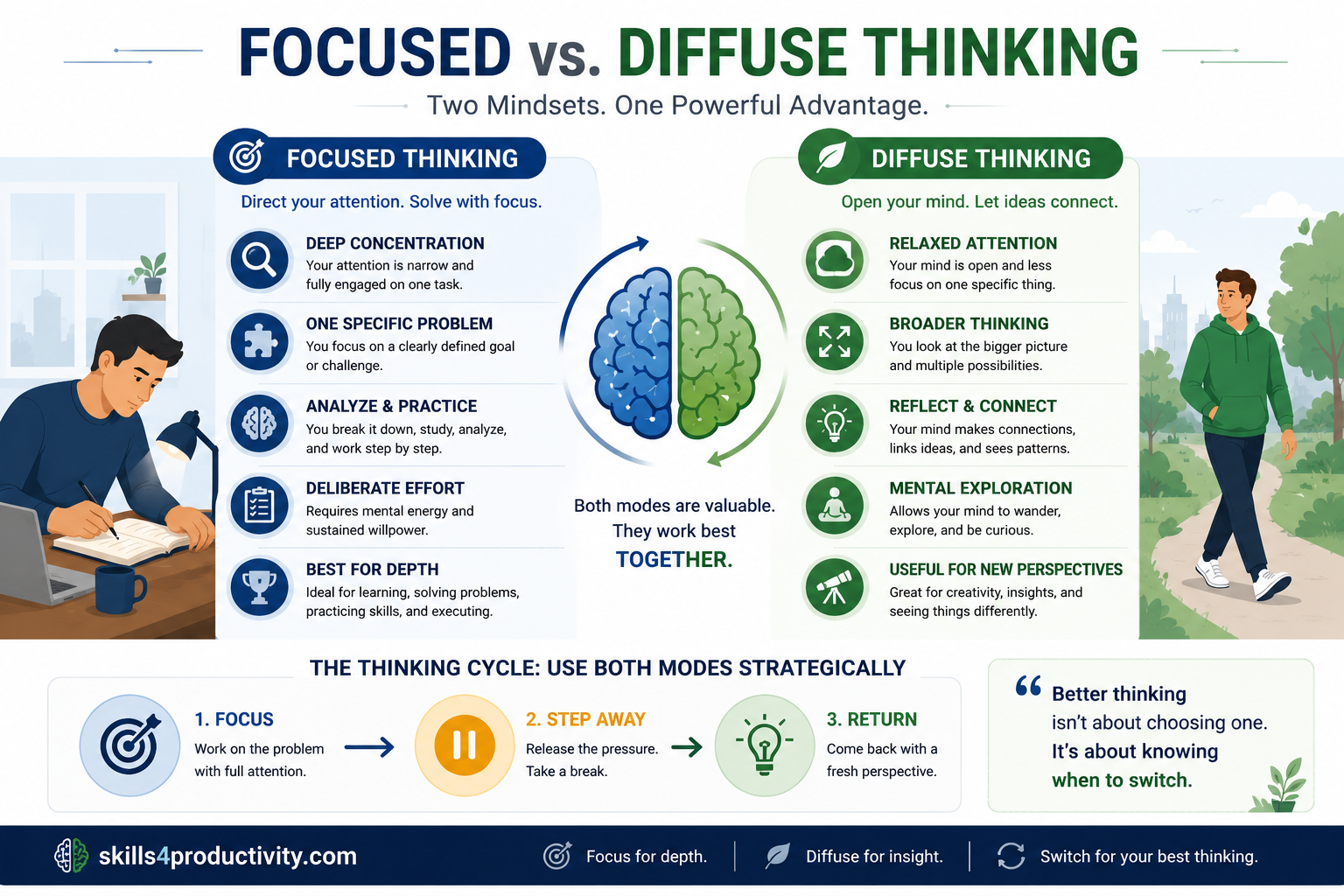
Focused thinking is about concentrating deeply on what you’re trying to accomplish.
Diffuse thinking is about relaxing that tight focus and giving your mind room to explore, reflect, and make connections.
Neither is better than the other.
The real skill is knowing when to focus—and when to step away.
What Are Focused and Diffuse Thinking?
🎯 Focused Thinking
Focused thinking happens when you deliberately direct your attention toward one specific task or problem.
You’re studying a difficult topic, writing an article, analyzing data, solving a problem, or practicing a new skill.
You’re concentrating, working through information and trying to make progress.
Focused thinking gives you depth.
🌱 Diffuse Thinking
Diffuse thinking is a more relaxed way of approaching a problem.
Your attention isn’t locked onto one specific thing. You might be walking, cooking, taking a shower, sitting quietly, or doing another simple activity.
You’re not necessarily trying to solve the problem—but your mind may still be making connections and looking at things from a different perspective.
Diffuse thinking gives you space.
And sometimes that space is exactly what you need.
Why Do We Need Both?
Here’s where things get interesting.
Imagine you’re trying to write an important report.
You spend an hour working on the introduction, but nothing sounds right.
You rewrite it.
Delete it.
Start again.
Still nothing.
At some point, you decide to stop.
You take a walk.
You’re thinking about completely different things when suddenly you realize:
“I should start with the problem my reader is facing.”
You return to your desk.
The introduction suddenly becomes much easier to write.
The walk didn’t magically write the report for you.
You had already done the focused work. You understood the topic and had wrestled with the problem.
Stepping away simply gave you some distance from it.
That’s why the two approaches work well together.
The Thinking Loop
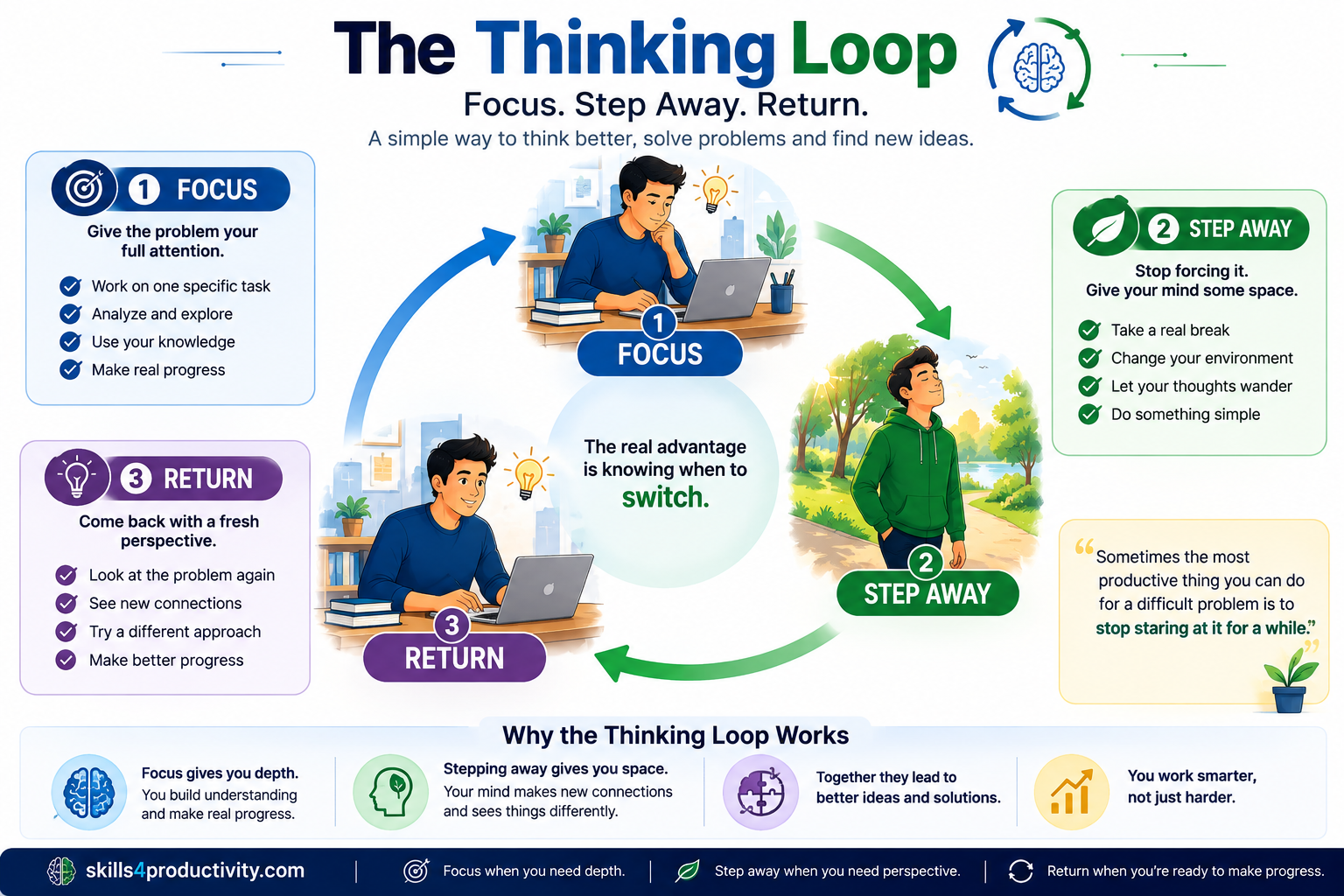
A simple way to remember it is: FOCUS → STEP AWAY → RETURN
Focus
Give the problem your full attention.
↓
Step away
If you’re stuck, stop forcing it.
↓
Return
Come back and see whether you can approach it differently.
You may not always get a brilliant idea after a break. And taking a break doesn’t guarantee a solution.
But when you’re stuck in the same mental loop, changing your environment and giving your attention some space can be surprisingly useful.
When Should You Focus—and When Should You Step Away?
You don’t need to overthink which mode you’re in. A simple question can often tell you what you need:
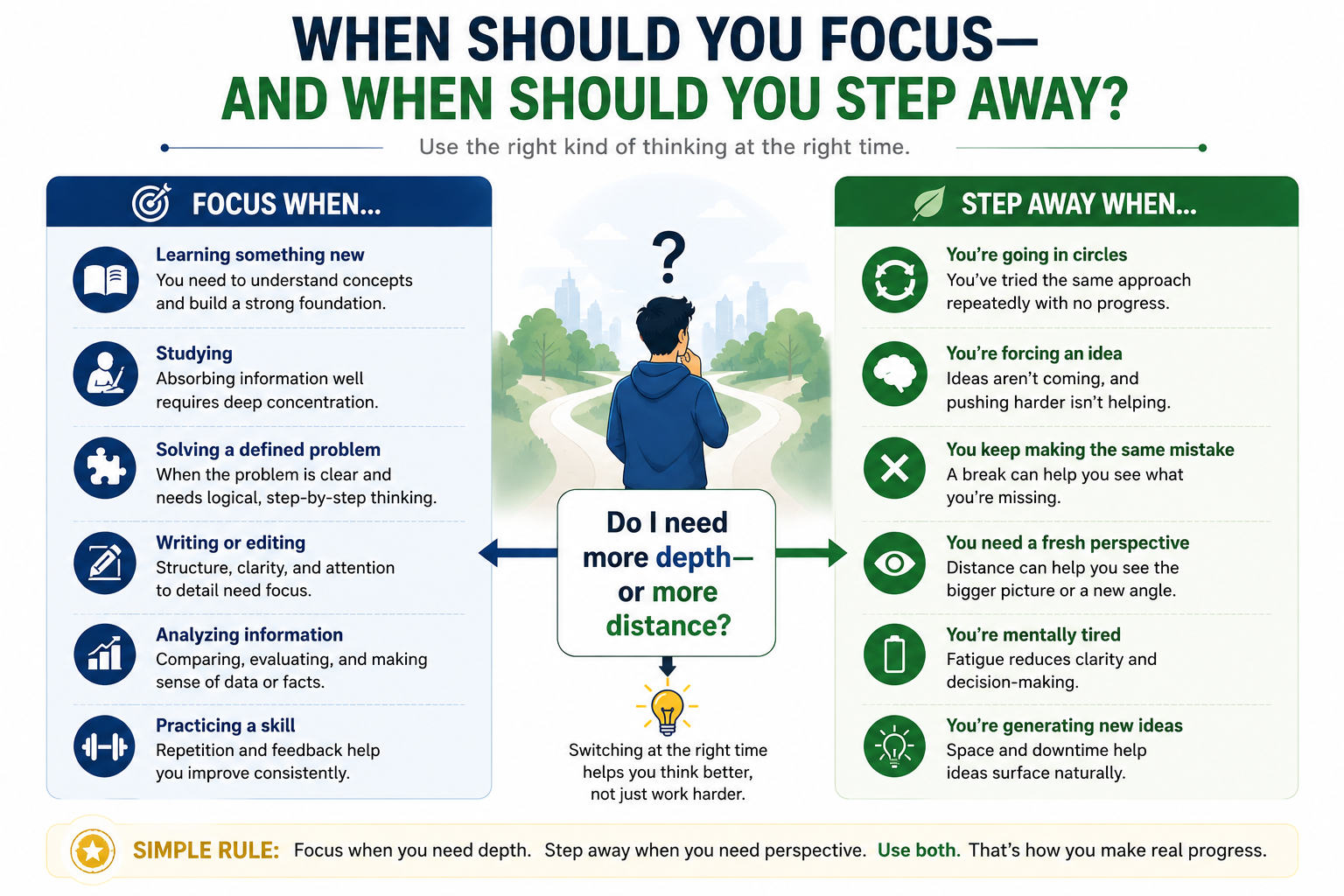
Do I need more depth—or do I need some distance?
🎯 Focus when you need depth
Focused thinking is useful when you need to:
- Learn something new
- Study for an exam
- Solve a clearly defined problem
- Write or edit
- Analyze information
- Practice a skill
- Finish an important task
When the path is clear and you’re making progress, stay with it.
🌱 Step away when you need perspective
A break may be more useful when:
- You’re going around in circles
- You’re forcing an idea
- You keep making the same mistake
- You need a fresh perspective
- You’re mentally tired
- You’re trying to generate new ideas
Stepping away doesn’t mean giving up.
It means recognizing that more effort isn’t always more progress.
And you don’t have to wait until you’re completely exhausted. Sometimes a short break at the right moment is enough to reset your attention and help you return to the problem differently.
Need depth? Focus.
Feeling stuck? Step away.
Ready to move forward? Return.
What This Means for Your Productivity
We often think productivity means staying focused for as long as possible.
But good productivity isn’t about forcing your brain to work at full intensity all day.
Some tasks need concentration. Others benefit from reflection, distance, or simply a change of activity.
The next time you’re stuck, don’t automatically ask: “How can I work harder?”
Try asking: “Do I need more focus—or do I need some space?”
That small shift can change how you approach learning, problem-solving, writing, and creative work.
Productivity isn’t about thinking harder all the time. It’s about knowing when to focus—and when to step away.
Key Takeaways
Focused and diffuse thinking aren’t about choosing one over the other. They work best together.
- 🎯 Focus when you need depth, concentration, and deliberate effort.
- 🌱 Step away when you’re stuck or need a different perspective.
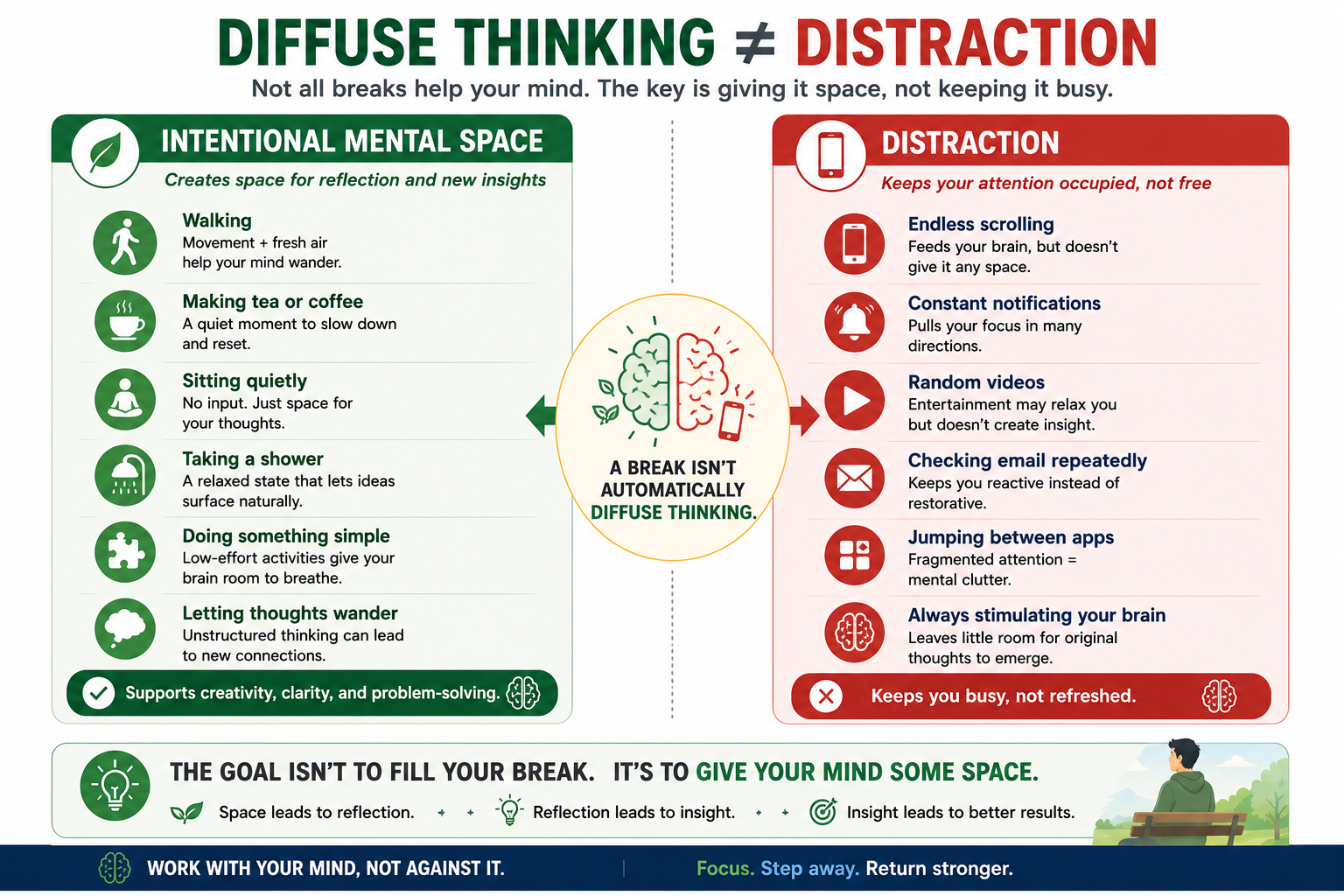
- 💡 Give your mind space instead of filling every break with distractions.
- 🔄 Return and refine—use focused thinking again to turn an idea into something useful.
- 🧠 Know when to switch. That’s the real skill.
The goal isn’t to stay focused all the time. It’s to think better.
Final Thoughts
The next time you find yourself stuck, don’t assume you need to push harder.
Sometimes the best move is to focus more deeply.
And sometimes the better move is to step away for a while.
Focused thinking helps you go deeper. Diffuse thinking can give you the space to see connections you might miss when you’re forcing the answer.
The real advantage comes from knowing when to move between the two.
Focus when you need depth.
Step away when you need perspective.
Return when you’re ready to move forward.
That’s not working less.
That’s learning to think better.
Related Articles
- How to Learn Better: 7 Science-Backed Strategies That Work
- What Is Chunking in Learning (coming soon)
- How to Stop Procrastinating While Studying (coming soon)
Disclosure: This article may contain affiliate links. If you purchase through these links, Skills4Productivity may earn a commission at no additional cost to you.