
What if happiness isn’t the ultimate goal?
For years, most of us have been told that the purpose of life is to be happy.
But what if happiness is just one part of something bigger?
In this Flourish book summary, we explore how Martin Seligman, one of the founders of positive psychology, introduces a broader idea of well-being in his book Flourish. Instead of focusing only on feeling good, he explains a powerful framework known as the PERMA model.
About the Book
Flourish builds on Seligman’s earlier work (Authentic Happiness), but with a key shift:
From happiness → to well-being
This change may sound small, but it completely transforms how we think about a meaningful life.
Rather than chasing temporary positive emotions, Seligman argues that we should focus on building a life that is engaged, meaningful, and fulfilling across multiple dimensions.
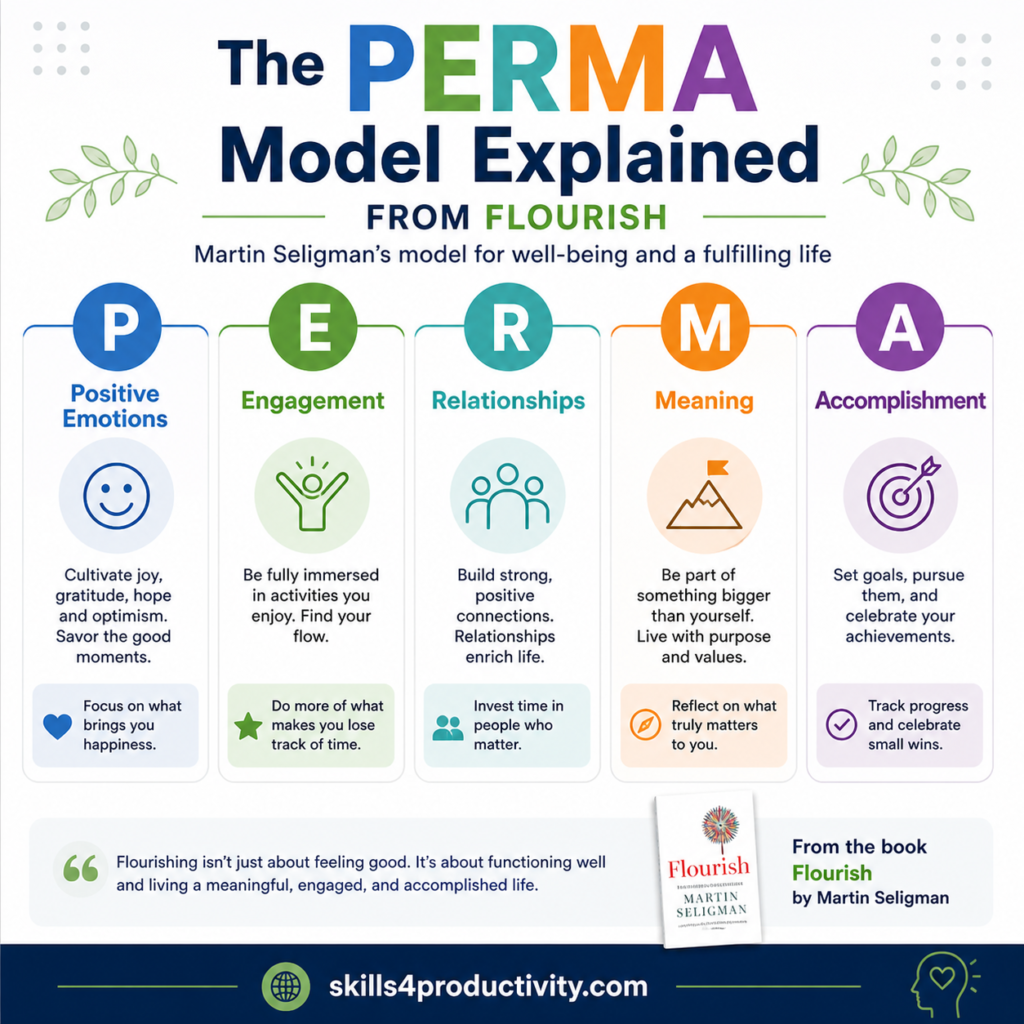
The PERMA Model Explained
The PERMA model is Seligman’s answer to a simple question: What actually makes a life worth living?
It consists of five core elements:
P — Positive Emotions
This is what most people think of as happiness.
It includes:
- Joy
- Gratitude
- Hope
- Contentment
But here’s the key: Positive emotions matter, but they are not enough on their own.
You can feel good temporarily and still feel unfulfilled overall.
E — Engagement
Engagement is about being fully absorbed in what you’re doing.
This is often called the flow state — when you lose track of time because you’re deeply involved in an activity.
Examples:
- Working on something challenging
- Playing music
- Solving a problem
Engagement gives depth to life, beyond surface-level happiness.
R — Relationships
Humans are social beings.
Strong relationships are one of the most consistent predictors of well-being.
This includes:
- Friends
- Family
- Colleagues
- Support systems
In fact, many studies show that quality relationships matter more than success or money when it comes to long-term well-being.
M — Meaning
Meaning comes from being part of something bigger than yourself.
It could be:
- A cause
- A mission
- Spiritual beliefs
- Contribution to others
Meaning gives direction to life — especially during difficult times.
A — Accomplishment
We all need goals.
Achievement, progress, and a sense of mastery contribute to how fulfilled we feel.
This includes:
- Personal goals
- Career growth
- Small daily wins
Accomplishment builds confidence and reinforces a sense of purpose.
Key Lessons from Flourish
1. Happiness is not the final goal
Seligman makes it clear: A good life is not just about feeling good — it’s about functioning well.
2. Well-being is multi-dimensional
You don’t need all five elements to be perfect.
You can strengthen one area even if another is weak.
3. Relationships matter more than we think
One of the strongest takeaways: Deep connections are more important than most people realize.
4. Meaning sustains long-term fulfillment
Pleasure is short-term.
Meaning is what keeps you going over the long run.
5. Small wins build momentum
Accomplishment doesn’t have to be big.
Even small progress contributes to a sense of growth.
Who Should Read This Book?
This book is ideal for:
- Beginners exploring positive psychology
- Coaches and consultants
- Professionals interested in personal growth
- Anyone feeling “something is missing” despite success
My Takeaways (Personal Perspective)
What stands out most about Flourish is its practicality.
It doesn’t just tell you to “be happy.”
It gives you a framework to build a better life intentionally.
Personally, I found the PERMA model useful because:
- It simplifies a complex idea into something actionable
- It connects well with productivity and goal-setting
- It shifts focus from chasing results → to building systems
It’s not about quick motivation — it’s about long-term structure.
Flourish vs Learned Optimism
If you’re deciding between the two:
- Flourish → Big-picture framework (well-being model)
- Learned Optimism → Practical mindset shift techniques
Best approach: Start with Flourish → then move to Learned Optimism
If You Liked This, You Might Also Explore
Final Thoughts
Flourish changes how you define success.
Instead of asking: “Am I happy?”
It encourages you to ask: “Am I building a meaningful, engaged, and fulfilling life?”
That shift alone can change everything.
Start with this book (Check price on Amazon)
Disclosure: This article may contain affiliate links. If you purchase through these links, Skills4Productivity may earn a commission at no additional cost to you.