
Best Books for Time Management
Time is the one resource everyone has in equal measure, yet it often feels like there’s never enough of it. Between constant notifications, overflowing inboxes, back-to-back meetings, and growing responsibilities, staying productive has become more challenging than ever.
The good news is that effective time management isn’t about squeezing more tasks into your day. It’s about making better decisions about what deserves your attention and building systems that help you focus on meaningful work.
The books in this guide don’t promise unrealistic “25-hour days” or miracle productivity hacks. Instead, they offer proven frameworks developed by respected authors, researchers, executives, and productivity experts. Some focus on building better habits, while others teach prioritization, deep focus, or managing complex workloads. Together, they provide practical strategies that can help you reduce stress, avoid procrastination, and make consistent progress toward your goals.
Whether you’re a student trying to balance coursework, a professional managing multiple projects, an entrepreneur wearing many hats, or simply someone who wants to make better use of each day, you’ll find a book here that fits your needs.
Quick Recommendations
If you’re short on time, here are our top picks:
- Best Overall: Getting Things Done by David Allen
- Best for Beginners: Atomic Habits by James Clear
- Best for Focus: Deep Work by Cal Newport
- Best for Prioritization: Essentialism by Greg McKeown
- Best for Overcoming Procrastination: Eat That Frog! by Brian Tracy
- Best Mindset Shift: Four Thousand Weeks by Oliver Burkeman
How We Chose These Books
There are hundreds of books that claim to improve productivity and time management, but not all of them stand the test of time. We selected these recommendations using the following criteria:
- Practical advice that can be applied immediately.
- Long-term relevance, avoiding books built around short-lived productivity trends.
- Credibility of the author, including researchers, experienced practitioners, and recognized experts.
- Reader impact, based on widespread recommendations and lasting influence.
- Coverage of different challenges, including focus, prioritization, procrastination, habits, planning, and attention management.
Rather than recommending multiple books that teach the same concepts, we’ve chosen titles that complement one another. Depending on your goals, you may only need one or two of these books—or you might combine ideas from several to create a productivity system that works for you.
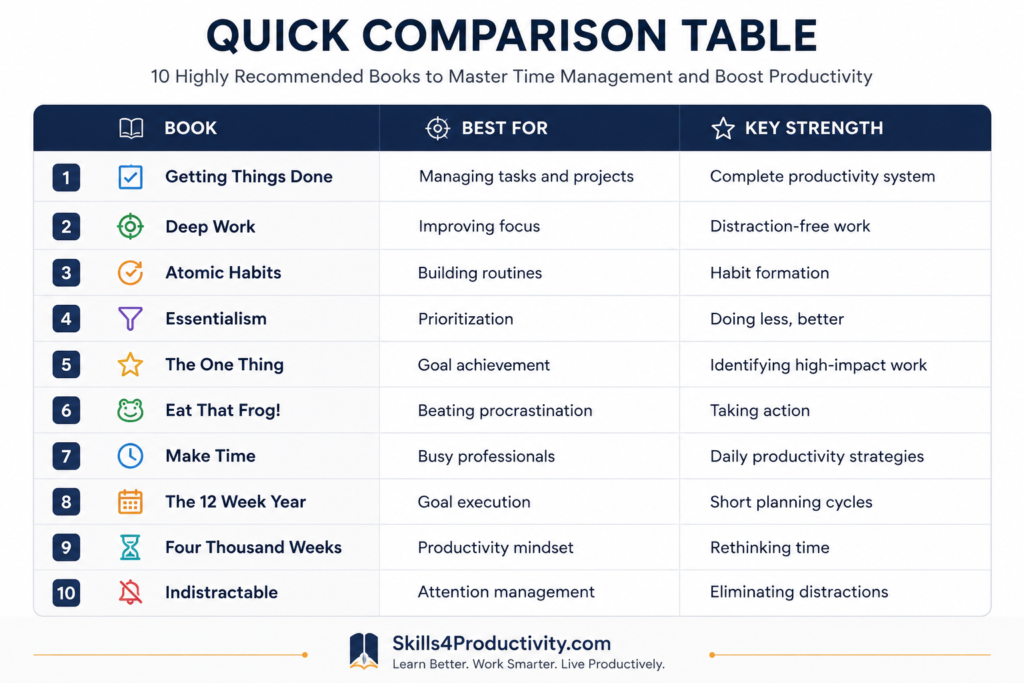
1. Getting Things Done by David Allen
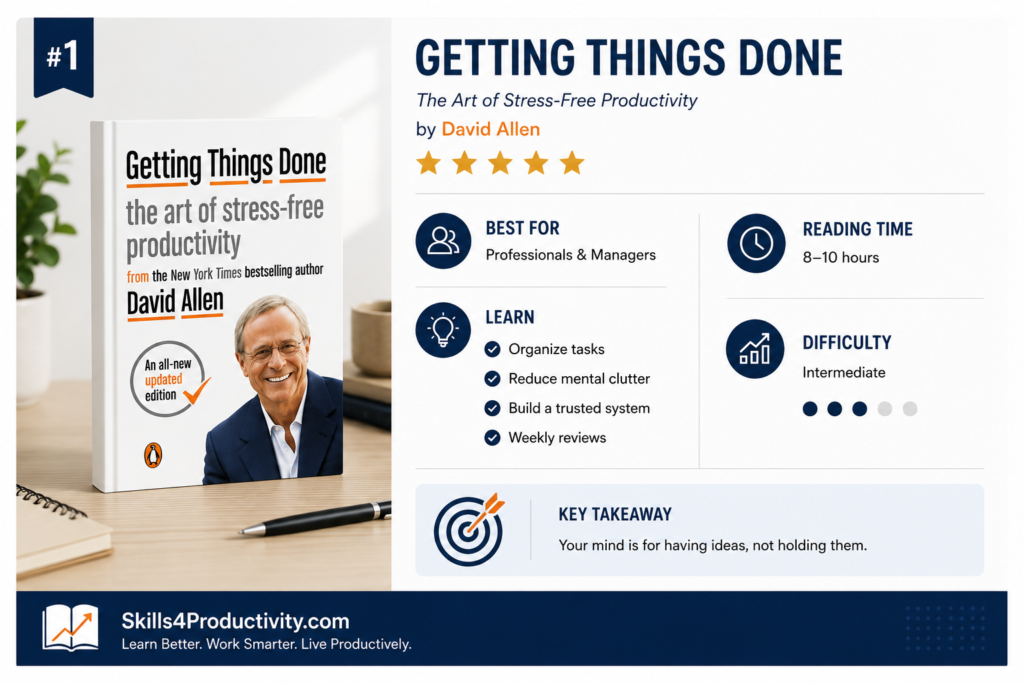
Best For: Professionals managing multiple projects
Getting Things Done by David Allen is widely regarded as one of the most influential productivity books ever written. Instead of relying on memory to keep track of tasks, Allen introduces the GTD (Getting Things Done) method—a practical system for capturing, organizing, and reviewing everything you need to do.
The book focuses on reducing mental clutter so you can spend less time worrying about unfinished tasks and more time making meaningful progress. While some of its concepts require practice, the underlying principles remain just as relevant today as when the book was first published.
Why You’ll Like It
- Introduces the proven GTD productivity system.
- Helps organize complex workloads.
- Reduces stress by creating a trusted task management process.
- Works with both digital apps and paper planners.
Key Takeaways
- Capture every task in a trusted system.
- Break projects into clear next actions.
- Review your commitments regularly.
- Focus on execution instead of remembering everything.
Pros
✔ Timeless productivity framework
✔ Practical and actionable
✔ Great for busy professionals
Cons
✘ Takes time to implement fully
✘ May feel too detailed for beginners
Quick Verdict
If you want one book that teaches a complete productivity system instead of isolated tips, Getting Things Done remains one of the strongest recommendations for professionals managing multiple responsibilities.
Read Our Detailed Summary
📖 Want a deeper understanding?
👉 Read our complete Getting Things Done Summary
🛒 Get This Book
Available in Kindle, Paperback, Hardcover, and Audiobook.
👉 Check Latest Price on Amazon
2. Deep Work by Cal Newport
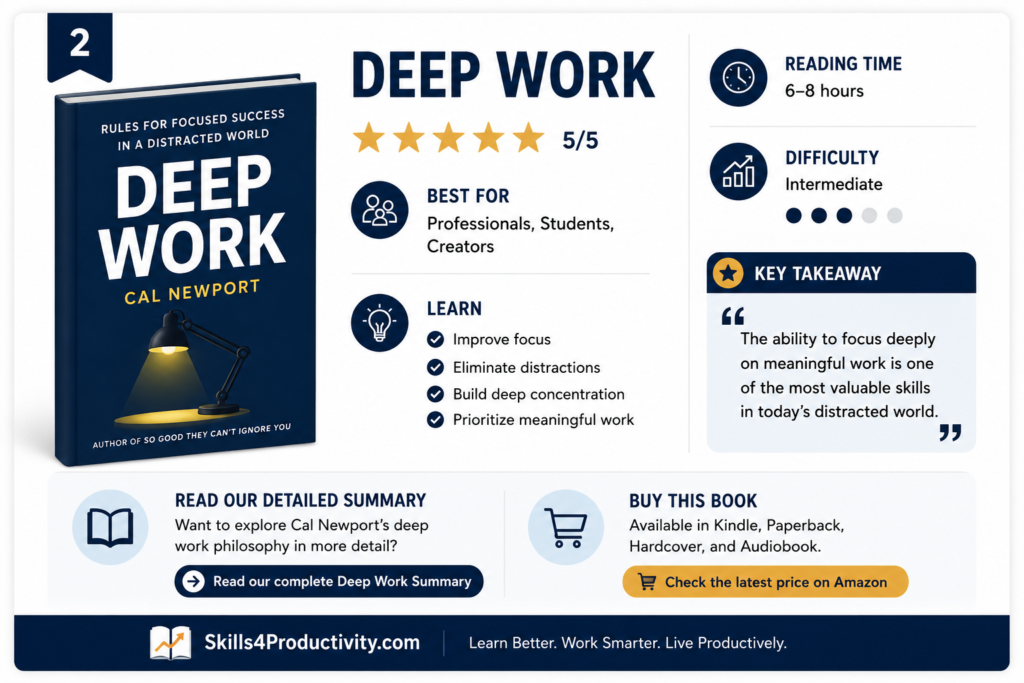
Best For: Professionals, students, creators, and anyone struggling with distractions.
In today’s always-connected world, one of the biggest obstacles to effective time management isn’t a lack of time—it’s a lack of focus. In Deep Work, Cal Newport argues that the ability to concentrate without distraction is becoming increasingly rare and increasingly valuable.
Rather than trying to do more in less time, Newport encourages readers to spend more time on meaningful, high-value work while eliminating the distractions that often consume the day. His approach shifts the conversation from time management to attention management, showing that protecting your focus is often more important than simply organizing your schedule.
The book introduces practical strategies for creating distraction-free work sessions, reducing shallow tasks, and building habits that support sustained concentration. Whether you’re writing, studying, coding, or solving complex problems, these ideas can help you produce better work in less time.
Why You’ll Like It
- Teaches practical strategies to improve focus and concentration.
- Helps reduce distractions from email, social media, and constant notifications.
- Encourages spending more time on high-impact work instead of busy work.
- Ideal for knowledge workers, students, and creative professionals.
Key Takeaways
- Schedule dedicated blocks for focused, uninterrupted work.
- Minimize shallow work that adds little long-term value.
- Train your brain to resist distractions instead of constantly switching tasks.
- Protect your attention—it is one of your most valuable professional assets.
Pros
✔ Practical and research-backed advice.
✔ Helps improve both productivity and work quality.
✔ Encourages healthier digital habits.
Cons
✘ Some strategies may be difficult to apply in highly collaborative workplaces.
✘ Requires discipline to maintain distraction-free routines.
Quick Verdict
If you constantly feel busy but struggle to make meaningful progress, Deep Work offers a powerful framework for reclaiming your attention. It’s one of the best books for anyone who wants to accomplish more by focusing on what truly matters—not by working longer hours.
Read Our Detailed Summary
Want to explore Cal Newport’s deep work philosophy in more detail?
👉 Read our complete Deep Work Summary
🛒 Get This Book
Available in Kindle, Paperback, Hardcover, and Audiobook.
👉 Check Latest Price on Amazon
3. Atomic Habits by James Clear
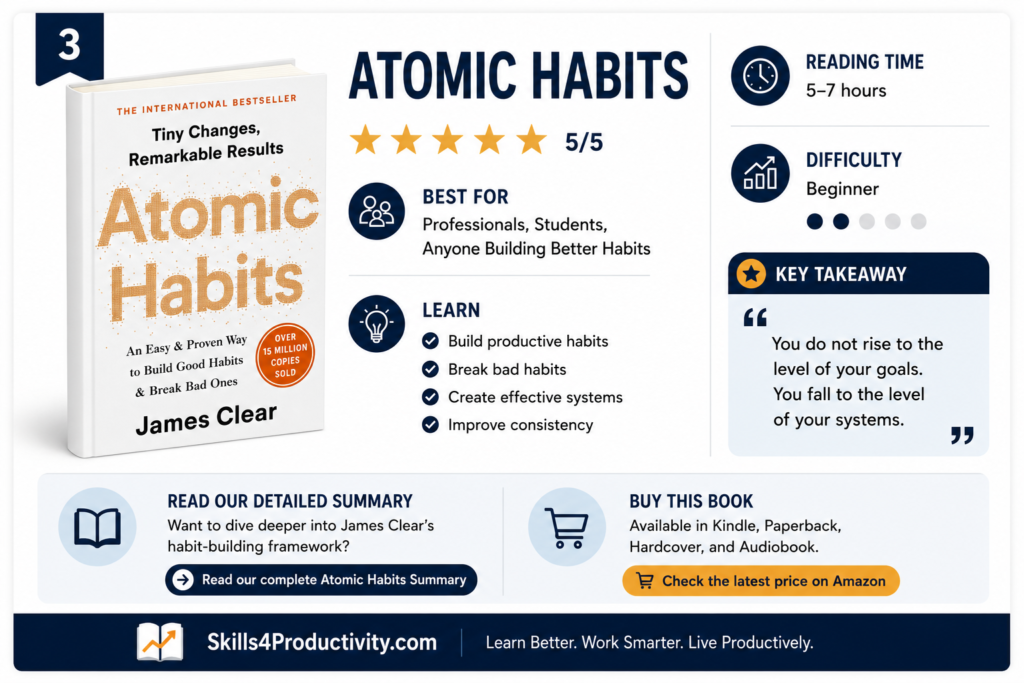
Best For: Anyone looking to build better habits, improve productivity, and create lasting routines.
Time management isn’t just about planning your day—it’s about building habits that make productive actions automatic. That’s exactly what James Clear teaches in Atomic Habits, one of the most influential personal development books of the last decade.
Rather than relying on motivation or willpower, Clear explains how small, consistent improvements can lead to remarkable long-term results. His practical framework helps readers replace bad habits with better ones by making positive behaviors easier to start and easier to maintain.
While Atomic Habits isn’t a traditional time management book, it’s an essential read because effective time management begins with consistent daily habits. Whether it’s planning your day, avoiding procrastination, exercising, or working without distractions, your habits determine how you spend your time.
One of the book’s biggest strengths is its simplicity. James Clear breaks complex behavioral science into practical strategies that anyone can apply, making it an excellent choice for beginners as well as experienced productivity enthusiasts.
Why You’ll Like It
- Provides a practical framework for building productive habits.
- Helps replace procrastination with consistent action.
- Easy to read, with actionable advice you can implement immediately.
- Focuses on long-term improvement rather than quick productivity hacks.
Key Takeaways
- Small habits, repeated consistently, create significant long-term results.
- Focus on building systems instead of chasing goals.
- Make good habits obvious, attractive, easy, and satisfying.
- Your daily habits shape how effectively you use your time.
Pros
✔ Easy to understand and highly practical.
✔ Actionable strategies backed by behavioral science.
✔ Suitable for readers at any stage of their productivity journey.
Cons
✘ Focuses more on habits than traditional scheduling or planning techniques.
✘ Readers looking for a complete productivity system may prefer Getting Things Done.
Quick Verdict
Atomic Habits earns its place on this list because better time management starts with better habits. If you’re looking for a practical guide to becoming more productive without relying on motivation alone, this is one of the best books you can read.
📖 Read Our Detailed Summary
Want to dive deeper into James Clear’s habit-building framework?
👉 Read our complete Atomic Habits Summary
🛒 Get This Book
Available in Kindle, Paperback, Hardcover, and Audiobook.
👉 Check the latest price on Amazon
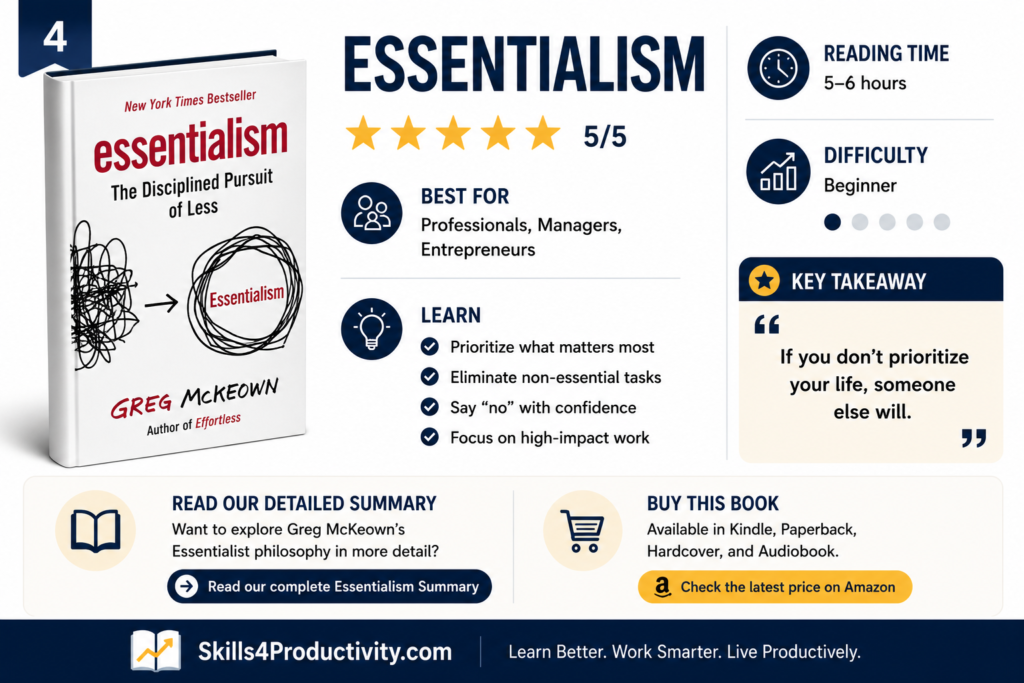
4. Essentialism by Greg McKeown
Best For: Professionals, managers, entrepreneurs, and anyone overwhelmed by too many commitments.
One of the biggest challenges in time management isn’t finding more hours in the day—it’s deciding what deserves your attention. In Essentialism, Greg McKeown argues that true productivity isn’t about doing more; it’s about doing the right things.
Instead of filling every minute with tasks, meetings, and obligations, McKeown encourages readers to focus on the few activities that create the greatest impact. By learning to eliminate the non-essential, you can spend more time on meaningful work and less time reacting to endless requests and distractions.
Unlike many productivity books that teach you how to manage a growing to-do list, Essentialism challenges you to question whether those tasks belong on your list at all. It’s a refreshing mindset shift for anyone who constantly feels busy but rarely feels accomplished.
If you often struggle with overcommitment, decision fatigue, or saying “yes” to too many opportunities, this book provides a practical framework for simplifying your work and life.
Why You’ll Like It
- Encourages focusing on fewer but more meaningful priorities.
- Helps reduce overwhelm and decision fatigue.
- Provides practical strategies for saying “no” without guilt.
- Promotes sustainable productivity instead of constant busyness.
Key Takeaways
- Focus on what matters most, not everything.
- Learn to say “no” to protect your time.
- Eliminate non-essential tasks and commitments.
- Prioritize quality over quantity.
Pros
✔ A refreshing approach to productivity and time management.
✔ Practical advice for reducing overwhelm.
✔ Easy to read with memorable real-world examples.
Cons
✘ Some ideas may feel difficult to apply in demanding workplaces.
✘ Less focused on scheduling and planning than traditional productivity books.
Quick Verdict
Essentialism is one of the best books for anyone who feels overwhelmed by an endless list of responsibilities. It teaches that effective time management begins with making better choices—not simply becoming more efficient.
📖 Read Our Detailed Summary
Want to explore Greg McKeown’s Essentialist philosophy in more detail?
👉 Read our complete Essentialism Summary
🛒 Get This Book
Available in Kindle, Paperback, Hardcover, and Audiobook.
👉 Check the latest price on Amazon
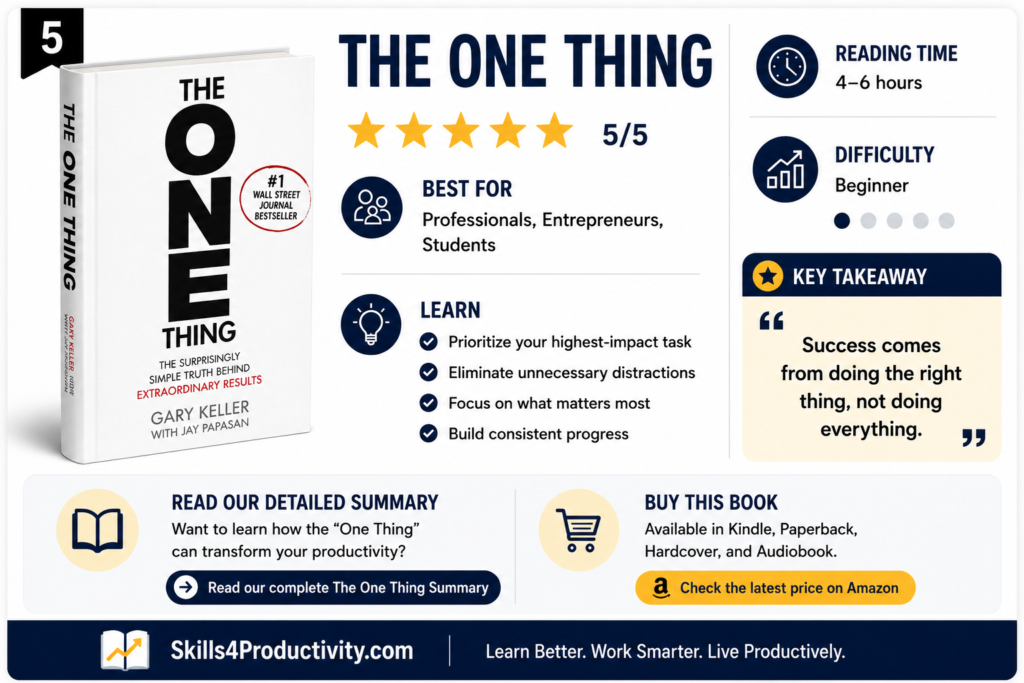
5. The One Thing by Gary Keller and Jay Papasan
Best For: Professionals, entrepreneurs, students, and anyone struggling with competing priorities.
Many people believe being productive means multitasking or keeping dozens of tasks moving at once. In The One Thing, Gary Keller and Jay Papasan challenge that belief by showing that extraordinary results come from focusing on one priority at a time.
The central idea is simple yet powerful: instead of asking, “What should I do next?”, ask yourself, “What’s the ONE thing I can do such that by doing it everything else becomes easier or unnecessary?”
This shift in thinking helps eliminate distractions and prevents you from spreading your time across too many low-impact activities. Rather than trying to accomplish everything, the book encourages readers to identify the task that will create the greatest progress toward their goals.
Whether you’re managing a busy workload, building a business, or pursuing personal goals, The One Thing provides a practical framework for prioritizing your time and energy where they matter most.
Why You’ll Like It
- Encourages laser-sharp focus on your highest-impact work.
- Helps simplify decision-making and daily planning.
- Easy to understand with practical examples.
- Promotes long-term productivity instead of constant busyness.
Key Takeaways
- Identify the one task that creates the biggest impact.
- Success comes from prioritization, not multitasking.
- Protect time for your most important work every day.
- Extraordinary results require focused attention and consistency.
Pros
✔ Simple yet highly effective productivity framework.
✔ Easy to apply in both personal and professional life.
✔ Helps reduce overwhelm by narrowing your focus.
Cons
✘ Some concepts overlap with Essentialism.
✘ Readers looking for detailed planning systems may prefer Getting Things Done.
Quick Verdict
The One Thing is one of the best books for improving focus and prioritization. If you’re constantly busy but unsure whether you’re making meaningful progress, this book will help you identify what deserves your attention first.
📖 Read Our Detailed Summary
Want to learn how the “One Thing” question can transform your productivity?
👉 Read our complete The One Thing Summary
🛒 Buy This Book
Available in Kindle, Paperback, Hardcover, and Audiobook.
👉 Check the latest price on Amazon
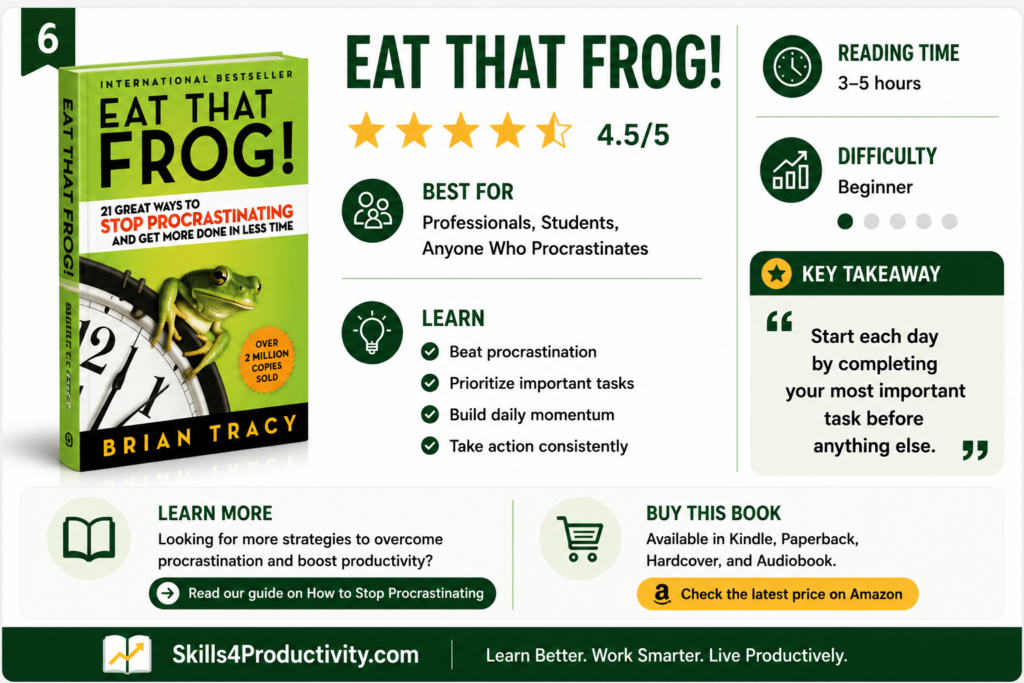
6. Eat That Frog! by Brian Tracy
Best For: Professionals, students, entrepreneurs, and anyone who struggles with procrastination.
Even the best time management system won’t help if you keep delaying your most important work. In Eat That Frog!, Brian Tracy tackles one of the biggest productivity challenges: procrastination.
The title comes from a famous saying often attributed to Mark Twain: if you eat a live frog first thing in the morning, everything else you face during the day will seem easier. Tracy uses this idea as a metaphor for tackling your most important and challenging task first, instead of putting it off until later.
Rather than introducing a complex productivity system, the book offers simple, practical techniques for prioritizing tasks, overcoming procrastination, and building momentum. Its short chapters and actionable advice make it an easy read for anyone looking to improve their daily productivity.
While some ideas overlap with other productivity classics, Eat That Frog! remains one of the most accessible books for developing the habit of taking action instead of waiting for motivation.
Why You’ll Like It
- Simple and practical advice that you can apply immediately.
- Helps overcome procrastination and decision paralysis.
- Encourages focusing on your highest-priority task each day.
- Easy to read with short, actionable chapters.
Key Takeaways
- Start each day with your most important task.
- Prioritize high-value activities over busy work.
- Break large projects into manageable steps.
- Build momentum through consistent action.
Pros
✔ Easy to read and highly actionable.
✔ Great for readers new to productivity.
✔ Practical techniques that can be implemented immediately.
Cons
✘ Some concepts overlap with The One Thing and Getting Things Done.
✘ Less comprehensive than larger productivity frameworks.
Quick Verdict
If procrastination is preventing you from making progress, Eat That Frog! is one of the best books you can read. Its practical advice and straightforward approach make it an excellent starting point for improving your daily productivity and time management.
📖 Learn More
Looking for more strategies to overcome procrastination and improve your productivity?
👉 Read our guide on How to Stop Procrastinating
🛒 Buy This Book
Available in Kindle, Paperback, Hardcover, and Audiobook.
👉 Check the latest price on Amazon
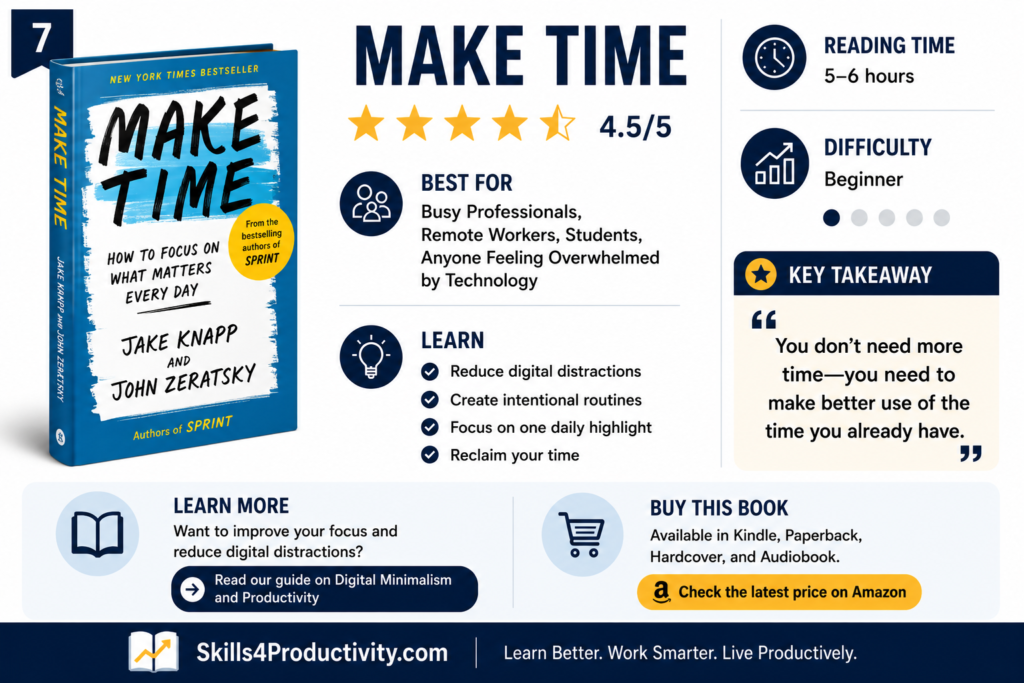
7. Make Time by Jake Knapp and John Zeratsky
Best For: Busy professionals, remote workers, students, and anyone feeling overwhelmed by technology.
Modern life is full of distractions. Emails, instant messages, social media, and endless notifications constantly compete for our attention, making it difficult to focus on meaningful work. In Make Time, former Google designers Jake Knapp and John Zeratsky offer a refreshing approach to reclaiming your day.
Instead of trying to optimize every minute, the authors encourage readers to intentionally create time for what matters most. Their philosophy is built around making one daily priority—called a Highlight—while reducing the distractions that consume our attention.
What makes Make Time unique is its practical approach. Rather than presenting one rigid productivity system, it offers dozens of flexible tactics that readers can mix and match based on their lifestyle. From reducing screen time to designing distraction-free work environments, the book is filled with realistic strategies that fit modern work and life.
If you’ve ever reached the end of the day wondering where your time went, Make Time provides practical ideas to help you regain control.
Why You’ll Like It
- Offers practical strategies for reducing digital distractions.
- Helps create more intentional and productive days.
- Flexible advice that works for different lifestyles.
- Written in an engaging, conversational style.
Key Takeaways
- Choose one daily “Highlight” that deserves your best attention.
- Reduce distractions from technology and constant notifications.
- Design your environment to support focus.
- Build simple daily habits that make productive work easier.
Pros
✔ Modern, practical advice for today’s digital world.
✔ Easy to read with actionable daily strategies.
✔ Flexible techniques that can be adapted to individual routines.
Cons
✘ Less structured than traditional productivity systems.
✘ Some tactics may already be familiar to experienced productivity readers.
Quick Verdict
Make Time is an excellent choice for anyone who feels constantly distracted by technology. Its practical, flexible advice makes it one of the most useful books for creating better daily routines and spending more time on what truly matters.
📖 Learn More
Want to improve your focus and reduce digital distractions?
👉 Read our guide on Productivity
🛒 Buy This Book
Available in Kindle, Paperback, Hardcover, and Audiobook.
👉 Check the latest price on Amazon
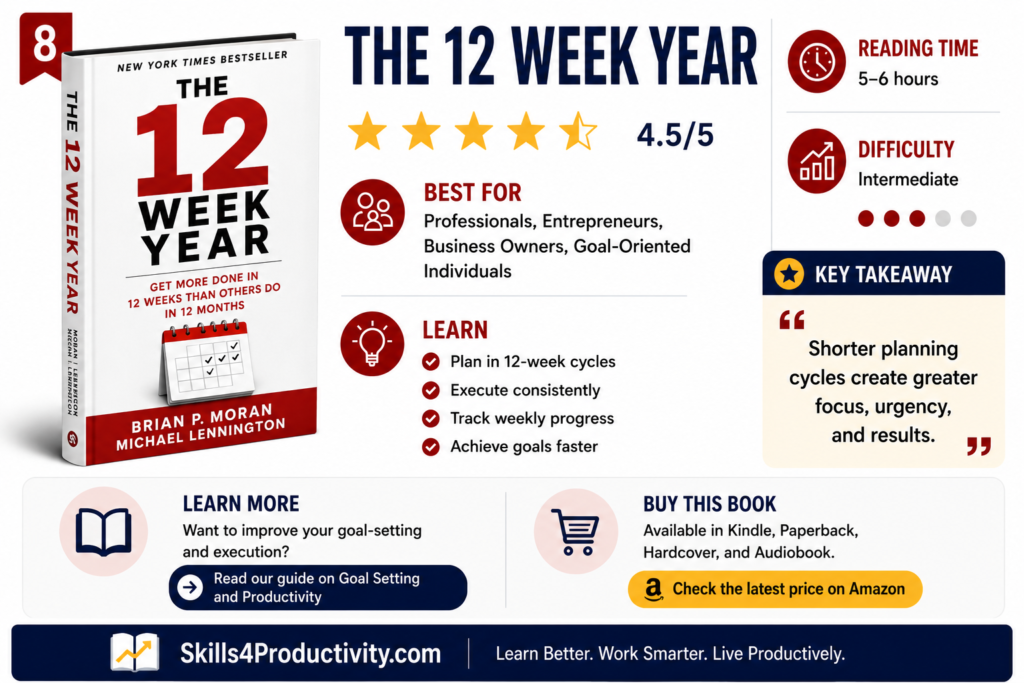
8. The 12 Week Year by Brian Moran and Michael Lennington
Best For: Professionals, entrepreneurs, business owners, and goal-oriented individuals.
Many people start the year with ambitious goals but lose focus long before December arrives. In The 12 Week Year, Brian Moran and Michael Lennington challenge the traditional annual planning model by suggesting that you treat every 12 weeks as a complete year.
The idea is simple: shorter planning cycles create urgency, improve focus, and encourage consistent execution. Instead of waiting until the end of the year to measure progress, you work toward meaningful goals over a 12-week period, making it easier to stay motivated and adapt when necessary.
The book also emphasizes execution over planning. It provides practical tools for setting priorities, tracking progress, and holding yourself accountable—making it particularly useful for professionals and entrepreneurs managing multiple projects.
If you struggle to follow through on long-term goals or often feel overwhelmed by yearly resolutions, The 12 Week Year offers a practical framework to help you make steady progress throughout the year.
Why You’ll Like It
- Replaces annual planning with focused 12-week execution cycles.
- Creates a greater sense of urgency and accountability.
- Helps break ambitious goals into manageable actions.
- Ideal for professionals, entrepreneurs, and teams.
Key Takeaways
- Think in 12-week cycles instead of annual plans.
- Prioritize execution over excessive planning.
- Review progress regularly and adjust quickly.
- Focus on a few meaningful goals at a time.
Pros
✔ Practical framework for achieving goals faster.
✔ Encourages consistent execution and accountability.
✔ Useful for both personal and professional goal setting.
Cons
✘ Requires regular planning and weekly reviews.
✘ May feel structured for readers who prefer a more flexible approach.
Quick Verdict
If you often lose momentum on long-term goals, The 12 Week Year provides a refreshing alternative to traditional planning. Its focus on short execution cycles makes it one of the most effective books for turning goals into consistent action.
📖 Learn More
Want to improve your goal-setting and execution?
👉 Read our guide on Goal Setting and Productivity skills
🛒 Buy This Book
Available in Kindle, Paperback, Hardcover, and Audiobook.
👉 Check the latest price on Amazon
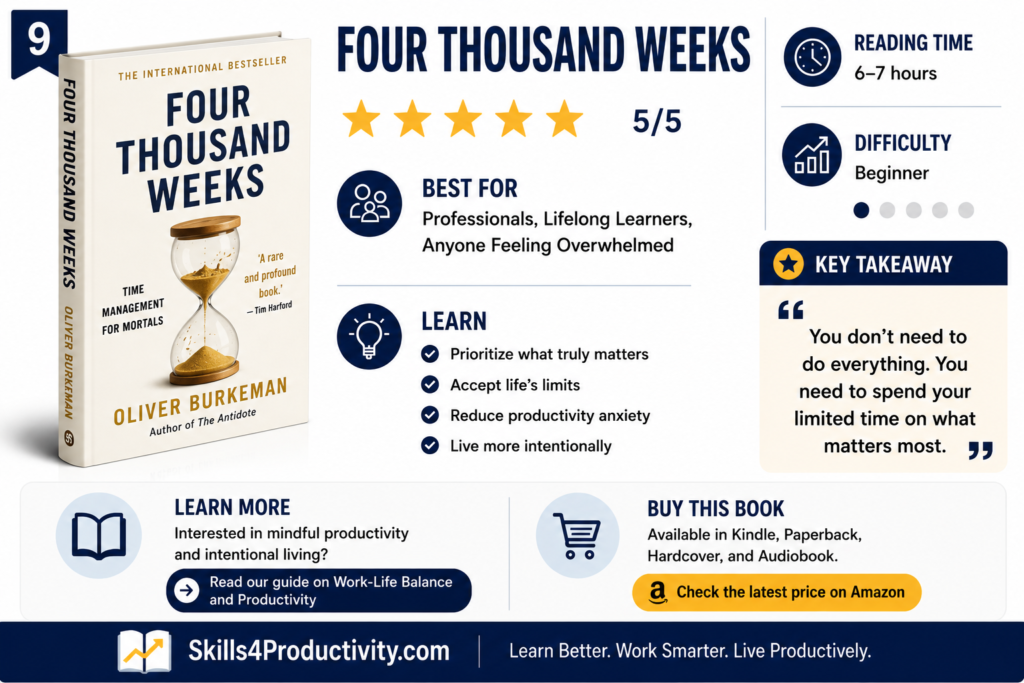
9. Four Thousand Weeks by Oliver Burkeman
Best For: Professionals, lifelong learners, and anyone feeling overwhelmed by the pressure to do more.
Most time management books focus on helping you become more efficient. Four Thousand Weeks by Oliver Burkeman takes a different approach. Instead of teaching you how to squeeze more into your schedule, it encourages you to accept a simple truth: the average human life is only about 4,000 weeks long.
Rather than viewing this as discouraging, Burkeman argues that recognizing our limited time can help us make better choices about how we spend it. Instead of chasing unrealistic productivity goals or trying to do everything, the book encourages readers to focus on what truly matters and let go of the pressure to optimize every minute.
The result is a refreshing perspective on productivity—one that emphasizes meaning, presence, and intentional living over endless busyness. If you’ve ever felt exhausted by productivity hacks or overwhelmed by an ever-growing to-do list, this book offers a healthier and more sustainable mindset.
Unlike traditional time management books, Four Thousand Weeks isn’t about getting more done. It’s about making peace with the fact that you can’t do everything—and learning why that’s perfectly okay.
Why You’ll Like It
- Offers a refreshing perspective on productivity and time.
- Helps reduce the pressure to constantly stay busy.
- Encourages intentional living and meaningful work.
- Challenges common productivity myths.
Key Takeaways
- Your time is limited, so choose your priorities wisely.
- Productivity should support a meaningful life—not become the goal itself.
- Accept that you can’t do everything.
- Focus on what truly matters instead of chasing endless efficiency.
Pros
✔ Thought-provoking and refreshingly different.
✔ Encourages a healthier relationship with work and productivity.
✔ Memorable insights that stay with you long after reading.
Cons
✘ Less practical than traditional productivity books.
✘ Readers looking for step-by-step systems may prefer other titles on this list.
Quick Verdict
Four Thousand Weeks is one of the most thought-provoking books on time management. Rather than teaching you how to do more, it reminds you why choosing what matters most is the real key to living and working well.
📖 Learn More
Interested in mindful productivity and intentional living?
👉 Read our guide on Productivity
🛒 Buy This Book
Available in Kindle, Paperback, Hardcover, and Audiobook.
👉 Check the latest price on Amazon
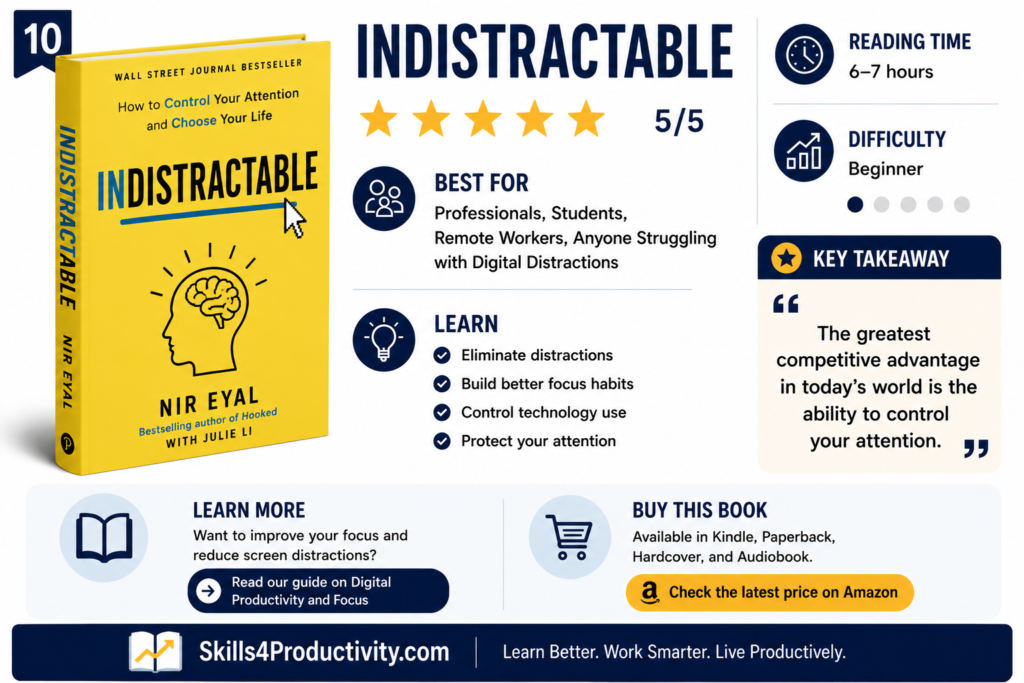
10. Indistractable by Nir Eyal
Best For: Professionals, students, remote workers, and anyone who struggles with digital distractions.
Staying focused has become one of the biggest challenges of modern life. Emails, social media, messaging apps, and constant notifications compete for our attention every day. In Indistractable, Nir Eyal explains why distraction happens—and more importantly, how to take control of it.
Rather than simply blaming technology, Eyal argues that many distractions begin internally. The book encourages readers to understand their triggers, manage interruptions, and design environments that support focused work instead of constantly fighting against distractions.
What makes Indistractable especially valuable is its practical approach. It combines behavioral psychology with actionable strategies that can be applied immediately, whether you’re working from home, studying, or managing a busy professional life.
If you’ve ever found yourself checking your phone without thinking or losing hours to unnecessary browsing, this book offers a realistic framework for building better focus habits.
Why You’ll Like It
- Practical strategies for reducing digital distractions.
- Helps build stronger focus and attention habits.
- Based on psychology and real-world research.
- Ideal for today’s technology-driven workplace.
Key Takeaways
- Understand what triggers distraction.
- Make time for focused work before distractions appear.
- Design your environment to support productivity.
- Control technology instead of letting it control you.
Pros
✔ Practical advice for today’s digital world.
✔ Research-backed strategies that are easy to apply.
✔ Complements other productivity systems like GTD and Deep Work.
Cons
✘ Some ideas overlap with Deep Work.
✘ Requires consistent effort to change long-standing habits.
Quick Verdict
Indistractable is an excellent final recommendation because effective time management isn’t just about planning your day—it’s about protecting your attention. If distractions constantly derail your productivity, this book offers practical strategies to help you stay focused on what matters most.
📖 Learn More
Want to improve your focus and reduce screen distractions?
👉 Read our guide on Digital Productivity and Focus
🛒 Buy This Book
Available in Kindle, Paperback, Hardcover, and Audiobook.
👉 Check the latest price on Amazon
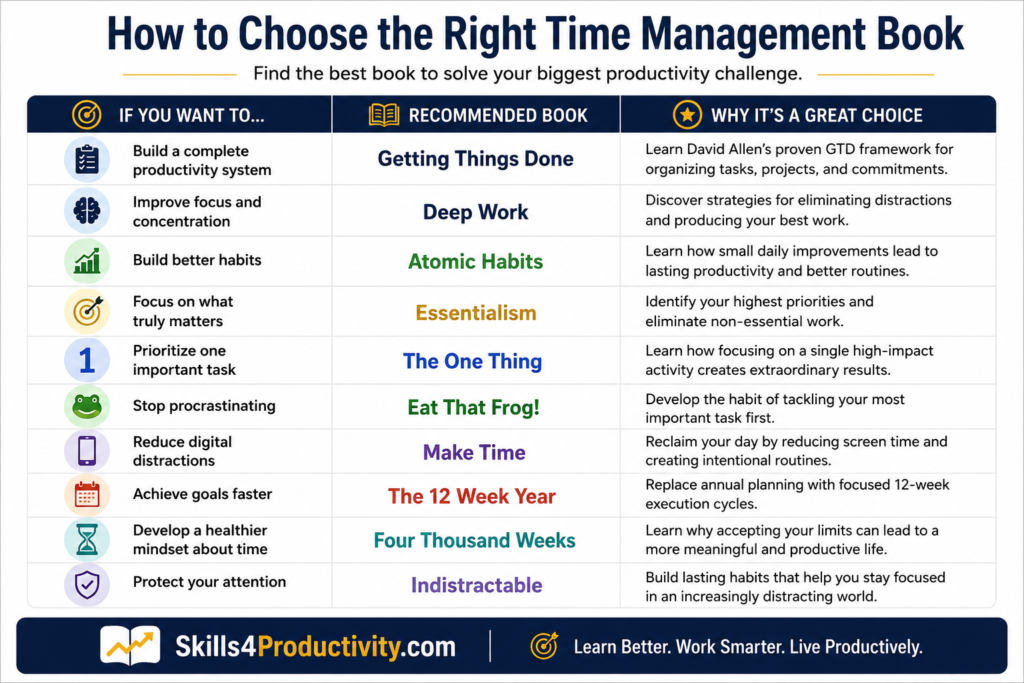
How to Choose the Right Time Management Book
The best time management book depends on the challenge you’re trying to solve. Some books teach practical productivity systems, while others focus on habits, prioritization, or improving your relationship with time. Use the guide below to find the book that best matches your goals.
Our Top Recommendations
If you’re not sure where to start, here are our top picks based on different needs:
🥇 Best Overall: Getting Things Done
A timeless productivity classic that offers a complete system for managing tasks, projects, and commitments.
🌟 Best for Beginners: Atomic Habits
Simple, practical, and easy to apply, making it an excellent introduction to productivity and personal development.
🎯 Best for Improving Focus: Deep Work
Ideal for professionals and students who want to eliminate distractions and accomplish meaningful work.
🚀 Best for Goal Achievement: The 12 Week Year
Perfect for anyone who struggles with execution and wants a structured approach to achieving ambitious goals.
🧠 Best Mindset Shift: Four Thousand Weeks
A thought-provoking read that encourages you to spend your limited time on what truly matters.
📱 Best for the Digital Age: Indistractable
One of the best books for managing attention, reducing digital distractions, and staying focused in today’s always-connected world.
Which Book Should You Read First?
If you’re completely new to time management, follow this reading order to build your productivity skills step by step:
- Atomic Habits – Build a foundation of positive habits.
- Getting Things Done – Learn a complete productivity system.
- Deep Work – Improve your ability to focus.
- Essentialism – Prioritize what truly matters.
- The One Thing – Concentrate on high-impact work.
- Eat That Frog! – Beat procrastination.
- Make Time – Reduce digital distractions.
- The 12 Week Year – Improve goal execution.
- Four Thousand Weeks – Develop a healthier relationship with time.
- Indistractable – Protect your attention for long-term success.
Note
You don’t need to read all ten books to improve your productivity. Start with the one that addresses your biggest challenge today. Once you’ve mastered those ideas, come back and explore the others to build a well-rounded approach to time management.
Frequently Asked Questions (FAQs)
1. What is the best book for time management?
There isn’t a single best book for everyone because the right choice depends on your goals. If you’re looking for a complete productivity system, Getting Things Done by David Allen is our top recommendation. For improving focus, Deep Work is an excellent choice, while Atomic Habits is ideal for building productive routines.
2. Which time management book is best for beginners?
Atomic Habits by James Clear is one of the best books for beginners. It’s easy to read, practical, and provides simple strategies for building better habits that naturally improve productivity and time management.
3. Which book helps overcome procrastination?
If procrastination is your biggest challenge, Eat That Frog! by Brian Tracy is a great place to start. It teaches practical techniques for tackling your most important task first and developing the habit of taking action instead of delaying important work.
4. What is the best book for improving focus?
Deep Work by Cal Newport is widely regarded as one of the best books for improving focus and concentration. It explains how distraction-free work leads to higher productivity and offers practical strategies for protecting your attention in a busy world.
5. Is Getting Things Done still worth reading today?
Yes. Although it was first published in 2001, the principles in Getting Things Done remain highly relevant. David Allen’s GTD framework continues to help professionals organize tasks, manage projects, and reduce mental clutter in today’s fast-paced work environment.
6. Which book is best for students?
Students can benefit from several books on this list, but Atomic Habits, Deep Work, and Make Time are particularly useful. Together, they teach effective study habits, better focus, and practical ways to reduce distractions while learning.
7. What’s the difference between Deep Work and Indistractable?
Both books focus on attention, but they approach the topic differently. Deep Work explains why focused work is valuable and how to create time for it, while Indistractable focuses on understanding distractions and building habits that help you stay focused in everyday life. Many readers find the two books complement each other well.
8. Can reading one productivity book really improve time management?
Yes—provided you apply what you learn. Simply reading a book won’t change your productivity, but consistently implementing even a few practical ideas can make a noticeable difference. Focus on adopting one or two strategies before moving on to another book.
9. Which book should I read first?
If you’re new to productivity, start with Atomic Habits because it provides a strong foundation for building positive routines. After that, Getting Things Done and Deep Work are excellent next reads to develop a complete productivity system and stronger focus.
10. Are these books suitable for professionals and managers?
Absolutely. Most of the books in this guide are written for professionals, managers, entrepreneurs, freelancers, and knowledge workers. Whether you’re leading a team, managing multiple projects, or trying to improve personal productivity, you’ll find practical strategies that can be applied immediately.
Related Reading
- Deep Work Summary
- Atomic Habits Summary
- Getting Things Done Summary
- The One Thing Summary
- Best Books on Discipline
- Best Positive Psychology Books
- How to Learn Better
Final Thoughts
Time management isn’t about squeezing more tasks into your day—it’s about making better decisions about how you spend your time. Whether you want to build stronger habits, improve your focus, overcome procrastination, or achieve your goals more consistently, the right book can provide practical strategies and a fresh perspective.
If you’re unsure where to begin, Getting Things Done remains our top overall recommendation for building a complete productivity system, while Atomic Habits is the best choice for beginners looking to create lasting habits. No matter which book you choose first, the key is to put its ideas into practice. Consistent action—not just reading—is what leads to lasting improvements in productivity and time management.
Disclosure: This article may contain affiliate links. If you purchase through these links, Skills4Productivity may earn a commission at no additional cost to you.